

Archive position — measured, not model output
0 likes on Devpost
2,263 of the 7,850 archived projects have more likes, and 5,587 share exactly 0 — so this project's #7,166 place in the like-ranked listing is a tie-break inside that group, not a ranking.
Projects (log scale)
Likes on Devpost. ▲ marks this project's group.
Show the figures
| Likes | Projects | Share of archive |
|---|---|---|
| 0 | 5,587 | 71.2% |
| 1 | 1,758 | 22.4% |
| 2 | 284 | 3.6% |
| 3–4 | 132 | 1.7% |
| 5–9 | 75 | 1.0% |
| 10+ | 14 | 0.2% |
 User Stories BotA demo video on every pull request
Get a demo video on every new feature
GitHub App that watches your pull requests and records a narrated, captioned demo.
Save time on demo prep and make informed decisions faster with a video walkthrough of every new feature.
Executive Summary
What the company appears to be
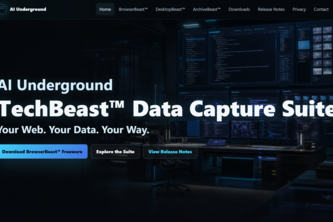
TechBeast™ Data Capture Suite is a self-reported local-first AI evidence capture tool for preserving digital information with provenance. It consists of two main components: BrowserBeast™ (a free, open-source Chrome extension) and DesktopBeast™ (a Windows-based desktop capture engine). The suite aims to create portable records that include not only content but also where, when, and how it was captured.
What changed
During OpenAI Build Week, the project transitioned from private development into a public release. Key changes included releasing BrowserBeast™ v1.0 under MIT License, cleaning up documentation, auditing code, preparing for marketplace submission (Chrome Web Store), and aligning architecture between BrowserBeast and DesktopBeast.
Single most important open question
Is there any evidence of actual usage or adoption beyond the author’s personal engagement?
What The Product Actually Is
The description states that TechBeast™ is a local-first AI evidence capture suite. It includes three components:
- BrowserBeast™: A free, open-source Chrome extension that captures rendered web pages, highlighted passages, and AI conversations as Markdown or plain text.
- DesktopBeast™: An extension of the same philosophy for Windows environments, capturing applications, documents, terminals, games, browser windows, AI clients, etc., combining OCR text, visual evidence, diagnostics, privacy advisories, and provenance into portable packages.
- TechBeast Library and Evidence Viewer™: An early unified environment for organizing and reviewing captures from both BrowserBeast and DesktopBeast.
All components are described as being built using technologies such as .NET, C#, JavaScript, TypeScript, HTML, CSS, Git, GitHub, OCR, AI models (GPT-5.6, Codex), and WPF.
Inference The product is conceptualized as a tool for capturing digital artifacts with metadata and provenance embedded in Markdown or other portable formats.
Positioning & Claim Evolution
The author positions TechBeast™ as a solution to the problem of losing important ideas due to disappearing browser tabs, changing web pages, AI conversations, desktop applications, PDFs, terminal windows, and account histories. The core claim is that current tools fail to preserve searchable text, source context, and provenance.
Key claims from the description
- TechBeast™ turns web pages and desktop content into portable, provenance-rich records for humans and AI.
- It provides durable records that include not only what something said but where it came from, when and how it was captured, and which tool created it.
- The philosophy is simple: "Capture the web. Capture the desktop. Keep the record."
- The project evolved through collaboration with AI models (Nyx and Vesper) rather than traditional software development.
Inference The positioning has shifted from a personal frustration-driven tool to a structured, documented, and publicly released suite during Build Week.
Target Customer & ICP
The description does not explicitly define target customers or ideal customer profiles. However, the author’s background as a retired screenwriter, former police officer, and security manager suggests an initial audience of individuals who may be working with AI tools and need to manage digital artifacts effectively.
Claims
- The tool is intended for people who work with AI and digital content.
- It supports both human-readable and AI-friendly formats.
- It targets users who value portability, control, and provenance in their data capture workflows.
Inference The ICP likely includes early adopters of AI tools, researchers, writers, developers, or professionals managing complex information environments. However, no explicit segmentation or persona details are provided.
Business Model & Pricing Evidence
The description states that BrowserBeast™ is released as free, open-source software under the MIT License. There is no mention of pricing models for DesktopBeast™ or any future monetization plans.
Claims
- BrowserBeast™ is a free, open-source Chrome extension.
- No revenue or pricing data are available beyond this statement.
Inference The business model appears to be based on open-source distribution with potential future paid features or services. No evidence of existing customers or monetization exists in the description.
Technical & Delivery Signals
The project is built using a range of technologies including .NET, C#, JavaScript, TypeScript, HTML, CSS, Git, GitHub, OCR, AI models (GPT-5.6, Codex), and WPF. The author reports extensive use of AI for development tasks such as translating ideas into architecture, reviewing code, improving documentation, testing builds, and preparing releases.
Claims
- The project uses AI extensively throughout its development lifecycle.
- The workflow involved ongoing engineering conversations with AI collaborators (Nyx and Vesper).
- The Evidence Envelope belongs to the artifact; primary Markdown records should stand on their own without requiring proprietary infrastructure.
- The architecture was aligned during Build Week to ensure consistency between BrowserBeast and DesktopBeast.
Inference The technical approach emphasizes local-first, user-controlled, and AI-assisted development. There is no evidence of scalability, performance metrics, or integration with enterprise systems.
Traction & Maturity Signals
There is no evidence of traction, revenue, customer base, or adoption beyond the author’s own use and development activities.
Claims
- The project was already active before Build Week.
- It includes real-world captures from prior to Build Week.
- The author relied on TechBeast™ for documenting and preserving his own work during Build Week.
- No formal metrics or user feedback are mentioned.
Inference The product is at an early stage of development, likely in beta or prototype form. There is no indication of external validation or market traction.
Competitive Context
No competitive analysis or references to existing tools are included in the description.
Claims
- The author identifies a gap in current tools that do not preserve searchable text, source context, and provenance.
- The goal is to make trustworthy evidence capture as easy as taking a screenshot while preserving context.
Inference The competitive landscape is unclear. The product may compete with tools like Notion, Roam Research, Obsidian, or browser extensions for capturing web content, but no direct comparisons are made.
Open Questions & Risks
- Lack of traction: No evidence of users, customers, or adoption beyond the author.
- Unverified claims: All assertions about functionality, impact, and development process are self-reported.
- Dependency on AI: Heavy reliance on AI for development raises questions about reproducibility and scalability.
- No monetization strategy: No indication of how the product will generate revenue or sustain itself.
- Limited scope: The project appears to be in early stages with minimal features beyond basic capture and organization.
Questions the description leaves open
- What specific problems are users facing that TechBeast™ solves?
- How many people are currently using the tool, and what is their feedback?
- Are there any plans for monetization or commercial partnerships?
- Can you provide examples of how the tool has been used in practice beyond your own use cases?
- What are the technical limitations of the current implementation, particularly around scalability or performance?
- How do you plan to handle data privacy and security concerns related to capturing sensitive content?
- What is the roadmap for expanding support beyond Chrome and Windows platforms?
Overall Assessment
Confidence Level Low This is a self-reported project with no verified traction, revenue, or customer data. The author describes significant personal involvement in development but does not provide evidence of broader impact or market validation.
Assessment Summary
- Not evidenced: No revenue, customers, or adoption metrics.
- Not evidenced: No formal business model or monetization strategy.
- Not evidenced: No competitive analysis or market positioning data.
- Inferred risk: Heavy dependence on AI for development raises concerns about long-term sustainability and replicability.
Conclusion
While the project demonstrates a clear concept and some technical execution, there is insufficient evidence to assess commercial viability or investment potential. Further due diligence would require independent verification of usage, user feedback, and market demand.
User Stories BotA demo video on every pull request
Get a demo video on every new feature
GitHub App that watches your pull requests and records a narrated, captioned demo.
Save time on demo prep and make informed decisions faster with a video walkthrough of every new feature.
Source
Submitted to the OpenAI 2026 hackathon on Devpost. Project home on Devpost. Back to the full gallery on Devpost.
This competitive analysis was produced by top-founders.com (opens in a new tab)
Generated by a language model from this project's public Devpost page — its tagline, the author's own write-up and any built-with tags listed there — as captured in August 2026. Short quotations are the author's words. It is an opinion on the idea as a business, not on the people behind it, and it reflects the description as published then. If the project has moved on, request a correction below. The analysis is not independent research and contains no verified traction, revenue or customer data.
An independent guide by KFG International LLC — not affiliated with, endorsed by, or connected to Devpost or OpenAI.