

Archive position — measured, not model output
0 likes on Devpost
2,263 of the 7,850 archived projects have more likes, and 5,587 share exactly 0 — so this project's #7,165 place in the like-ranked listing is a tie-break inside that group, not a ranking.
Projects (log scale)
Likes on Devpost. ▲ marks this project's group.
Show the figures
| Likes | Projects | Share of archive |
|---|---|---|
| 0 | 5,587 | 71.2% |
| 1 | 1,758 | 22.4% |
| 2 | 284 | 3.6% |
| 3–4 | 132 | 1.7% |
| 5–9 | 75 | 1.0% |
| 10+ | 14 | 0.2% |
 User Stories BotA demo video on every pull request
Get a demo video on every new feature
GitHub App that watches your pull requests and records a narrated, captioned demo.
Save time on demo prep and make informed decisions faster with a video walkthrough of every new feature.
Executive Summary
Company: TeamRoom
Self-reported basis: The description is entirely self-reported by the author, unverified, and lacks any independent corroboration.
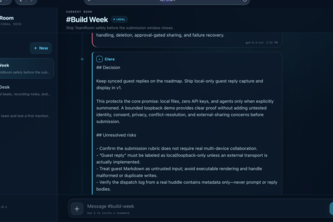
What it appears to be: A local-first group chat application for humans and AI personas, built using Codex and GPT-5.6, designed to enable collaboration among multiple AI agents in a shared workspace without API keys or external billing.
What changed: The project is presented as a hackathon submission with no prior development history or traction.
Single most important open question: Is there any evidence of actual usage, user feedback, or product-market fit beyond the author's own description?
What The Product Actually Is
The description states that TeamRoom is:
- A local-first team chat for one human and a team of AI personas.
- It allows users to create project rooms, @mention teammates (AI personas), and drop in files.
- AI personas are described as running on GPT-5.6 through Codex's non-interactive mode.
- Messages and rooms are stored as append-only Markdown files in a sandboxed folder synced via cloud drive.
- The system uses no polling, no idle cost, and hard caps on context and turns to bound cost.
- It supports live file analysis (e.g., CSVs) and deduplication by content hash.
- The UI is updated via SSE (Server-Sent Events) when new messages are written.
Inference: The product appears to be a prototype or proof-of-concept built in a single session using Codex, with no external dependencies beyond local file storage and ChatGPT subscriptions. It is not described as a commercial product or platform.
Positioning & Claim Evolution
The description states:
- TeamRoom aims to solve the problem of manually coordinating multiple AIs via tabs, copy-paste, and re-explanation.
- The core claim is that it enables AI agents to work with each other, not just with a human user.
- It positions itself as a local group chat where GPT-5.6 personas collaborate without API keys or new bills.
Inference: The positioning appears to be a response to the fragmentation of AI usage and the lack of integrated collaboration between AI tools. However, there is no evidence of prior market research, user interviews, or competitive analysis to support this framing.
Target Customer & ICP
The description states:
- The target is one human working with a team of AI personas.
- It supports multi-human rooms in its future roadmap.
Inference: The initial ICP appears to be individual developers or researchers who use multiple AIs and want them to collaborate. However, no evidence is provided about actual users or their needs beyond the author's own perspective.
Business Model & Pricing Evidence
The description states:
- No API keys are required.
- No new bills are incurred.
- The system is free in its current form (as a hackathon submission).
- There is no mention of monetization, pricing tiers, or revenue streams.
Inference: There is no evidence of a business model or pricing strategy. The product is presented as a prototype with no indication of commercial intent.
Technical & Delivery Signals
The description states:
- Built entirely in Codex, using a single session.
- Uses GPT-5.6 personas via Codex's non-interactive mode.
- No database; messages are stored as append-only Markdown files.
- Uses SSE for live updates.
- The system is sandboxed, with no shell access or delete codepath.
- File deduplication by content hash and context-aware handling of text files.
Inference: The technical architecture is described as minimal, secure, and local-first. However, there is no evidence of scalability, performance testing, or production deployment.
Traction & Maturity Signals
The description states:
- This is a hackathon submission.
- It was built in one session with nine phase commits.
- The full build trail is in BUILD_LOG.md and a linked Codex session.
- No users, customers, or adoption data are mentioned.
Inference: There is no evidence of traction, usage, or product-market fit. The project is described as a prototype with no prior history or user feedback.
Competitive Context
The description does not mention any competitors or similar products.
Inference: No competitive analysis or positioning against existing tools is provided. The author does not reference other AI collaboration platforms or chat tools.
Open Questions & Risks
- No evidence of traction or users: The project is a hackathon submission with no user data.
- Unproven commercial viability: No pricing, monetization, or business model is described.
- Limited technical validation: The product is described as built in one session; no testing or scalability data provided.
- Self-reported only: All claims are unverified and based on the author’s own account.
Questions the description leaves open
- What specific problem are you solving, and how did you identify it?
- Have you tested this with any users or in real-world scenarios?
- What is your plan for scaling beyond a single-user, local-first model?
- How do you intend to monetize this product if at all?
- What are the limitations of the current architecture that would prevent broader adoption?
Overall Assessment
The description states that TeamRoom is a hackathon submission and not a commercial product or platform.
Inference: There is no evidence of a viable business, traction, or market demand beyond the author’s own claims. The project is described as a prototype with no revenue, customers, or product-market fit. It is not ready for investment or partnership at this stage.
User Stories BotA demo video on every pull request
Get a demo video on every new feature
GitHub App that watches your pull requests and records a narrated, captioned demo.
Save time on demo prep and make informed decisions faster with a video walkthrough of every new feature.
Source
Submitted to the OpenAI 2026 hackathon on Devpost. Project home on Devpost. Back to the full gallery on Devpost.
This competitive analysis was produced by top-founders.com (opens in a new tab)
Generated by a language model from this project's public Devpost page — its tagline, the author's own write-up and any built-with tags listed there — as captured in August 2026. Short quotations are the author's words. It is an opinion on the idea as a business, not on the people behind it, and it reflects the description as published then. If the project has moved on, request a correction below. The analysis is not independent research and contains no verified traction, revenue or customer data.
An independent guide by KFG International LLC — not affiliated with, endorsed by, or connected to Devpost or OpenAI.