

Archive position — measured, not model output
1 like on Devpost
505 of the 7,850 archived projects have more likes, and 1,758 share exactly 1 — so this project's #1,277 place in the like-ranked listing is a tie-break inside that group, not a ranking.
Projects (log scale)
Likes on Devpost. ▲ marks this project's group.
Show the figures
| Likes | Projects | Share of archive |
|---|---|---|
| 0 | 5,587 | 71.2% |
| 1 | 1,758 | 22.4% |
| 2 | 284 | 3.6% |
| 3–4 | 132 | 1.7% |
| 5–9 | 75 | 1.0% |
| 10+ | 14 | 0.2% |
 User Stories BotA demo video on every pull request
Get a demo video on every new feature
GitHub App that watches your pull requests and records a narrated, captioned demo.
Save time on demo prep and make informed decisions faster with a video walkthrough of every new feature.
Executive Summary
What the company appears to be
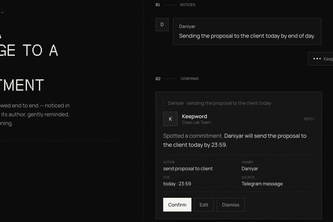
Keepword is a Telegram-first AI assistant for team commitments, built as a hackathon project. The description states it watches group chats, identifies high-confidence promises or assignments, and asks for confirmation before turning them into follow-through actions. It operates within Telegram’s privacy model, sending reminders privately and preserving source messages.
What changed
The author describes building a lightweight system that avoids noise by only acting on confirmed commitments, and respects user privacy through private communication and idempotent delivery mechanisms. The product is positioned as an assistant for team conversations rather than a full task manager.
Single most important open question
Is there evidence of real-world usage or feedback from teams using Keepword beyond the hackathon? The description does not indicate any traction, revenue, or customer data.
What The Product Actually Is
The description states that Keepword is:
- A Telegram bot.
- An AI assistant for team commitments.
- Designed to watch group chats and identify actionable promises.
- A system that requires confirmation before turning a promise into a follow-through action.
- Not a full task manager, but a tool to ensure conversation-based commitments are not lost.
Inferred: It uses a combination of Telegram Bot API (via Grammy), LLMs (OpenRouter), PostgreSQL (via Drizzle ORM), and Fastify for backend logic. A static Next.js landing page is also part of the stack.
Positioning & Claim Evolution
The description states:
- Keepword aims to bridge the gap between “we agreed on this in the chat” and “someone actually follows through.”
- It is described as a lightweight memory for team conversations.
- The product does not replace existing tools but ensures that promises made in chat do not get lost.
Inferred: The positioning has evolved from a general idea of improving follow-through to a specific, privacy-conscious tool that integrates into Telegram and avoids noise by requiring confirmation.
Target Customer & ICP
The description states:
- Keepword is for teams using group chats (specifically Telegram).
- It targets users who make promises or assignments in chat but do not follow up.
- Chat administrators can configure settings like mode, language, timezone, and digest time per group.
Inferred: The target customer is small to mid-sized teams that use Telegram for collaboration and want to improve accountability without adopting a new tool.
Business Model & Pricing Evidence
Not evidenced.
The description does not state anything about pricing, monetization, or business model.
Technical & Delivery Signals
The description states:
- Built with TypeScript, Fastify, Telegram Bot API (Grammy), PostgreSQL via Drizzle ORM, and OpenRouter.
- Uses a lightweight pre-filter before sending messages to the LLM.
- Backend modules include Telegram updates, commitment extraction, confirmation, reminders, digests, onboarding, and privacy operations.
- A background worker runs reminder and digest jobs every minute.
- Private onboarding, reminders, overdue alerts, and digests are implemented.
- Supports English, Russian, and Spanish.
Inferred: The system is designed with a modular backend, idempotent delivery, and server-authorized callbacks to protect group boundaries. It handles timezones and language preferences as part of its core functionality.
Traction & Maturity Signals
Not evidenced.
The description does not mention any users, customers, revenue, or usage metrics beyond the hackathon submission. The project is described as a prototype built for a hackathon.
Competitive Context
Not evidenced.
The description does not compare Keepword to other tools or identify competitors in the market.
Open Questions & Risks
- No traction or user feedback: The product is described as a hackathon submission with no evidence of real-world usage.
- Unproven commercial viability: No pricing, monetization, or business model is described.
- Limited scope for growth: The focus on Telegram and chat-based commitments may limit scalability or adoption outside that ecosystem.
- Founder team size: Only one member (Amirzhan Zhampeissov) is listed, which may indicate limited execution capacity.
Questions the description leaves open
- What real-world feedback have you received from teams using Keepword beyond the hackathon?
- How do you plan to scale beyond a single founder and a prototype?
- Have you identified any specific use cases or industries where this tool might be more valuable?
- What is your strategy for monetization or product-market fit validation?
- How do you plan to handle privacy compliance (e.g., GDPR, data retention) at scale?
Overall Assessment
Not evidenced.
The description does not provide any information about funding, valuation, or investment interest. The project is described as a hackathon submission with no indication of commercial traction or investor engagement.
User Stories BotA demo video on every pull request
Get a demo video on every new feature
GitHub App that watches your pull requests and records a narrated, captioned demo.
Save time on demo prep and make informed decisions faster with a video walkthrough of every new feature.
Source
Submitted to the OpenAI 2026 hackathon on Devpost. Project home on Devpost. Back to the full gallery on Devpost.
This competitive analysis was produced by top-founders.com (opens in a new tab)
Generated by a language model from this project's public Devpost page — its tagline, the author's own write-up and any built-with tags listed there — as captured in August 2026. Short quotations are the author's words. It is an opinion on the idea as a business, not on the people behind it, and it reflects the description as published then. If the project has moved on, request a correction below. The analysis is not independent research and contains no verified traction, revenue or customer data.
An independent guide by KFG International LLC — not affiliated with, endorsed by, or connected to Devpost or OpenAI.