

Archive position — measured, not model output
0 likes on Devpost
2,263 of the 7,850 archived projects have more likes, and 5,587 share exactly 0 — so this project's #7,162 place in the like-ranked listing is a tie-break inside that group, not a ranking.
Projects (log scale)
Likes on Devpost. ▲ marks this project's group.
Show the figures
| Likes | Projects | Share of archive |
|---|---|---|
| 0 | 5,587 | 71.2% |
| 1 | 1,758 | 22.4% |
| 2 | 284 | 3.6% |
| 3–4 | 132 | 1.7% |
| 5–9 | 75 | 1.0% |
| 10+ | 14 | 0.2% |
 User Stories BotA demo video on every pull request
Get a demo video on every new feature
GitHub App that watches your pull requests and records a narrated, captioned demo.
Save time on demo prep and make informed decisions faster with a video walkthrough of every new feature.
Executive Summary
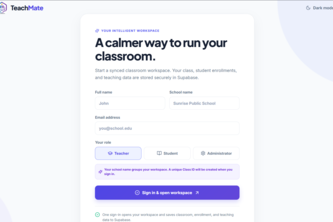
What the company appears to be: TeachMate is an AI-powered education platform designed for teachers, students, and school administrators. The description states it aims to automate repetitive administrative tasks in classrooms while keeping educators in control of academic decisions.
What changed: This is a hackathon submission (submitted to OpenAI 2026 hackathon) with no evidence of commercial traction or revenue generation. It represents an early-stage concept built as a full-stack application using modern technologies like React, FastAPI, Supabase, and AI providers such as Gemini, OpenRouter, and Groq.
Single most important open question: Is there any evidence that teachers, schools or educational institutions are currently using this platform in real-world settings? The description makes no claims about adoption, customers, or revenue — only self-reported features and architecture.
Note: This analysis is based entirely on the self-reported project description provided by the authors. No external verification or historical data exists for this project.
What The Product Actually Is
The description states that TeachMate is an AI-powered education platform with three dedicated workspaces:
- 👩🏫 Teacher Portal
- 👨🎓 Student Portal
- 🏫 Admin Portal
It includes functionality such as:
- Quiz creation (manual or AI-generated)
- Assessment grading and feedback
- Learning gap analysis
- Voice feedback generation
- Context-aware AI assistant
- Role-based access control
The platform is built using:
- Frontend: React, TypeScript, Tailwind CSS
- Backend: FastAPI, Python
- Database: Supabase PostgreSQL
- Authentication: Supabase Authentication
- AI Providers: Gemini (primary), OpenRouter, Groq (fallback)
Inference: The product appears to be a classroom management tool that integrates AI into teacher workflows. It is not described as a marketplace or SaaS platform with recurring revenue models.
Positioning & Claim Evolution
The description states that TeachMate was built to assist educators instead of replacing them, emphasizing human decision-making and control over AI automation.
Key claims:
- "TeachMate combines AI-powered automation with human decision-making"
- "Teachers remain in control while eliminating repetitive tasks"
- "AI never publishes quizzes automatically, changes marks, sends feedback without approval, or makes academic decisions on behalf of teachers"
Inference: The positioning is centered around ethical AI use in education — avoiding replacement of teachers and focusing on augmentation. This suggests a focus on trust-building and compliance with educational governance.
Target Customer & ICP
The description identifies three main user types:
- 👩🏫 Teachers
- 👨🎓 Students
- 🏫 Administrators
It also mentions that the platform supports:
- Class management
- Student enrollment via invite codes
- Role-based access control
Inference: The ICP appears to be K-12 or higher education institutions with teachers, students, and school administrators. However, no evidence of specific customer segments, geographies, or institutional sizes is provided.
Business Model & Pricing Evidence
No information about pricing, monetization strategy, or business model is included in the description.
Not evidenced: There is no mention of subscription plans, licensing fees, usage-based billing, or any commercial structure.
Technical & Delivery Signals
The platform uses a modern full-stack architecture:
- Frontend: React, TypeScript, Tailwind CSS
- Backend: FastAPI, Python
- Database: Supabase PostgreSQL
- Authentication: Supabase Authentication
- AI Integration: Gemini (primary), OpenRouter, Groq (fallback)
It leverages AI tools like GPT-5.6 and Codex for development:
- GPT-5.6 helped with system design, UX refinement, API structures, prompt engineering
- Codex accelerated code generation, UI components, database schemas, and CRUD operations
Inference: The technical stack suggests a scalable, modern SaaS-like architecture. However, no evidence of production deployment or scalability metrics is provided.
Traction & Maturity Signals
The description indicates this is a hackathon submission (OpenAI 2026) with no evidence of:
- Revenue
- Customers
- Users
- Product-market fit
- Market traction
Not evidenced: No data on adoption, retention, or usage metrics exists.
Competitive Context
No mention of competitors or market positioning is included in the description. The author does not reference existing classroom management platforms, AI education tools, or LMS vendors.
Not evidenced: There is no competitive analysis or differentiation strategy described.
Open Questions & Risks
- Unproven commercial viability: No evidence of revenue, customers, or product-market fit.
- Lack of real-world testing: Built as a hackathon project with no indication of pilot use or feedback loops.
- AI dependency risk: Relies on multiple AI providers (Gemini, OpenRouter, Groq) and could face disruptions if any fail.
- Ethical concerns around AI in education: While the description emphasizes human control, there is no evidence of how this will be enforced or audited.
- No clear monetization path: No pricing, licensing, or business model described.
Inference: The project lacks commercial readiness and may not have moved beyond concept stage.
Questions the description leaves open
- Has the platform been tested with actual teachers or students?
- What is the current status of the product — prototype, MVP, or deployed?
- Are there any early adopters or pilot schools using TeachMate?
- How does the team plan to monetize this platform?
- What are the key assumptions about user behavior and adoption?
- How do you ensure that AI-generated content aligns with educational standards and curriculum requirements?
- What is the long-term vision for scaling the platform beyond a single school or district?
Overall Assessment
Not evidenced: There is no evidence of traction, revenue, or customer validation to support an investment or partnership decision.
Confidence Level: Very low — this is a self-reported hackathon project with no external verification. Any commercial potential remains speculative and unproven.
User Stories BotA demo video on every pull request
Get a demo video on every new feature
GitHub App that watches your pull requests and records a narrated, captioned demo.
Save time on demo prep and make informed decisions faster with a video walkthrough of every new feature.
Source
Submitted to the OpenAI 2026 hackathon on Devpost. Project home on Devpost. Back to the full gallery on Devpost.
This competitive analysis was produced by top-founders.com (opens in a new tab)
Generated by a language model from this project's public Devpost page — its tagline, the author's own write-up and any built-with tags listed there — as captured in August 2026. Short quotations are the author's words. It is an opinion on the idea as a business, not on the people behind it, and it reflects the description as published then. If the project has moved on, request a correction below. The analysis is not independent research and contains no verified traction, revenue or customer data.
An independent guide by KFG International LLC — not affiliated with, endorsed by, or connected to Devpost or OpenAI.