

Archive position — measured, not model output
0 likes on Devpost
2,263 of the 7,850 archived projects have more likes, and 5,587 share exactly 0 — so this project's #7,163 place in the like-ranked listing is a tie-break inside that group, not a ranking.
Projects (log scale)
Likes on Devpost. ▲ marks this project's group.
Show the figures
| Likes | Projects | Share of archive |
|---|---|---|
| 0 | 5,587 | 71.2% |
| 1 | 1,758 | 22.4% |
| 2 | 284 | 3.6% |
| 3–4 | 132 | 1.7% |
| 5–9 | 75 | 1.0% |
| 10+ | 14 | 0.2% |
 User Stories BotA demo video on every pull request
Get a demo video on every new feature
GitHub App that watches your pull requests and records a narrated, captioned demo.
Save time on demo prep and make informed decisions faster with a video walkthrough of every new feature.
Executive Summary
What the company appears to be
TeachUEasy is a self-reported platform for English language teachers, built by one developer (Oleksandr Kopaievych), that offers an all-in-one dashboard for lesson creation, live classes, homework, chat, scheduling, and payment tracking. It includes AI-assisted features such as interactive lessons, AI-generated dialogue blocks, and attachment-based lesson generation using OpenAI models (GPT-5.6) and ElevenLabs for audio.
What changed
During Build Week, two new features were added:
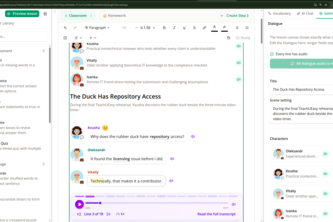
- A "Dialogue block" — an AI-generated structured conversation within a lesson with voiceover, illustrations, vocabulary highlighting, and deterministic quality control.
- Attachment support for AI lesson generation — teachers can upload files or links, which are read by a low-effort model (Luna) and used as context by a writing model (Sol).
The single most important open question
Is there any evidence of actual teacher adoption or revenue? The description states the platform is "free to start, no credit card" but provides no data on user base, monetization, or usage beyond self-reported development activity.
What The Product Actually Is
- The description states that TeachUEasy is an all-in-one platform for English teachers.
- It includes features like:
- Interactive lessons with embedded exercises
- Live classroom tools (Zoom/Google Meet integration)
- Homework assignment, review, and feedback
- Real-time chat with students
- Scheduling and calendar sync
- Payment tracking
- Personal vocabulary dictionaries per student with audio and games
- The AI layer includes:
- AI-generated lessons from topics, levels, and durations
- An AI chat inside the editor for editing blocks like a coding agent
Inference The platform appears to be built as a SaaS product targeting English language educators, with an emphasis on reducing tab-juggling through a unified interface.
Positioning & Claim Evolution
- The author positions TeachUEasy as a solution to inefficiencies in how teachers currently work — using multiple browser tabs and spreadsheets.
- The tagline: “TeachUEasy is an all-in-one platform for language teachers and their students to create AI-assisted interactive content, run classes, chat, and gamify vocabulary practice.”
- The author describes the project as a personal passion and pursuit of happiness.
- There is no mention of competitors or market positioning beyond self-description.
Inference The product is positioned as a tool for simplifying teacher workflows, especially in English language instruction, with an AI-first approach to lesson creation and student engagement.
Target Customer & ICP
- The description states that TeachUEasy targets English language teachers.
- It also mentions students, particularly those learning vocabulary through gamified practices.
- The platform is described as being available in English, Ukrainian, and Czech languages.
Inference The primary customer segment is English language teachers who are looking for a centralized tool to manage lessons, classes, homework, and student interaction. Secondary users include students engaged in vocabulary practice.
Business Model & Pricing Evidence
- The description states that the platform is free to start, no credit card required.
- There is no explicit mention of pricing tiers or monetization strategy beyond this.
- The author mentions a "cost estimator" that prices the whole run before commitment — including costs for Luna reading, Sol writing, images at $0.13, and audio at one credit per character.
- No revenue data, subscription plans, or conversion metrics are provided.
Inference The business model appears to be based on usage-based pricing with a free tier, but there is no evidence of actual monetization or customer acquisition.
Technical & Delivery Signals
- Built using:
- Frontend: Next.js, React, TypeScript
- Backend: tRPC, Prisma, PostgreSQL
- AI tools: OpenAI (GPT-5.6), ElevenLabs, Lexical editor
- Infrastructure: Cloudflare R2, Supabase, Vercel, Stripe, Sentry, PostHog
- The author mentions a monorepo with ~594,000 lines of code across ~3,000 files.
- The stack includes:
- tRPC routers (50)
- Prisma schema with 128 models and 71 enums
- 87 pages
- The author built the platform alone over time, including a major refactor in 2025.
Inference The technical architecture is complex but well-structured, leveraging modern tools for full-stack development and AI integration. However, there's no evidence of scaling or production deployment beyond self-reported engineering effort.
Traction & Maturity Signals
- The author has been working on the project since at least February 2024.
- A major refactor occurred in August 2025 after a year-long hiatus.
- The platform was submitted to an OpenAI hackathon in April 2026.
- The author became a YouTuber in April 2026, livestreaming development and monetizing the process.
- No evidence of users, customers, or revenue is provided.
Inference There is no traction data available. The project appears to be in an early stage of development with no confirmed user base or monetization.
Competitive Context
- The description does not mention any competitors.
- It focuses on the inefficiencies of current teacher workflows rather than existing platforms.
- No comparison to other edtech tools or marketplace players is made.
Inference There is no evidence of competitive analysis or awareness of similar products in the market. The author seems to be building a new solution without clear reference points.
Open Questions & Risks
- No traction or revenue: No data on users, monetization, or adoption.
- Single developer: The entire platform was built by one person (Oleksandr Kopaievych).
- Self-reported only: All claims are unverified and based solely on the author's account.
- Lack of customer validation: No evidence of feedback loops, user testing, or product-market fit.
- AI integration complexity: The author notes several prompt and billing issues during development — suggesting potential instability in AI workflows.
Inference Without any external validation or usage data, this is a high-risk investment or partnership opportunity. The lack of traction and limited team size raise concerns about scalability and viability.
Questions the description leaves open
- What specific feedback have you received from teachers who have tried the platform?
- How do you plan to monetize the platform beyond the free tier?
- Have you conducted any user research or interviews with English language teachers?
- What is your roadmap for scaling beyond a single developer?
- Are there any existing partnerships or pilot programs with schools or institutions?
- How are you handling data privacy and compliance (e.g., GDPR)?
- What metrics do you track to measure product success?
Overall Assessment
Not evidenced
There is no evidence of revenue, customers, or traction to support a commercial due-diligence read. The description is entirely self-reported and unverified, with no data on user engagement, monetization, or market validation.
The platform appears to be in an early development stage, built by one individual with no confirmed adoption or business model traction. While the technical implementation seems robust, the lack of external validation makes it difficult to assess commercial viability or potential return on investment.
Confidence Low — based entirely on self-reported evidence and author's own narrative.
User Stories BotA demo video on every pull request
Get a demo video on every new feature
GitHub App that watches your pull requests and records a narrated, captioned demo.
Save time on demo prep and make informed decisions faster with a video walkthrough of every new feature.
Source
Submitted to the OpenAI 2026 hackathon on Devpost. Project home on Devpost. Back to the full gallery on Devpost.
This competitive analysis was produced by top-founders.com (opens in a new tab)
Generated by a language model from this project's public Devpost page — its tagline, the author's own write-up and any built-with tags listed there — as captured in August 2026. Short quotations are the author's words. It is an opinion on the idea as a business, not on the people behind it, and it reflects the description as published then. If the project has moved on, request a correction below. The analysis is not independent research and contains no verified traction, revenue or customer data.
An independent guide by KFG International LLC — not affiliated with, endorsed by, or connected to Devpost or OpenAI.