

Archive position — measured, not model output
0 likes on Devpost
2,263 of the 7,850 archived projects have more likes, and 5,587 share exactly 0 — so this project's #3,238 place in the like-ranked listing is a tie-break inside that group, not a ranking.
Projects (log scale)
Likes on Devpost. ▲ marks this project's group.
Show the figures
| Likes | Projects | Share of archive |
|---|---|---|
| 0 | 5,587 | 71.2% |
| 1 | 1,758 | 22.4% |
| 2 | 284 | 3.6% |
| 3–4 | 132 | 1.7% |
| 5–9 | 75 | 1.0% |
| 10+ | 14 | 0.2% |
 User Stories BotA demo video on every pull request
Get a demo video on every new feature
GitHub App that watches your pull requests and records a narrated, captioned demo.
Save time on demo prep and make informed decisions faster with a video walkthrough of every new feature.
Executive Summary
Company: Chronicles Without Chains
Self-reported basis: The entire analysis is based on a single author-supplied project description, submitted to the OpenAI 2026 hackathon on Devpost. No external verification, revenue, customer data or traction evidence is available.
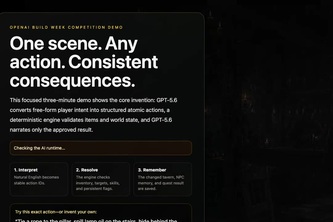
What it appears to be: A bilingual AI narrative RPG prototype that allows players to describe free-form actions in a persistent world, with GPT-5.6 interpreting intent and a deterministic engine enforcing consequences.
What changed: The author describes building a system where generative AI interprets open-ended player intent, but the actual outcome is constrained by deterministic logic. This is presented as a novel approach to narrative games.
Single most important open question: Is there any evidence of user engagement or adoption beyond the single developer's prototype?
What The Product Actually Is
The description states that Chronicles Without Chains is:
- A bilingual AI narrative RPG.
- Players can enter free-form actions, rather than choosing predefined responses.
- It uses GPT-5.6 to interpret natural-language plans into structured JSON action contracts.
- A deterministic engine checks inventory, scene targets, dependencies, skills, quest state, and world conditions.
- Only approved consequences are persisted.
- GPT-5.6 narrates the facts produced by the deterministic engine.
- The interface shows:
- Action trace
- Accepted/rejected/blocked atoms
- Inventory changes
- Provider/model evidence
- Quest progress
- Persistent world state
The system is described as separating generative intent interpretation from deterministic consequence enforcement, with a focus on consistency and control.
Inference: The product is a prototype for a narrative game engine that attempts to merge open-ended player creativity with structured, deterministic gameplay logic.
Not evidenced: No information about actual gameplay mechanics beyond the demo, no evidence of real-world use or user feedback.
Positioning & Claim Evolution
The author states:
- Most narrative games reduce imagination to a short row of buttons.
- Tabletop RPGs allow creative plans but depend on a human game master.
- Chronicles Without Chains explores a third path: players describe what they want, and software keeps the world consistent.
Claim: The product positions itself as a novel approach to narrative games that bridges the gap between digital interactivity and tabletop creativity.
Inference: This is an early-stage prototype with a strong conceptual framing around AI-assisted storytelling and deterministic control.
Not evidenced: No evidence of market positioning, user feedback, or competitive differentiation beyond self-description.
Target Customer & ICP
The description states:
- The product is a narrative RPG.
- It targets players who want to describe compound plans, not just choose from predefined actions.
- It supports Thai and English languages.
Inference: The target customer appears to be gamers interested in narrative freedom, particularly those who enjoy tabletop-style creativity.
Not evidenced: No evidence of actual users, personas, or market segmentation beyond the author’s own interest.
Business Model & Pricing Evidence
The description states:
- The system is a prototype.
- It uses GPT-5.6 and is deployed on OVH with Caddy and PostgreSQL.
- There is a live judge demo available without login.
- No pricing or monetization model is described.
Claim: The product is not yet commercialized, nor does it have a defined business model.
Not evidenced: No evidence of revenue streams, pricing tiers, or monetization strategy.
Technical & Delivery Signals
The description states:
- Built with:
- Next.js, React, TypeScript
- OpenAI GPT-5.6 (luna)
- Zod for schema validation
- Prisma, PostgreSQL
- Docker, Caddy
- Vitest, Playwright
- Uses strict structured output and Zod for validation.
- The system:
- Interprets free-form intent into atomic actions
- Enforces deterministic resolution of those actions
- Narrates outcomes via GPT-5.6
- A deterministic engine checks capabilities, inventory, targets, dependencies, and world state.
- The UI displays action trace, accepted/rejected atoms, and persistent world state.
Inference: The system is technically sophisticated for a prototype, with clear separation of generative and deterministic logic.
Not evidenced: No evidence of scalability, performance metrics, or production deployment beyond the demo.
Traction & Maturity Signals
The description states:
- It was submitted to the OpenAI 2026 hackathon.
- There is a live judge demo.
- The system passes 135 unit tests, plus content, localization, asset, and deterministic smoke validation.
- The author built it in one continuous task with Codex.
Inference: This is an early-stage prototype, likely built during a hackathon.
Not evidenced: No evidence of user adoption, retention, or real-world usage beyond the demo.
Competitive Context
The description states:
- Most narrative games reduce imagination to a short row of buttons.
- Tabletop RPGs allow creative plans but depend on a human game master.
- Chronicles Without Chains explores a third path.
Inference: The author positions this as a novel approach in narrative gaming, distinct from both digital and tabletop formats.
Not evidenced: No evidence of competitors or market analysis beyond the author’s framing.
Open Questions & Risks
- The system is described as a single-developer prototype.
- It uses GPT-5.6, which is not publicly available, and is likely an in-house or proprietary model.
- No evidence of:
- User engagement
- Revenue
- Customers
- Scalability
- Long-term viability
Inference: The product is a proof-of-concept with no demonstrated traction or commercial viability.
Not evidenced: No evidence of competitive threats, technical limitations, or scalability concerns.
Questions the description leaves open
- What is the actual scope of the prototype? Is it a full game or just a demo?
- How does the deterministic engine handle edge cases or ambiguous actions?
- Are there any plans to monetize or scale this beyond the current demo?
- What are the limitations of GPT-5.6 in this context, and how are they mitigated?
- Is there any user feedback or testing beyond the author’s own experience?
Overall Assessment
The description states that Chronicles Without Chains is a single-developer hackathon prototype with no evidence of traction, revenue, or commercialization.
Assessment: Not suitable for investment or partnership at this stage.
Confidence level: Low — based on self-reported evidence only, with no external validation or user data.
Not evidenced: No information about market demand, scalability, or long-term vision beyond the author’s own description.
User Stories BotA demo video on every pull request
Get a demo video on every new feature
GitHub App that watches your pull requests and records a narrated, captioned demo.
Save time on demo prep and make informed decisions faster with a video walkthrough of every new feature.
Source
Submitted to the OpenAI 2026 hackathon on Devpost. Project home on Devpost. Back to the full gallery on Devpost.
This competitive analysis was produced by top-founders.com (opens in a new tab)
Generated by a language model from this project's public Devpost page — its tagline, the author's own write-up and any built-with tags listed there — as captured in August 2026. Short quotations are the author's words. It is an opinion on the idea as a business, not on the people behind it, and it reflects the description as published then. If the project has moved on, request a correction below. The analysis is not independent research and contains no verified traction, revenue or customer data.
An independent guide by KFG International LLC — not affiliated with, endorsed by, or connected to Devpost or OpenAI.