

Archive position — measured, not model output
0 likes on Devpost
2,263 of the 7,850 archived projects have more likes, and 5,587 share exactly 0 — so this project's #5,201 place in the like-ranked listing is a tie-break inside that group, not a ranking.
Projects (log scale)
Likes on Devpost. ▲ marks this project's group.
Show the figures
| Likes | Projects | Share of archive |
|---|---|---|
| 0 | 5,587 | 71.2% |
| 1 | 1,758 | 22.4% |
| 2 | 284 | 3.6% |
| 3–4 | 132 | 1.7% |
| 5–9 | 75 | 1.0% |
| 10+ | 14 | 0.2% |
 User Stories BotA demo video on every pull request
Get a demo video on every new feature
GitHub App that watches your pull requests and records a narrated, captioned demo.
Save time on demo prep and make informed decisions faster with a video walkthrough of every new feature.
Executive Summary
What the company appears to be
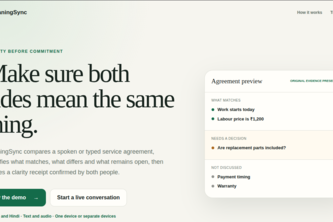
MeaningSync is a solo-built tool designed to help two people—typically a customer and service provider—compare their understanding of a spoken or typed conversation before work begins. It supports English, Hindi, and mixed-language conversations, with a focus on identifying disagreements and enabling both parties to confirm shared meaning.
What changed
The project was built as a solo effort for the OpenAI 2026 hackathon. The author describes it as an experiment in preserving original evidence while using AI to analyze agreement across languages. It includes both live (with transcription) and deterministic demo modes, with no external dependencies for judges.
Single most important open question
Does MeaningSync have a viable commercial use case beyond the hackathon context? The description does not indicate any revenue, customers, or adoption—only a self-reported product built to solve a personal problem in service agreements.
What The Product Actually Is
The description states that MeaningSync is a tool for comparing understanding between two participants in a conversation. It supports English, Hindi, and mixed-language interactions. The system allows users to:
- Choose each participant’s language.
- Enter conversation data via typing or real-time transcription.
- Compare what matches, needs a decision, or was not discussed.
- Resolve only the decisions that genuinely need attention.
- Confirm separate decisions in their own language.
- Generate a clarity receipt containing agreed meaning, unresolved terms, original evidence, timestamps, and an integrity hash.
It is described as not being a contract, legal advice provider, or identity verification system. It preserves original statements and translations separately, with AI used to analyze agreement rather than generate summaries.
Evidence
- The author describes the product’s six-step interface.
- It supports typed messages and real-time transcription.
- Translations are stored separately; original evidence is preserved.
- GPT-5.6 is used for agreement reasoning in live mode.
- A deterministic demo exists without requiring API keys or paid requests.
Inference The tool appears to be a prototype built for demonstration, not production use.
Positioning & Claim Evolution
The author states that MeaningSync was built to answer one practical question: “Did both people understand the same agreement?” It is positioned as a solution to misunderstandings in service agreements, especially when participants speak different languages.
It does not claim to be an AI summary tool or legal contract generator. Instead, it emphasizes clarity before disputes arise and preserves evidence of original statements.
Evidence
- The tagline: “Turn spoken service agreements into shared, bilingual understanding before work begins.”
- The author’s stated inspiration: a common disagreement in service contexts.
- The product is described as not providing legal advice or identity verification.
Inference The positioning reflects a niche, problem-specific solution rather than a broad commercial platform.
Target Customer & ICP
The description does not name specific customer segments. However, the author’s stated use case involves customers and service providers in situations where language differences can lead to misunderstandings—such as hiring electricians or other service professionals.
It is implied that the tool targets individuals or businesses who engage in frequent verbal or typed service agreements and want to avoid disputes.
Evidence
- The inspiration comes from a customer-electrician scenario.
- It supports English, Hindi, and mixed-language conversations.
- Designed for shared-device or separate-device participation.
Inference The ICP likely includes small businesses, freelancers, or individuals in service industries where language barriers are common. No explicit segmentation is provided.
Business Model & Pricing Evidence
There is no evidence of a business model or pricing strategy in the description. The author describes the tool as a solo hackathon project and does not mention monetization, subscriptions, or fees.
Evidence
- No mention of pricing.
- No indication of revenue streams.
- The product includes both live (requires API key) and deterministic demo modes.
Inference The business model is unknown. It may be a prototype with no commercial intent at this stage.
Technical & Delivery Signals
The system uses:
- Frontend: Next.js, React, TypeScript
- Backend: FastAPI, Python
- Database: SQLite (local), PostgreSQL (future)
- AI tools: GPT-5.6 for agreement analysis, Codex for development assistance
- Real-time features: WebRTC, OpenAI Realtime transcription
- Persistence: SQLAlchemy, Alembic
It supports both shared and separate-device participation, with private decision submission to avoid influence.
Evidence
- The author lists tools used in building the product.
- It handles typed and transcribed messages.
- Translations are stored separately from original text.
- Private decision submission prevents one participant from influencing another.
Inference The technical stack suggests a prototype built with modern tools, but no production deployment or scalability data is provided.
Traction & Maturity Signals
There is no evidence of traction, customers, revenue, or adoption. The project is described as a solo hackathon submission, and the author does not mention any users or usage beyond testing.
Evidence
- Built by one person (Sarang Markandey).
- Submitted to OpenAI 2026 hackathon.
- No mention of customers, revenue, or product usage.
Inference The project is at a very early stage—likely a prototype with no commercial traction.
Competitive Context
There is no evidence of competitors in the description. The author explicitly states they did not want to build another AI summary tool, suggesting a niche focus rather than broad competition.
Evidence
- No mention of existing tools or platforms.
- The author’s stated intent was to avoid generic summarization.
Inference The competitive landscape is unclear. It may be a unique solution in its domain but lacks any indication of market presence or competition.
Open Questions & Risks
- No commercial traction or revenue: The project is described as a solo hackathon effort with no evidence of adoption.
- Unproven product-market fit: No data on whether the problem it solves is widespread or significant enough to justify a commercial offering.
- Limited scalability: The system is built for demonstration and testing, not production use.
- Dependency on AI tools: Reliance on GPT-5.6 and OpenAI APIs may limit its viability without access to those services.
- Unclear monetization strategy: No indication of how the product would be monetized or scaled.
Evidence
- No revenue, customers, or adoption data.
- No mention of a go-to-market plan or pricing.
- The tool is described as a prototype.
Questions the description leaves open
- What specific market pain point are you trying to solve beyond the hackathon context?
- Have you validated demand from potential customers in service industries?
- How would you monetize this product if it were to scale?
- What is your plan for production deployment and scalability?
- Are there any legal or compliance considerations around clarity receipts?
- How do you intend to build trust with users who may be hesitant to share conversation data?
Overall Assessment
Not evidenced.
The description provides no information on valuation, funding rounds, or investment interest. It is a solo-built hackathon project with no commercial traction or evidence of market validation.
Confidence Level Low This analysis is based entirely on self-reported information and lacks any external corroboration. The product is described as a prototype with no revenue, customers, or adoption data.
User Stories BotA demo video on every pull request
Get a demo video on every new feature
GitHub App that watches your pull requests and records a narrated, captioned demo.
Save time on demo prep and make informed decisions faster with a video walkthrough of every new feature.
Source
Submitted to the OpenAI 2026 hackathon on Devpost. Project home on Devpost. Back to the full gallery on Devpost.
This competitive analysis was produced by top-founders.com (opens in a new tab)
Generated by a language model from this project's public Devpost page — its tagline, the author's own write-up and any built-with tags listed there — as captured in August 2026. Short quotations are the author's words. It is an opinion on the idea as a business, not on the people behind it, and it reflects the description as published then. If the project has moved on, request a correction below. The analysis is not independent research and contains no verified traction, revenue or customer data.
An independent guide by KFG International LLC — not affiliated with, endorsed by, or connected to Devpost or OpenAI.