

Archive position — measured, not model output
0 likes on Devpost
2,263 of the 7,850 archived projects have more likes, and 5,587 share exactly 0 — so this project's #5,202 place in the like-ranked listing is a tie-break inside that group, not a ranking.
Projects (log scale)
Likes on Devpost. ▲ marks this project's group.
Show the figures
| Likes | Projects | Share of archive |
|---|---|---|
| 0 | 5,587 | 71.2% |
| 1 | 1,758 | 22.4% |
| 2 | 284 | 3.6% |
| 3–4 | 132 | 1.7% |
| 5–9 | 75 | 1.0% |
| 10+ | 14 | 0.2% |
 User Stories BotA demo video on every pull request
Get a demo video on every new feature
GitHub App that watches your pull requests and records a narrated, captioned demo.
Save time on demo prep and make informed decisions faster with a video walkthrough of every new feature.
Executive Summary
What the company appears to be
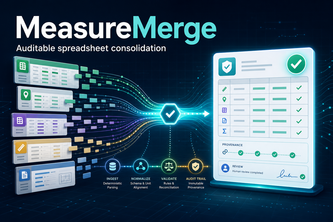
MeasureMerge is a self-reported tool that imports XLSX files containing measurement data and applies deterministic domain rules to reconcile addresses and detect inconsistencies. It is described as a privacy-safe, independently deployable reviewer edition built using Codex with GPT-5.6 for development.
What changed
The project was developed during the OpenAI Build Week hackathon, where it extended an existing German rule engine into a public-facing demo. The author states that this version was built using AI tools (Codex + GPT-5.6) and includes features like synthetic data handling, audit trails, and human review workflows.
Single most important open question
Is there any evidence of real-world usage or traction beyond the hackathon demo? The description does not indicate whether MeasureMerge has been adopted by users outside of its own development context.
What The Product Actually Is
The description states that MeasureMerge:
- Imports XLSX object lists.
- Converts service-position quantities into address-level evidence trails.
- Recognizes order and partial-measurement identifiers.
- Keeps addenda linked to base measurements.
- Applies deterministic domain rules before data can be accepted.
- Highlights unknown positions, duplicates, splits, implausible totals, and address conflicts.
- Uses a conservative Levenshtein threshold for address reconciliation.
- Allows manual corrections with full audit logging.
- Provides clean previews, exception handling, and exportable audit logs.
It also states that the system supports:
- Automatic daily backups.
- Backups before destructive changes.
- A recoverable trash workflow.
- Exportable audit logs.
- Provenance tracking back to source files, sheets, and rows.
Inferred: The tool appears designed for operational use in environments where spreadsheet-based measurement data needs validation and reconciliation, particularly in contexts involving address consistency and regulatory compliance.
Positioning & Claim Evolution
The description states:
- MeasureMerge was built as a response to “headaches” caused by fragmented spreadsheets.
- It aims to turn “fragmented measurement spreadsheets into auditable, human-reviewed evidence.”
- The author claims it is a privacy-safe, independently deployable reviewer edition.
Inferred: The positioning suggests a niche application for organizations managing large volumes of spreadsheet-based data that require auditability and consistency checks. However, no indication exists that this has been validated in the market or adopted by users beyond the developer’s own workflow.
Target Customer & ICP
The description does not name specific customer segments or personas. It implies a target audience:
- Organizations using spreadsheets for measurement data.
- Teams needing to validate and reconcile address-level information.
- Users requiring audit trails and human-reviewed evidence.
Inferred: The tool seems tailored toward internal operational teams or compliance-focused departments within larger organizations, but no explicit ICP is defined.
Business Model & Pricing Evidence
There is no mention of pricing models, monetization strategies, or business model assumptions in the description. The product is described as a demo built during a hackathon and not yet deployed for commercial use.
Not evidenced: No evidence of revenue streams, customer acquisition plans, or pricing structures.
Technical & Delivery Signals
The description states:
- Built using Codex with GPT-5.6.
- Uses a mature German rule engine.
- Includes synthetic dataset (Musterhausen).
- Implements database prefixing and configuration separation for security.
- Protects uploads, backups, source code, and data folders from direct web access.
- Features English Decision Brief and one-click end-to-end scenario.
- Deployed using Codex Computer Use.
- Demonstrated in a narrated, subtitled demo under three minutes.
Inferred: The technical stack and delivery approach suggest a developer-centric tool with strong AI-assisted development capabilities. However, no evidence of production-grade infrastructure or scalability beyond the demo environment is provided.
Traction & Maturity Signals
The description states:
- This is a runnable product rather than a mock-up.
- Judges can sign in to the hosted instance and exercise workflows.
- The public-facing data is synthetic but retains rule depth representative of real workflow.
- The tool was developed during a hackathon and is presented as a working prototype.
Not evidenced: No evidence of user adoption, customer feedback, or usage metrics beyond the demo. No indication of whether the tool has moved past the prototype stage or been used in production settings.
Competitive Context
The description does not reference competitors or similar tools. It focuses solely on the internal workflow and AI-driven development process.
Not evidenced: No competitive analysis or positioning relative to existing tools for spreadsheet reconciliation, data validation, or audit trail systems.
Open Questions & Risks
- No commercial traction: The tool is described only as a hackathon demo with no evidence of real-world adoption.
- Unproven market fit: There is no indication that the target audience has validated demand for this solution.
- AI dependency: Heavy reliance on AI tools (Codex + GPT) may not scale or be replicable outside the current developer’s environment.
- Limited scope: The tool appears narrowly focused on a specific domain (measurement data with address reconciliation), which limits potential market reach.
- Lack of transparency: No information about how the deterministic rules are applied or maintained, nor how they might evolve.
Questions the description leaves open
- What is the actual business problem you're solving for users? Is there a real-world use case beyond the demo?
- How do you plan to validate demand for this tool in the market?
- Can you provide examples of how the deterministic rules are applied in practice?
- Are there any known limitations or edge cases that aren’t covered by the current implementation?
- What is your long-term roadmap for scaling beyond the demo environment?
- How do you intend to monetize this product, if at all?
Overall Assessment
Not evidenced: No evidence of revenue, customer traction, or financial viability exists in the description.
The project appears to be a hackathon prototype built using AI tools, demonstrating a working demo but lacking any indication of commercial readiness or market validation. The author describes it as a privacy-safe, independently deployable reviewer edition, but no evidence supports its adoption by users beyond the developer’s own workflow.
Confidence level Low. This is a self-reported, unverified account of a prototype with no demonstrated traction or business model.
User Stories BotA demo video on every pull request
Get a demo video on every new feature
GitHub App that watches your pull requests and records a narrated, captioned demo.
Save time on demo prep and make informed decisions faster with a video walkthrough of every new feature.
Source
Submitted to the OpenAI 2026 hackathon on Devpost. Project home on Devpost. Back to the full gallery on Devpost.
This competitive analysis was produced by top-founders.com (opens in a new tab)
Generated by a language model from this project's public Devpost page — its tagline, the author's own write-up and any built-with tags listed there — as captured in August 2026. Short quotations are the author's words. It is an opinion on the idea as a business, not on the people behind it, and it reflects the description as published then. If the project has moved on, request a correction below. The analysis is not independent research and contains no verified traction, revenue or customer data.
An independent guide by KFG International LLC — not affiliated with, endorsed by, or connected to Devpost or OpenAI.