

Archive position — measured, not model output
1 like on Devpost
505 of the 7,850 archived projects have more likes, and 1,758 share exactly 1 — so this project's #1,275 place in the like-ranked listing is a tie-break inside that group, not a ranking.
Projects (log scale)
Likes on Devpost. ▲ marks this project's group.
Show the figures
| Likes | Projects | Share of archive |
|---|---|---|
| 0 | 5,587 | 71.2% |
| 1 | 1,758 | 22.4% |
| 2 | 284 | 3.6% |
| 3–4 | 132 | 1.7% |
| 5–9 | 75 | 1.0% |
| 10+ | 14 | 0.2% |
 User Stories BotA demo video on every pull request
Get a demo video on every new feature
GitHub App that watches your pull requests and records a narrated, captioned demo.
Save time on demo prep and make informed decisions faster with a video walkthrough of every new feature.
Executive Summary
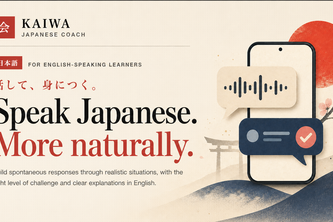
KAIWA is a self-reported AI-powered Japanese conversation coach for Vietnamese- and English-speaking learners, designed to help users build real-world speaking confidence through short role-play sessions tailored to JLPT N5–N3 levels. The product is described as a responsive web application built with React, TypeScript, Vite, Node.js, Express, and OpenAI's Realtime API via WebRTC.
The description states that KAIWA offers voice or text practice, JLPT-specific difficulty settings, progressive hints, and structured explanations after conversations. It also claims to store learning history locally by default and includes privacy controls and fallback modes for reliability.
Key commercial due-diligence read
The author describes a product with a clear positioning in the language-learning AI space but provides no evidence of revenue, customers, or traction beyond its submission to a hackathon. The project is self-reported and unverified; there is no indication of market validation, user adoption, or business model implementation.
Most important open question
Is there any evidence that users are engaging with KAIWA beyond the initial prototype, or that it has moved past the experimental stage?
What The Product Actually Is
The description states that KAIWA is an AI Japanese conversation coach for Vietnamese- and English-speaking learners. It creates short role-play sessions based on real-life situations such as shopping, transportation, workplace communication, and meeting someone new.
It supports both voice and text practice modes, allows users to select JLPT N5, N4, or N3 difficulty levels, and provides progressive hints and structured explanations after each conversation.
The application is built as a responsive web app using:
- Frontend: React, TypeScript, Vite
- Backend: Node.js, Express
- AI integration: OpenAI Realtime API via WebRTC for voice conversations
- Additional features include local data storage, activity tracking, privacy controls, and fallback modes
Inference The product appears to be a prototype or proof-of-concept rather than a production-ready service. No evidence of monetization or customer base is provided.
Positioning & Claim Evolution
The author positions KAIWA as an AI tool that helps learners build real-world Japanese speaking confidence through short, tailored role-play sessions. It aims to bridge the gap between grammar/vocabulary study and spontaneous conversation practice.
Key claims:
- Learners can practice in a safe environment where they can make mistakes.
- Sessions are based on real-life scenarios.
- The system provides hints and explanations tailored to JLPT levels (N5–N3).
- Voice/text options allow flexibility in practice methods.
- Progress is stored locally by default, emphasizing user privacy.
Inference This is a self-described educational product targeting language learners who want structured, low-pressure speaking practice. It does not claim to be a full-fledged language course or platform but rather a focused tool for conversational fluency building.
Target Customer & ICP
The description states that KAIWA targets Vietnamese- and English-speaking learners of Japanese. These users are likely at beginner to intermediate levels, specifically those preparing for JLPT N5–N3 exams.
There is no further segmentation or targeting beyond language and proficiency level.
Inference The ICP seems narrow — focused on learners who are already studying Japanese but lack confidence in speaking. However, the description does not indicate whether this audience has been validated through market research or user interviews.
Business Model & Pricing Evidence
There is no evidence of a business model or pricing structure in the provided description.
The author mentions that learning history and progress are stored locally by default, suggesting a privacy-first approach. No mention of subscriptions, freemium tiers, or monetization strategies is made.
Inference The project appears to be non-commercial at this stage. There is no indication of how it would generate revenue if developed further.
Technical & Delivery Signals
The product is described as a responsive web application, built using:
- Frontend: React, TypeScript, Vite
- Backend: Node.js, Express
- AI services: OpenAI Realtime API via WebRTC
- Voice handling: WebRTC for voice conversations; fallback to text-to-speech or text input
Additional technical features include:
- Prepared scenarios
- JLPT-specific coaching
- Progressive hints
- Post-session feedback
- Local data storage
- Privacy controls
- Provider-free fallback mode
Inference The tech stack suggests a modern, web-based solution with AI integration. However, no evidence of scalability, performance metrics, or production deployment is provided.
Traction & Maturity Signals
The project was submitted to the OpenAI 2026 hackathon, indicating it is likely in an early-stage prototype phase.
There is no evidence of:
- Revenue
- Customers
- User engagement
- Product usage data
- Market traction
- Any form of monetization or business development
The description emphasizes that this was a hackathon submission, implying no prior commercial activity.
Inference The product has not yet demonstrated any measurable traction or maturity beyond the initial concept and prototype stage.
Competitive Context
No specific competitors are named in the description. However, the author notes that many learners struggle with real-world conversation despite studying grammar and vocabulary — a common pain point in language learning.
The described functionality overlaps with:
- AI-powered language practice tools
- Role-play-based conversation apps
- JLPT prep platforms
- Speech recognition and feedback systems
Inference While KAIWA addresses a known gap in language learning, there is no evidence of competitive analysis or differentiation from existing tools. The author does not reference any direct competitors.
Open Questions & Risks
- No commercial traction: Submitted to a hackathon; no evidence of users or revenue.
- Unproven market demand: No indication that target users are actively seeking such a tool.
- Limited scope and maturity: Prototype-level product with no production deployment or user feedback loop.
- Unclear monetization path: No business model or pricing strategy described.
- Dependency on AI providers: Reliance on OpenAI Realtime API may pose risks if service changes or becomes unavailable.
- Privacy vs. usability trade-offs: Local storage and provider-free fallback are mentioned, but no clarity on how these affect long-term user retention or scalability.
Inference The project is at a very early stage with significant uncertainty around viability, adoption, and commercial potential.
Questions the description leaves open
- What inspired the decision to focus specifically on JLPT N5–N3 learners?
- How many users have interacted with KAIWA beyond the prototype phase?
- Have you conducted any user testing or feedback sessions with target learners?
- Is there a plan to monetize the product, and if so, what model are you considering?
- What are the key challenges in scaling voice-based AI conversation practice?
- How do you intend to differentiate KAIWA from other language-learning tools currently available?
- Are there any partnerships or institutional ties that support development or distribution?
Overall Assessment
Not evidenced
The description provides no information on:
- Revenue
- Customers
- Traction
- Market validation
- Business model
- Scalability
- Competitive positioning beyond the author’s own claims
This is a self-reported, unverified prototype, submitted to a hackathon. It does not demonstrate commercial readiness or viability.
Confidence level Low — based entirely on self-description and no external corroboration.
Conclusion
KAIWA appears to be an early-stage idea with potential in the language-learning AI space, but lacks any evidence of traction, adoption, or business development. Any investment or partnership decision should be contingent upon further validation and proof-of-concept data.
User Stories BotA demo video on every pull request
Get a demo video on every new feature
GitHub App that watches your pull requests and records a narrated, captioned demo.
Save time on demo prep and make informed decisions faster with a video walkthrough of every new feature.
Source
Submitted to the OpenAI 2026 hackathon on Devpost. Project home on Devpost. Back to the full gallery on Devpost.
This competitive analysis was produced by top-founders.com (opens in a new tab)
Generated by a language model from this project's public Devpost page — its tagline, the author's own write-up and any built-with tags listed there — as captured in August 2026. Short quotations are the author's words. It is an opinion on the idea as a business, not on the people behind it, and it reflects the description as published then. If the project has moved on, request a correction below. The analysis is not independent research and contains no verified traction, revenue or customer data.
An independent guide by KFG International LLC — not affiliated with, endorsed by, or connected to Devpost or OpenAI.