

Archive position — measured, not model output
1 like on Devpost
505 of the 7,850 archived projects have more likes, and 1,758 share exactly 1 — so this project's #2,005 place in the like-ranked listing is a tie-break inside that group, not a ranking.
Projects (log scale)
Likes on Devpost. ▲ marks this project's group.
Show the figures
| Likes | Projects | Share of archive |
|---|---|---|
| 0 | 5,587 | 71.2% |
| 1 | 1,758 | 22.4% |
| 2 | 284 | 3.6% |
| 3–4 | 132 | 1.7% |
| 5–9 | 75 | 1.0% |
| 10+ | 14 | 0.2% |
 User Stories BotA demo video on every pull request
Get a demo video on every new feature
GitHub App that watches your pull requests and records a narrated, captioned demo.
Save time on demo prep and make informed decisions faster with a video walkthrough of every new feature.
Executive Summary
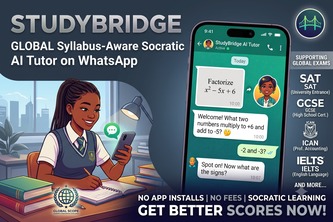
StudyBridge is a WhatsApp-based educational tool built by two founders (Emmanuel Olayinka and Ashiah Ibrahim) that uses AI to guide students through homework and exam preparation without simply providing answers. The product is described as a Socratic tutor powered by Codex and GPT-5.6, leveraging the Meta WhatsApp Cloud API for messaging and Node.js/Express for backend infrastructure.
The project was submitted to the OpenAI 2026 hackathon on Devpost and is self-reported only — no external verification or traction data is available. The description indicates a focus on West African exam systems (e.g., WAEC/JAMB), with plans to expand into other regional formats like WASSCE/KCSE.
Key commercial due-diligence questions include: Is there evidence of user adoption or feedback? What are the actual costs and scalability challenges of running this at scale? How does StudyBridge differentiate from existing tutoring platforms?
Single most important open question
What is the actual demand for this product, and how will it be monetized beyond a hackathon prototype?
What The Product Actually Is
The description states that StudyBridge is a WhatsApp tutor that digitizes syllabi to guide students through homework using AI. It uses Codex and GPT-5.6 as core technologies.
It operates via the Meta WhatsApp Cloud API, where incoming messages are validated and passed into an LLM reasoning pipeline designed with Socratic prompts. The system avoids direct answer provision by asking guiding questions and identifying knowledge gaps.
The product is described as a "Socratic tutor" that helps students arrive at answers themselves rather than delivering solutions directly.
Evidence
- Built using Node.js, Express, Twilio, OpenAI (Codex/GPT-5.6), TypeScript.
- Uses WhatsApp Cloud API for real-time message ingestion and delivery.
- Implements custom state-handling logic to manage conversation history efficiently.
- Powered by LLMs constrained with system prompts to act as educational facilitators.
Inference The product is an AI-powered chatbot integrated into WhatsApp, designed for personalized learning in regions where access to quality tutoring is limited.
Positioning & Claim Evolution
StudyBridge positions itself as a way to bring elite, personalized educational tools to students who lack access due to high student-to-teacher ratios and expensive tutoring fees. It emphasizes accessibility through WhatsApp — a platform nearly universally available.
The authors claim that StudyBridge avoids the pitfalls of traditional bots by acting as a Socratic tutor instead of delivering answers directly. This is framed as a pedagogical approach intended to promote deeper understanding.
Evidence
- Inspired by need for personalized guidance in areas with limited access.
- Explicitly states it does not feed students answers, but guides them through questions.
- Describes itself as a “Socratic tutor” using AI to encourage learning over rote memorization.
Inference The positioning reflects an intent to democratize education via accessible technology, targeting underserved markets where WhatsApp is prevalent.
Target Customer & ICP
The description indicates that StudyBridge targets students in regions with high student-to-teacher ratios and limited access to affordable tutoring. These include areas where standardized exams like WAEC/JAMB are taken.
It also implies a focus on students who already use WhatsApp daily, suggesting the target audience is likely low-income or middle-class youth in developing economies.
Evidence
- Mentions lack of access due to high student-to-teacher ratios and expensive tutoring.
- Notes that almost every student has access to WhatsApp.
- Focuses on West African exam systems (WAEC/JAMB).
Inference The ICP appears to be students aged 12–18 in low-income or middle-income regions where WhatsApp is widely used and formal tutoring is inaccessible.
Business Model & Pricing Evidence
There is no evidence of pricing, monetization strategy, or business model in the provided description. The authors do not mention how they plan to charge users, whether through subscriptions, freemium models, or partnerships with schools or governments.
Evidence
- No mention of revenue streams.
- No indication of pricing tiers or user plans.
- No reference to institutional or government partnerships for funding or distribution.
Inference The business model remains undefined in the self-reported account. It is unclear how this would be monetized beyond a hackathon prototype.
Technical & Delivery Signals
StudyBridge uses Node.js and Express backend, integrates with Meta WhatsApp Cloud API, and leverages Codex and GPT-5.6 for AI inference. The architecture includes asynchronous processing to handle webhook timeouts and reduce duplicate responses.
It implements a decay function for managing conversation history relevance, prioritizing recent messages over older ones in the LLM context window.
Evidence
- Built with Node.js, Express, TypeScript.
- Uses Meta WhatsApp Cloud API for messaging.
- Implements asynchronous message handling to avoid webhook timeouts.
- Employs custom prompt engineering and system prompts to constrain LLM behavior.
- Applies a decay function to conversation relevance weights.
Inference The technical stack suggests a scalable architecture capable of handling real-time messaging with AI inference, though no production data or performance metrics are shared.
Traction & Maturity Signals
There is no evidence of traction, customer adoption, or usage metrics. The project is described as a hackathon submission and lacks any indication of user testing, feedback loops, or market validation beyond the authors' own claims.
Evidence
- Submitted to OpenAI 2026 hackathon.
- No mention of users, customers, or real-world deployment.
- No data on engagement, retention, or performance.
Inference The product is at an early stage — likely a prototype or proof-of-concept — with no demonstrated traction or maturity in the market.
Competitive Context
No information is provided about competitors or competitive landscape. The description does not reference existing WhatsApp-based tutoring tools, AI-powered homework helpers, or educational platforms targeting similar demographics.
Evidence
- No mention of competing products.
- No discussion of differentiation from other edtech solutions.
- No indication of market analysis or competitive positioning.
Inference The competitive environment is unknown. It’s unclear whether StudyBridge addresses a gap in the market or competes with existing tools that may already exist.
Open Questions & Risks
Several risks and open questions emerge from the self-reported description:
- Unproven demand: No evidence of user adoption, feedback, or real-world usage.
- Scalability concerns: The described architecture is complex and may face issues at scale (e.g., latency, token costs).
- Monetization ambiguity: No clear path to revenue generation.
- Dependency on proprietary tech: Reliance on Codex/GPT-5.6 raises questions about long-term viability and cost.
- Limited scope: Currently focused only on WAEC/JAMB exams; unclear expansion strategy.
Evidence
- No traction or usage data.
- No pricing or monetization model.
- Heavy reliance on OpenAI APIs (Codex/GPT-5.6).
- Focus limited to specific regional exams.
Inference This is a high-risk, early-stage idea with no demonstrated market validation or sustainable business model.
Questions the description leaves open
- Have you tested StudyBridge with actual students? If so, what were the results?
- What is your plan for scaling beyond the current prototype and hackathon submission?
- How do you intend to monetize this product once it moves past the demo phase?
- Are there any existing partnerships or pilot programs with schools or educational institutions?
- What are the technical limitations of using Codex/GPT-5.6 at scale, especially in terms of cost and latency?
- How will you ensure consistent quality of Socratic guidance across different subjects and topics?
- What is your timeline for expanding beyond WAEC/JAMB to other regional exam systems?
Overall Assessment
StudyBridge is a conceptually interesting idea that attempts to democratize education through AI-powered WhatsApp tutoring. However, it is currently at the prototype stage, with no evidence of traction, revenue, or customer validation.
The product is described as a hackathon submission and lacks any indication of real-world deployment or market testing.
Assessment Not ready for investment or partnership at this time. The idea shows promise but requires significant development, user testing, and business model clarification before it can be considered viable.
User Stories BotA demo video on every pull request
Get a demo video on every new feature
GitHub App that watches your pull requests and records a narrated, captioned demo.
Save time on demo prep and make informed decisions faster with a video walkthrough of every new feature.
Source
Submitted to the OpenAI 2026 hackathon on Devpost. Project home on Devpost. Back to the full gallery on Devpost.
This competitive analysis was produced by top-founders.com (opens in a new tab)
Generated by a language model from this project's public Devpost page — its tagline, the author's own write-up and any built-with tags listed there — as captured in August 2026. Short quotations are the author's words. It is an opinion on the idea as a business, not on the people behind it, and it reflects the description as published then. If the project has moved on, request a correction below. The analysis is not independent research and contains no verified traction, revenue or customer data.
An independent guide by KFG International LLC — not affiliated with, endorsed by, or connected to Devpost or OpenAI.