

Archive position — measured, not model output
0 likes on Devpost
2,263 of the 7,850 archived projects have more likes, and 5,587 share exactly 0 — so this project's #5,931 place in the like-ranked listing is a tie-break inside that group, not a ranking.
Projects (log scale)
Likes on Devpost. ▲ marks this project's group.
Show the figures
| Likes | Projects | Share of archive |
|---|---|---|
| 0 | 5,587 | 71.2% |
| 1 | 1,758 | 22.4% |
| 2 | 284 | 3.6% |
| 3–4 | 132 | 1.7% |
| 5–9 | 75 | 1.0% |
| 10+ | 14 | 0.2% |
 User Stories BotA demo video on every pull request
Get a demo video on every new feature
GitHub App that watches your pull requests and records a narrated, captioned demo.
Save time on demo prep and make informed decisions faster with a video walkthrough of every new feature.
Executive Summary
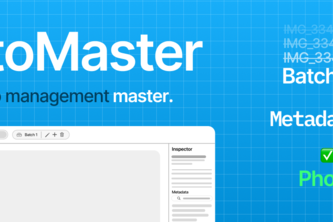
PhotoMaster is a self-reported macOS application built by one developer (Hamish Ferguson) to address personal needs in photo organization workflows. The author describes it as a local-first tool for batch renaming, metadata editing and culling of photographs, with no subscription or cloud components. It was developed using Swift, SwiftUI and AI tools like Codex and GPT-5.6 Sol.
The description states that PhotoMaster began as a solution to repetitive tasks around photo naming and metadata handling, evolving into a more complete workflow tool over time. The author emphasizes its privacy model (no accounts, no cloud), performance considerations, and user-friendliness.
Key commercial due-diligence questions:
- What is the actual product-market fit for this niche?
- Is there any evidence of traction or user feedback beyond the creator's own use?
- How does the developer plan to scale beyond one-person development?
The most important open question: Does PhotoMaster have a viable path to adoption beyond its creator’s personal use?
What The Product Actually Is
The description states that PhotoMaster is a native macOS application for importing, reviewing, renaming, editing and culling local photo libraries. It supports:
- Importing individual photographs or entire folders (including nested)
- Batch renaming with customizable naming conventions
- Metadata inspection and editing
- XMP sidecar file creation for non-writable formats
- Photo culling (marking picks/rejects)
- Persistent batch workspaces and session restoration
- Local-first operation with no cloud backend
The application is described as running entirely on the user's Mac, without accounts, subscriptions or internet connectivity.
Positioning & Claim Evolution
The author states that PhotoMaster started as a solution to a personal problem around batch renaming but evolved into a more complete workflow tool. It was initially built to solve issues with macOS bulk renaming tools and Adobe Lightroom’s subscription model.
The positioning appears to be:
- A local-first, privacy-focused photo management tool
- An alternative to subscription-based software like Adobe Lightroom
- A solution for users who want control over their photo organization without cloud dependencies
There is no evidence of a formal brand or marketing strategy beyond the author's own description. The evolution from "batch renaming" to "workflow application" suggests an expansion in scope, but this is self-reported.
Target Customer & ICP
The description states that PhotoMaster was built for someone who:
- Has personal photo libraries requiring organization
- Needs consistent naming schemes across batches
- Works with film scans or digital photos with limited metadata
- Values local-first privacy and control over their data
- Wants to avoid subscription-based software
It is implied that the target user is likely a photographer (especially film photographers) who:
- Manages large photo collections
- Values metadata accuracy
- Is technically capable but not necessarily technical
- Prefers simple, focused tools over complex suites
No specific customer segments or personas are defined beyond this general description.
Business Model & Pricing Evidence
The description states that PhotoMaster is a local-first application with no accounts, subscriptions or cloud backend. It does not collect analytics or upload user data.
There is no evidence of any pricing model, monetization strategy or revenue streams. The author describes it as "no subscription" and "no accounts", implying a free or one-time purchase model, but no details are provided.
Technical & Delivery Signals
The application was built using:
- Swift and SwiftUI
- Apple Silicon macOS native development
- System frameworks (AppKit)
- AI tools including Codex and GPT-5.6 Sol for implementation assistance
Key technical features mentioned include:
- Local-first architecture
- Metadata handling across multiple formats
- XMP sidecar support
- Performance optimizations (background loading, threading)
- Session restoration
- Error handling for destructive operations
The author notes that development was iterative, involving testing with real photo libraries and continuous refinement.
Traction & Maturity Signals
Not evidenced. The description contains no information about:
- User adoption or customer base
- Revenue or monetization
- Customer feedback or reviews
- Market traction or usage metrics
- Product roadmap or future plans beyond the author's own development
The project is described as a personal tool that has evolved over time, but there is no evidence of external validation or market response.
Competitive Context
The description does not provide information about:
- Direct competitors
- Indirect substitutes
- Market size or growth trends
- Pricing or feature comparisons with existing tools
It only mentions macOS bulk renaming tools and Adobe Lightroom as alternatives, without describing the competitive landscape.
Open Questions & Risks
Inferences based on self-reported information:
- Single-person development: The project is built by one developer (Hamish Ferguson), which raises concerns about scalability, maintenance, feature delivery and long-term support.
- No external validation: There is no evidence of user feedback, customer interviews or market testing beyond the creator's own experience.
- Limited commercial viability: The absence of any pricing model, monetization strategy or revenue data suggests a lack of business planning.
- Technical risk: The author notes challenges with metadata handling, file operations and performance — all critical for photo management software.
- Market risk: Without evidence of traction or user feedback, there is uncertainty about whether the problem being solved is widespread enough to support a commercial product.
Questions the description leaves open
- What specific problems do users encounter with existing tools that PhotoMaster solves?
- How many people are currently using PhotoMaster beyond yourself?
- What is your plan for scaling beyond one-person development?
- Have you considered monetization strategies or pricing models?
- What feedback have you received from other photographers or users?
- How do you intend to maintain and improve the application long-term?
- What are the key technical challenges that remain unresolved?
Overall Assessment
Not evidenced.
The description provides no information about:
- Financial performance
- Customer acquisition costs
- Market opportunity size
- Competitive positioning in terms of market share or growth
- Any investment history or funding rounds
- Partnership opportunities or strategic fit
This is a self-reported personal project with no commercial evidence. The author's own account describes it as a tool built for personal use that has evolved into something more complete, but there is no indication of commercial viability or traction beyond the creator's own experience.
User Stories BotA demo video on every pull request
Get a demo video on every new feature
GitHub App that watches your pull requests and records a narrated, captioned demo.
Save time on demo prep and make informed decisions faster with a video walkthrough of every new feature.
Source
Submitted to the OpenAI 2026 hackathon on Devpost. Project home on Devpost. Back to the full gallery on Devpost.
This competitive analysis was produced by top-founders.com (opens in a new tab)
Generated by a language model from this project's public Devpost page — its tagline, the author's own write-up and any built-with tags listed there — as captured in August 2026. Short quotations are the author's words. It is an opinion on the idea as a business, not on the people behind it, and it reflects the description as published then. If the project has moved on, request a correction below. The analysis is not independent research and contains no verified traction, revenue or customer data.
An independent guide by KFG International LLC — not affiliated with, endorsed by, or connected to Devpost or OpenAI.