

Archive position — measured, not model output
0 likes on Devpost
2,263 of the 7,850 archived projects have more likes, and 5,587 share exactly 0 — so this project's #5,933 place in the like-ranked listing is a tie-break inside that group, not a ranking.
Projects (log scale)
Likes on Devpost. ▲ marks this project's group.
Show the figures
| Likes | Projects | Share of archive |
|---|---|---|
| 0 | 5,587 | 71.2% |
| 1 | 1,758 | 22.4% |
| 2 | 284 | 3.6% |
| 3–4 | 132 | 1.7% |
| 5–9 | 75 | 1.0% |
| 10+ | 14 | 0.2% |
 User Stories BotA demo video on every pull request
Get a demo video on every new feature
GitHub App that watches your pull requests and records a narrated, captioned demo.
Save time on demo prep and make informed decisions faster with a video walkthrough of every new feature.
Executive Summary
What the company appears to be
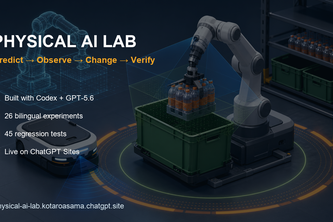
Physical AI Lab is a self-contained browser-based educational tool designed to teach embodied AI concepts through interactive simulations. The author describes it as an interactive course with 26 experiments that allow learners to observe physical failures, change parameters, and verify outcomes in real-time.
What changed
The project was submitted to the OpenAI 2026 hackathon by a single founder (Kotaro Asama), who used tools like Codex, GPT-5.6, React, Three.js, and Vinext to build it. It is described as a prototype or proof-of-concept with no revenue, customers, or traction.
Single most important open question
Is there evidence of a viable market need for this type of educational tool beyond the hackathon context?
What The Product Actually Is
The description states that Physical AI Lab is a bilingual interactive course with 26 browser-based experiments, built using:
- HTML simulation
- Three.js engine
- Vinext application for OpenAI Sites
- No runtime API dependencies
- Local browser storage for progress and experiment records
It uses a consistent loop: Predict → Observe → Change → Verify. Each mission starts with a deliberately weak baseline, shows failure, allows parameter changes, and verifies results against an acceptance envelope.
The product is described as:
- Offline-capable
- Self-contained
- Not dependent on external APIs or services
- Designed to teach physical AI concepts such as latency, friction, uncertainty, calibration, and safety margins through direct interaction
Inference The tool appears to be a simulation-based learning platform focused on embodied AI education, using 3D visualizations and interactive feedback.
Positioning & Claim Evolution
The author claims the product aims to:
- Make abstract concepts like sensing, feedback control, Sim-to-Real, and robot safety tangible
- Provide physical intuition before mathematical or vocabulary-heavy explanations
- Allow learners to see how changing one causal input affects real-world outcomes
It positions itself as a learning tool for newcomers to embodied AI, particularly those who lack prior experience in robotics or advanced mathematics.
Inference The positioning reflects an attempt to bridge the gap between theoretical knowledge and practical understanding in physical AI education — targeting early-stage learners or educators rather than professionals.
Target Customer & ICP
The description does not explicitly name target customers. However, it implies:
- Learners interested in embodied AI
- Educators teaching robotics or control systems
- Individuals seeking hands-on experience with physical systems without needing hardware access
There is no evidence of segmentation beyond general audiences (e.g., students, educators).
Inference The ICP likely includes individuals or institutions looking for accessible, low-cost, interactive tools to teach embodied AI concepts — possibly in academic or training settings.
Business Model & Pricing Evidence
No business model or pricing information is provided. The product is described as:
- A prototype built for a hackathon
- Self-contained and offline-capable
- Not monetized or sold
There is no mention of licensing, subscriptions, or revenue streams.
Inference There is no evidence of any commercialization strategy or pricing model at this stage.
Technical & Delivery Signals
The product is built with:
- Technology stack: JavaScript, TypeScript, React, Three.js, OpenAI Sites, codex, GPT-5.6
- Architecture: Single HTML simulation wrapped in a Vinext app; no runtime API dependencies
- Delivery method: Browser-based, offline-capable
- Data handling: Simulation state, meters, logs, and pass/fail gates share one source of truth; progress stored locally
The author notes:
- Codex and GPT-5.6 were used for implementation and verification
- The tool includes automated regression coverage and QA testing
- It supports both English and Japanese versions
Inference The technical architecture is lightweight, self-contained, and suitable for browser deployment. AI tools were used to accelerate development.
Traction & Maturity Signals
The project was submitted to the OpenAI 2026 hackathon and has:
- 26 working experiments
- A five-minute English judge route
- Support for both English and Japanese
- Automated regression tests and QA
- No revenue, customers, or traction data beyond its submission context
There is no evidence of adoption, usage metrics, or market validation.
Inference The product exists as a prototype or proof-of-concept. It lacks any signs of traction or commercial maturity.
Competitive Context
No competitive landscape is described in the project write-up. The author does not reference existing tools or platforms for teaching embodied AI or robotics education.
Inference There is no evidence of awareness of competitors or market positioning relative to others in the space.
Open Questions & Risks
- No commercialization strategy: No pricing, monetization, or go-to-market plan
- Single founder: Only one team member involved (Kotaro Asama)
- Prototype-only: Built for a hackathon; no indication of scalability or long-term development
- Limited audience: No evidence of target customer segmentation or demand validation
- No external feedback or testing: No mention of educator or user testing beyond internal validation
Inference The project is in early-stage development and lacks any signs of commercial viability or traction.
Questions the description leaves open
- What specific educational institutions or training programs are you targeting?
- Have you validated the curriculum with educators or students?
- Are there plans to expand beyond the current 26 experiments?
- How do you intend to monetize or scale this product?
- What is your roadmap for adding features like instructor tools, progress sharing, or real-world data integration?
- Do you have any feedback from robotics educators or industry experts?
Overall Assessment
Not evidenced
There is no evidence of revenue, customers, traction, or a clear path to monetization. The project is described as a hackathon submission with no indication of commercial intent or market validation.
Inference At this stage, the product appears to be an experimental prototype with potential educational value but no demonstrated business case or investment opportunity. It would require significant further development and market validation before being considered for investment or partnership.
User Stories BotA demo video on every pull request
Get a demo video on every new feature
GitHub App that watches your pull requests and records a narrated, captioned demo.
Save time on demo prep and make informed decisions faster with a video walkthrough of every new feature.
Source
Submitted to the OpenAI 2026 hackathon on Devpost. Project home on Devpost. Back to the full gallery on Devpost.
This competitive analysis was produced by top-founders.com (opens in a new tab)
Generated by a language model from this project's public Devpost page — its tagline, the author's own write-up and any built-with tags listed there — as captured in August 2026. Short quotations are the author's words. It is an opinion on the idea as a business, not on the people behind it, and it reflects the description as published then. If the project has moved on, request a correction below. The analysis is not independent research and contains no verified traction, revenue or customer data.
An independent guide by KFG International LLC — not affiliated with, endorsed by, or connected to Devpost or OpenAI.