

Archive position — measured, not model output
1 like on Devpost
505 of the 7,850 archived projects have more likes, and 1,758 share exactly 1 — so this project's #2,009 place in the like-ranked listing is a tie-break inside that group, not a ranking.
Projects (log scale)
Likes on Devpost. ▲ marks this project's group.
Show the figures
| Likes | Projects | Share of archive |
|---|---|---|
| 0 | 5,587 | 71.2% |
| 1 | 1,758 | 22.4% |
| 2 | 284 | 3.6% |
| 3–4 | 132 | 1.7% |
| 5–9 | 75 | 1.0% |
| 10+ | 14 | 0.2% |
 User Stories BotA demo video on every pull request
Get a demo video on every new feature
GitHub App that watches your pull requests and records a narrated, captioned demo.
Save time on demo prep and make informed decisions faster with a video walkthrough of every new feature.
Executive Summary
What the company appears to be
SubnetLens is a Windows-based network discovery tool that integrates AI to investigate unknown devices on a local network. The product, called "Device DNA," allows users to ask questions about unfamiliar network devices and receive evidence-led answers from an AI model, while maintaining control over what data is shared with the AI and ensuring final results are validated locally.
What changed
The project evolved from a general-purpose network scanner into a specialized tool focused on AI-assisted device identification. It introduced a new application edition (Device DNA) that uses local AI reasoning via either a local Codex engine or an optional OpenAI API key, with strict data minimization and permission controls.
Single most important open question
Is there any evidence of traction, revenue, or customer adoption beyond the author's own development work?
What The Product Actually Is
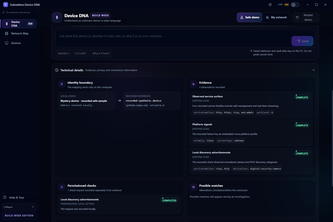
The description states that SubnetLens Device DNA is a focused Windows edition designed to turn an unfamiliar network device into a plain-language, evidence-led investigation. It allows users to ask questions like “What is this device?” or “Why might it be on my network?” and receive ranked hypotheses tied to recorded evidence.
- The user explicitly chooses and connects an AI provider (Local or with an API key).
- Nothing contacts Codex or OpenAI unless the user presses Connect.
- A deterministic safe sample lets anyone try the complete experience without scanning a real device.
- The application represents the selected target and supplies minimized, pseudonymized evidence.
- Codex compares possible identities and publishes ranked hypotheses tied to recorded evidence.
- If another observation would help, Device DNA presents a visible Allow Once or Not Now decision.
- The result includes likely identity-or honest uncertainty-along with confidence, supporting and contradictory evidence, conditions that would change the answer, a privacy receipt, and progressively disclosed technical details.
Inference This is not just a scanner but an AI-powered investigative tool that emphasizes user control over data exposure and validation of results. It operates under strict local boundaries to prevent unauthorized access or data leakage.
Positioning & Claim Evolution
The author claims SubnetLens addresses the gap in existing network scanners, which are good at finding devices but poor at answering "What is this unknown device, why might it be here, and what evidence supports that conclusion?"
- The product positions itself as more than just a scanner.
- It introduces a new concept: AI reasoning about a device while keeping local control over the target, evidence, permissions, and final result.
- The goal is not merely an answer but one that can be inspected by the user.
Inference The positioning reflects a shift from generic network discovery to specialized AI-assisted forensic analysis of unknown devices. It emphasizes trustworthiness through transparency and validation.
Target Customer & ICP
The description does not clearly define the specific customer segment or ideal customer profile (ICP). However, it implies that users are individuals or teams who manage local networks and need to identify unknown devices.
- The tool is built for Windows users.
- It targets those who may be concerned about network security and want to understand what devices are present on their network.
- Users must have some familiarity with basic networking concepts to use the tool effectively.
Inference The primary user base likely includes IT professionals, home network administrators, or security-conscious individuals managing small-to-medium networks. There is no evidence of enterprise customers or B2B targeting.
Business Model & Pricing Evidence
The description mentions a pricing structure involving Personal, Team, and Business tiers, with a Pro trial available for seven days.
- The app includes a no-card seven-day Pro trial.
- Pricing and activation work were completed as part of the Build Week scope.
- There is mention of website improvements related to analytics, search-discovery, distribution, antivirus, and documentation.
Inference SubnetLens appears to be moving toward a freemium or tiered subscription model with paid upgrades. However, there is no evidence of actual revenue streams, customer acquisition, or monetization data beyond the stated pricing structure.
Technical & Delivery Signals
The project was built using Electron and React for the UI, Node.js for backend logic, and integrates with local AI models like Codex (via GPT-5.6 Terra). It uses tools such as Playwright, Vitest, and Zod for testing and validation.
- The application launches a local Codex investigation using an existing signed-in desktop-managed client.
- A loopback-only, bearer-authenticated MCP companion exposes exactly eight typed Device DNA operations.
- The model never selects arbitrary IP addresses or commands; the local service resolves targets, enforces attempt limits, and validates hypotheses.
- A deterministic synthetic fixture provides a reproducible judge path without requiring a real network.
- The final product includes a signed Windows x64 installer.
Inference The technical architecture shows strong emphasis on safety, privacy, and control. It avoids exposing raw identifiers or credentials to the AI model and ensures local validation of outputs.
Traction & Maturity Signals
There is no evidence of traction, revenue, customers, or adoption beyond the author's own development efforts.
- The project was submitted to the OpenAI 2026 hackathon.
- It includes a beta.8 release and documentation of build-week scope.
- No mention of active users, sales figures, or market feedback.
Inference There is no indication that SubnetLens has achieved any measurable traction or commercial success beyond its development phase.
Competitive Context
The description does not provide information about competitors in the network discovery or AI-assisted device identification space.
- The author notes that many users were asking for a tool capable of identifying unrecognized devices.
- No direct comparison with existing tools is made.
Inference While the product aims to fill a gap in current tools, there is no evidence of competitive analysis or awareness of specific market players.
Open Questions & Risks
Several potential risks and open questions emerge from the self-reported description:
- No Traction or Revenue Evidence: The project has not demonstrated any real-world usage or monetization.
- Unproven Market Demand: There is no evidence that users actually want this product beyond the author’s own use case.
- Limited Scope: The tool is only available for Windows, limiting its reach.
- Self-Contained Development: The entire development was done by one person (Jerry Karatzis), raising questions about scalability and team capacity.
- Unverified Claims: Many claims are based on internal development rather than external validation or user feedback.
Inference Without traction or evidence of demand, the risk of failure is high. The lack of third-party verification also raises concerns about the accuracy of self-reported features.
Questions the description leaves open
- Has SubnetLens been tested by anyone outside of the development team?
- Are there any real-world use cases or feedback from early adopters?
- What is the plan for expanding beyond Windows and into other platforms?
- How will the optional OpenAI API route be validated before being presented as a tested path?
- What are the actual costs associated with running this type of AI-assisted network tool?
- Is there any intention to partner with cybersecurity vendors or network management platforms?
Overall Assessment
Not evidenced
There is no evidence of revenue, customers, traction, or market validation to support an investment or partnership decision.
The project is described as a self-contained development effort by one individual, with no indication of commercial viability or scalability. The claims made about the product’s capabilities are based on internal development rather than external testing or user feedback.
Confidence Level: Low
This analysis is based entirely on the author's own description and lacks any independent corroboration or historical data. Any conclusions drawn should be treated as speculative and not reflective of actual performance or market readiness.
User Stories BotA demo video on every pull request
Get a demo video on every new feature
GitHub App that watches your pull requests and records a narrated, captioned demo.
Save time on demo prep and make informed decisions faster with a video walkthrough of every new feature.
Source
Submitted to the OpenAI 2026 hackathon on Devpost. Project home on Devpost. Back to the full gallery on Devpost.
This competitive analysis was produced by top-founders.com (opens in a new tab)
Generated by a language model from this project's public Devpost page — its tagline, the author's own write-up and any built-with tags listed there — as captured in August 2026. Short quotations are the author's words. It is an opinion on the idea as a business, not on the people behind it, and it reflects the description as published then. If the project has moved on, request a correction below. The analysis is not independent research and contains no verified traction, revenue or customer data.
An independent guide by KFG International LLC — not affiliated with, endorsed by, or connected to Devpost or OpenAI.