

Archive position — measured, not model output
0 likes on Devpost
2,263 of the 7,850 archived projects have more likes, and 5,587 share exactly 0 — so this project's #3,972 place in the like-ranked listing is a tie-break inside that group, not a ranking.
Projects (log scale)
Likes on Devpost. ▲ marks this project's group.
Show the figures
| Likes | Projects | Share of archive |
|---|---|---|
| 0 | 5,587 | 71.2% |
| 1 | 1,758 | 22.4% |
| 2 | 284 | 3.6% |
| 3–4 | 132 | 1.7% |
| 5–9 | 75 | 1.0% |
| 10+ | 14 | 0.2% |
 User Stories BotA demo video on every pull request
Get a demo video on every new feature
GitHub App that watches your pull requests and records a narrated, captioned demo.
Save time on demo prep and make informed decisions faster with a video walkthrough of every new feature.
Executive Summary
What the company appears to be
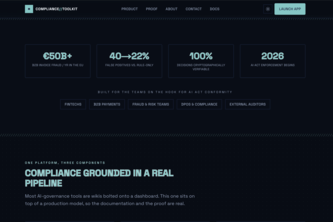
eu-comply is a self-reported service that claims to offer fraud detection AI with integrated EU AI Act compliance tooling. It integrates three components: (1) InvGuard for invoice scoring, (2) rify-AI for anchoring decisions onchain, and (3) an AI Act Compliance Toolkit that auto-generates audit reports from live decision data.
What changed
The project is presented as a hackathon submission with a deliberately minimal scope. It includes stand-ins for advanced features like blockchain anchoring and trained models, but emphasizes honesty in its design constraints and implementation.
Single most important open question
Is the described system capable of being scaled into a production-grade fraud detection and compliance platform that can be trusted by auditors?
What The Product Actually Is
The description states that eu-comply is one service with three components:
- InvGuard: Scores invoices against a versioned rule engine, returning outcome (approve / review / block), rules fired with weights, and plain-language explanation.
- rify-AI: Signs and anchors each decision so it can be verified later; supports both signing and verification of decisions.
- AI Act Compliance Toolkit: Auto-generates auditor-required artifacts such as model cards, bias reports, and combined audit reports directly from live pipeline data.
All components share a single decision record.
Evidence
- The author states that these are the three core parts of eu-comply.
- The system is described as sharing one decision record across all components.
- Each component has distinct functions but integrates through this shared decision log.
Inference That the system is built around a centralized decision log, which serves as both a functional and compliance layer.
Positioning & Claim Evolution
The tagline claims:
"We ship a solid fraud detection AI, autogenerate its entire EU AI Act paperwork straight from the live pipeline, and anchor every decision onchain so an auditor can prove nothing was tampered with."
Evidence
- The author states that the service provides fraud detection AI.
- It claims to auto-generate EU AI Act compliance documentation directly from decisions made in the pipeline.
- It asserts onchain anchoring of decisions for audit verification.
Inference The positioning is aimed at regulated environments where trust and auditability are critical, such as financial services or government procurement. The claim evolution suggests a move from generic fraud detection to a compliance-focused solution that leverages blockchain-like verification.
Target Customer & ICP
Not evidenced.
Evidence needed
- Who the intended users are (e.g., enterprises, regulators, auditors).
- Whether there is a defined persona or use case beyond the hackathon demo.
- Any indication of customer segments or verticals.
Business Model & Pricing Evidence
Not evidenced.
Evidence needed
- How the service would be monetized (e.g., SaaS, per decision, subscription).
- Pricing structure or tiers.
- Whether there are plans for commercialization beyond the hackathon.
Technical & Delivery Signals
The author describes a deliberately "boring" architecture with:
- Domain-first layering: business logic isolated from transport and persistence.
- Async SQLAlchemy 2.0 + Alembic, SQLite for local dev, Postgres in production.
- Production hardening features: API-key auth, rate limiting, structured logging, health probes, CI gate.
- Use of stand-ins for advanced features (e.g., Neo4j, IPFS, on-chain anchoring) behind interfaces that mirror real implementations.
Evidence
- The system is built with FastAPI and uses a modular architecture.
- It includes production-grade features like migrations, auth, logging, and containerization.
- Stand-ins are explicitly named and scoped as such.
Inference The project shows technical maturity for a proof-of-concept but lacks evidence of scalability or full implementation of advanced features like blockchain anchoring or trained models.
Traction & Maturity Signals
Not evidenced.
Evidence needed
- Any revenue, customer base, or adoption data.
- Evidence of product-market fit beyond the hackathon.
- Metrics on usage, retention, or growth.
Competitive Context
Not evidenced.
Evidence needed
- Who the competitors are in fraud detection or AI compliance.
- Whether there is a defined market or competitive landscape.
- Any mention of existing solutions or differentiation strategies.
Open Questions & Risks
- Unproven scalability: The system uses stand-ins for advanced features like blockchain anchoring and trained models, which may not scale to real-world requirements.
- Limited scope: The project is described as a hackathon submission with intentional scope cuts; no evidence of full implementation or production readiness.
- Trust-based positioning: The entire value proposition hinges on trustworthiness, but the system’s maturity and auditability are unverified beyond the demo.
- No commercialization plan: No indication of how this would transition from a hackathon idea to a viable product.
Questions the description leaves open
- What is the exact scope of the stand-ins used in the current version, and how do they map to future full implementations?
- How does the system handle edge cases or failures in the on-chain anchoring process?
- Are there any plans for integrating with real blockchain infrastructure or third-party auditors?
- What are the assumptions about the rule engine and AI model that would need to be validated in production?
- Is there a plan for monetization, and how does it align with the regulatory compliance focus?
Overall Assessment
Not evidenced.
Evidence needed
- A clear business case or traction data.
- Evidence of market demand or customer interest.
- A defined go-to-market strategy or roadmap beyond the hackathon.
The project is described as a hackathon submission with strong technical foundations but no evidence of commercial viability, traction, or scalability. It may be an interesting concept for further development, but there is insufficient basis to assess its readiness for investment or partnership at this stage.
User Stories BotA demo video on every pull request
Get a demo video on every new feature
GitHub App that watches your pull requests and records a narrated, captioned demo.
Save time on demo prep and make informed decisions faster with a video walkthrough of every new feature.
Source
Submitted to the OpenAI 2026 hackathon on Devpost. Project home on Devpost. Back to the full gallery on Devpost.
This competitive analysis was produced by top-founders.com (opens in a new tab)
Generated by a language model from this project's public Devpost page — its tagline, the author's own write-up and any built-with tags listed there — as captured in August 2026. Short quotations are the author's words. It is an opinion on the idea as a business, not on the people behind it, and it reflects the description as published then. If the project has moved on, request a correction below. The analysis is not independent research and contains no verified traction, revenue or customer data.
An independent guide by KFG International LLC — not affiliated with, endorsed by, or connected to Devpost or OpenAI.