

Archive position — measured, not model output
0 likes on Devpost
2,263 of the 7,850 archived projects have more likes, and 5,587 share exactly 0 — so this project's #3,973 place in the like-ranked listing is a tie-break inside that group, not a ranking.
Projects (log scale)
Likes on Devpost. ▲ marks this project's group.
Show the figures
| Likes | Projects | Share of archive |
|---|---|---|
| 0 | 5,587 | 71.2% |
| 1 | 1,758 | 22.4% |
| 2 | 284 | 3.6% |
| 3–4 | 132 | 1.7% |
| 5–9 | 75 | 1.0% |
| 10+ | 14 | 0.2% |
 User Stories BotA demo video on every pull request
Get a demo video on every new feature
GitHub App that watches your pull requests and records a narrated, captioned demo.
Save time on demo prep and make informed decisions faster with a video walkthrough of every new feature.
Executive Summary
What the company appears to be
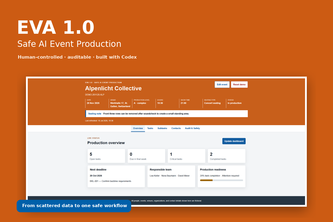
EVA 1.0 – Safe AI Event Production is a self-reported human-controlled workflow system for live event production, built as a browser-based prototype during OpenAI Build Week. It aims to organize scattered information (emails, contracts, tasks) into structured, auditable workspaces while maintaining human oversight at every critical step.
What changed
The project was initiated by Andreas Müller, a long-time event producer with decades of experience in live events and cultural organizations. He built a prototype using AI tools like Codex and GPT-5.6 to demonstrate how AI can support coordination without removing responsibility from people. The prototype focuses on a single-event workspace but is part of a broader system architecture that includes multi-event indexing and management.
Single most important open question
Is there evidence of real-world use or testing beyond the prototype, and does the author have a plan to scale beyond a single-person build?
What The Product Actually Is
The description states that EVA is a human-controlled and auditable production system for live events, designed to connect source information (emails, contracts, technical riders) with operational work and management oversight. It includes:
- A single-event workspace with structured master files, contacts, deadlines, tasks, subtasks, and dashboards.
- A multi-event index that provides access to active event workspaces and their statuses.
- A management cockpit, which is described as future functionality.
The prototype demonstrates:
- A production overview;
- Task filtering;
- Confirmed completion/reopening of tasks;
- A backline subtask interface;
- Controlled edits using PLAN → APPROVE → APPLY;
- Before-and-after previews;
- An audit trail;
- Safe local reset using fictional data.
It runs completely in a browser without installation or server dependencies, storing only demo changes in localStorage.
Not evidenced No evidence of actual deployment, usage by others, or integration with real event workflows beyond the prototype. No mention of revenue, customers, or adoption metrics.
Positioning & Claim Evolution
The author positions EVA as a safe and auditable human-AI collaboration tool, not an autonomous system. Key claims include:
- AI helps organize complexity without removing responsibility.
- The system ensures that “important knowledge should not remain hidden across emails, contracts, folders and spreadsheets.”
- It emphasizes human control over automation: no automatic deletion, silent overwriting, or unreviewed changes.
The name EVA is derived from German for "event pre-production automation" and symbolically references Eve and the Tree of Knowledge — suggesting that visibility and understanding are key, not just access.
Not evidenced There is no evidence of market positioning beyond this self-description. No competitor comparison, pricing strategy, or target segment validation is provided.
Target Customer & ICP
The author describes a target audience of small cultural organizations, including venues, festivals, and event teams that manage complex productions but do not want to rely on fully autonomous systems.
He notes:
- The goal is to support “small teams” who can trust the system during busy production days.
- It is intended as a practical production copilot for these types of users.
However, there is no explicit segmentation or ICP definition beyond this general description. No customer personas, use cases, or buyer profiles are detailed.
Not evidenced No evidence of actual customers, user interviews, or feedback from target organizations. No indication of whether the author has tested with real users or validated demand.
Business Model & Pricing Evidence
The description does not mention any business model, pricing structure, or monetization strategy.
It states:
- The prototype is a browser-based demo.
- It stores data locally and makes no AI calls at runtime.
- No API keys, databases, or server infrastructure are involved in the current version.
Not evidenced No evidence of revenue streams, subscription models, licensing fees, or commercialization plans. No indication of how EVA would be sold or used commercially beyond its prototype form.
Technical & Delivery Signals
The prototype was built using:
- AI tools: Codex and GPT-5.6
- Technologies: HTML, CSS, JavaScript, JSON, CSV, Excel, PowerShell, Windows, Microsoft products
- Frameworks: Human-in-the-loop design principles
- Architecture: Browser-based, file:// compatible, no external dependencies
Key technical features include:
- PLAN → APPROVE → APPLY interaction model
- Audit trail for every action
- Before-and-after previews
- Safe local reset using fictional data
- Controlled edits with read-only analysis before productive changes
The system avoids:
- Silent overwrites or deletions
- Unreviewed AI-driven actions
- Parallel sources of truth
Not evidenced No evidence of scalability, performance testing, security audits, or production-ready infrastructure. No mention of how the prototype would evolve into a full product.
Traction & Maturity Signals
The author reports:
- A single-person build team (Andreas Müller)
- The project was submitted to the OpenAI 2026 hackathon
- A public browser prototype demonstrating core functionality
- Use of AI tools like Codex and GPT-5.6 for development
- Independent review of the main Codex thread, which reported no findings
However:
- There is no evidence of real-world usage, customer feedback, or adoption.
- No mention of internal testing, user trials, or iterative improvements beyond the prototype.
- No indication of traction metrics such as active users, engagement, or retention.
Not evidenced No data on product maturity, iteration cycles, or market validation. No evidence of a roadmap or development timeline beyond stated next steps.
Competitive Context
The description does not provide any competitive analysis, including:
- Mention of existing tools in event production
- Comparison with similar platforms (e.g., Asana, Notion, Airtable, etc.)
- Clarification of how EVA differs from current solutions
It only states that the author is tired of solving “the same avoidable coordination problems again and again.”
Not evidenced No evidence of competitive landscape, market size, or differentiation strategy. No indication of whether similar tools already exist or are being used in the field.
Open Questions & Risks
Several risks and open questions emerge from the self-reported description:
- Single-person development: The entire project was built by one person (Andreas Müller), raising questions about scalability, support, and long-term maintenance.
- Prototype-only status: The system is currently only demonstrated as a prototype with no real-world deployment or usage.
- No commercialization plan: No evidence of how EVA will transition from prototype to product or generate revenue.
- Limited scope: The prototype focuses on a single-event workspace; the broader system remains conceptual.
- AI dependency without clarity: While AI is used in development, it's unclear whether AI will be part of the final product or just a tool for building it.
- No validation with users: No evidence of user testing, feedback loops, or real-world trials.
Not evidenced There is no evidence of risk mitigation strategies, team expansion plans, or market validation beyond the author’s own experience and prototype.
Questions the description leaves open
- What specific event production challenges did you observe that led to building EVA?
- Have you tested EVA with any real teams or organizations? If so, what were their reactions?
- How do you plan to transition from a browser-based prototype to a scalable product?
- What is your vision for integrating AI into the system beyond its current use in development?
- Are there any known limitations of the current prototype that would prevent adoption by small teams?
- Do you have a plan for data privacy, security, and compliance with event-related information handling?
- How do you intend to monetize EVA? What pricing model are you considering?
- What is your timeline for developing the multi-event index and management cockpit?
Overall Assessment
Not evidenced.
There is no evidence of:
- Revenue or financial performance
- Customer traction or adoption
- Market validation or competitive positioning
- Team expansion or funding history
- Product roadmap or commercial strategy
The project remains a self-reported prototype, built by one individual using AI tools, without any indication of real-world use or scalability. It is unclear whether EVA will evolve into a viable product or remain a proof-of-concept.
This is a highly speculative early-stage idea with no demonstrated traction, revenue, or customer base. Any investment or partnership would be based on potential rather than evidence.
User Stories BotA demo video on every pull request
Get a demo video on every new feature
GitHub App that watches your pull requests and records a narrated, captioned demo.
Save time on demo prep and make informed decisions faster with a video walkthrough of every new feature.
Source
Submitted to the OpenAI 2026 hackathon on Devpost. Project home on Devpost. Back to the full gallery on Devpost.
This competitive analysis was produced by top-founders.com (opens in a new tab)
Generated by a language model from this project's public Devpost page — its tagline, the author's own write-up and any built-with tags listed there — as captured in August 2026. Short quotations are the author's words. It is an opinion on the idea as a business, not on the people behind it, and it reflects the description as published then. If the project has moved on, request a correction below. The analysis is not independent research and contains no verified traction, revenue or customer data.
An independent guide by KFG International LLC — not affiliated with, endorsed by, or connected to Devpost or OpenAI.