

Archive position — measured, not model output
0 likes on Devpost
2,263 of the 7,850 archived projects have more likes, and 5,587 share exactly 0 — so this project's #5,936 place in the like-ranked listing is a tie-break inside that group, not a ranking.
Projects (log scale)
Likes on Devpost. ▲ marks this project's group.
Show the figures
| Likes | Projects | Share of archive |
|---|---|---|
| 0 | 5,587 | 71.2% |
| 1 | 1,758 | 22.4% |
| 2 | 284 | 3.6% |
| 3–4 | 132 | 1.7% |
| 5–9 | 75 | 1.0% |
| 10+ | 14 | 0.2% |
 User Stories BotA demo video on every pull request
Get a demo video on every new feature
GitHub App that watches your pull requests and records a narrated, captioned demo.
Save time on demo prep and make informed decisions faster with a video walkthrough of every new feature.
Executive Summary
Company: Pigeon Drop
Self-reported basis: The entire analysis is based on a single author-supplied description of a project submitted to the OpenAI 2026 hackathon. No independent verification, revenue, customer data or traction evidence is available.
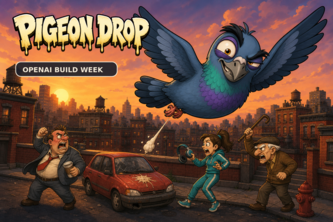
What it appears to be: A browser-based game where players control a pigeon that paints art on streets, cars and people, built in one week using AI tools like Codex and GPT-5.6.
What changed: The author states they had an idea 10 years ago but only built it recently due to the availability of AI tools like Codex.
Most important open question: Is there any evidence of user engagement, monetization or product-market fit beyond the one-week build and self-reported fun?
What The Product Actually Is
The description states that Pigeon Drop is a browser-based game where players control a pigeon painting art on streets, cars, and people. It can be registered as a Progressive Web App, and is optimized for both PC and mobile.
- Engine: Phaser 3
- Language: TypeScript
- Graphics: GLSL Shaders
- AI Tools Used: Codex, ChatGPT 5.6 (Sol, Terra, Luna), GPT Image 2
- Technical Execution: Built in one week by a single developer using AI for architecture, coding, asset generation, and deployment.
Inference: The game is a creative, experimental project built with AI tools, not a commercial product or platform. It appears to be a prototype or proof-of-concept.
Positioning & Claim Evolution
The author states that the idea originated 10 years ago but was only realized due to advancements in AI tools like Codex and GPT-5.6.
- Original Inspiration: Receiving a "gift" from a pigeon led to an idea for a game.
- Evolution of Idea: The idea stayed just an idea until now, when AI made it possible to build quickly.
- Positioning Claim: The game is about creativity and humor — “being creative with what you eat allows you to modify what you produce and irritate everybody even more!”
Inference: This is a self-reported narrative of personal fulfillment rather than a commercial positioning. It does not indicate any market or user traction.
Target Customer & ICP
The description does not state the target customer or ideal customer profile (ICP).
- No explicit customer segment mentioned.
- The game is described as a personal project, built by one developer.
- No indication of audience, demographics, or use cases beyond “fun.”
Not evidenced: There is no evidence of who uses this product or whether it has a defined market.
Business Model & Pricing Evidence
The description does not mention any business model or pricing strategy.
- The game is described as ready to play, available via ChatGPT Sites and a custom domain.
- No mention of monetization, subscriptions, in-app purchases, or paid features.
- No evidence of revenue streams or pricing models.
Not evidenced: No indication of how the product generates value or money.
Technical & Delivery Signals
The project was built using:
- Engine: Phaser 3
- Language: TypeScript
- Graphics: GLSL Shaders
- AI Tools: Codex, GPT-5.6 (Sol, Terra, Luna), GPT Image 2
- Build Timeline: One week
- Team Size: 1 developer (Andrey Dodonov)
- Deployment: Via ChatGPT Sites and custom domain
- Optimization: For both PC and mobile
Inference: The use of AI tools like Codex and GPT-5.6 suggests a rapid development process, but does not indicate scalability or long-term technical strategy.
Traction & Maturity Signals
The description states:
- The game was built in one week.
- It is ready to play.
- The author claims to have shipped hundreds of sprites, tens of sound effects, and thousands of lines of code.
- The project was submitted to a hackathon (OpenAI 2026).
Not evidenced: No evidence of user engagement, downloads, retention, or adoption. No data on usage, audience, or product-market fit.
Competitive Context
The description does not mention any competitors or market context.
- No reference to similar games or platforms.
- No indication of how this project fits into existing markets or ecosystems.
Not evidenced: No competitive analysis or positioning relative to other products.
Open Questions & Risks
- No traction or user data: The product is described as a one-week build with no evidence of adoption or engagement.
- Unproven monetization model: No indication of how the project will generate revenue.
- Single-person development: The entire project was built by one developer, raising questions about scalability and long-term maintenance.
- AI dependency: Heavy reliance on AI tools like Codex and GPT-5.6 may not be sustainable or replicable in a commercial context.
- Lack of clarity on audience: No defined customer or use case beyond personal fulfillment.
Questions the description leaves open
- What is the intended user base for Pigeon Drop?
- Are there any plans to monetize the game, and how?
- How do you plan to scale beyond a single developer?
- What are the limitations of using AI tools like Codex for development?
- Have you tested the game with users or gathered feedback?
- Is there a long-term roadmap beyond “more fun”?
Overall Assessment
Not evidenced: There is no evidence of commercial viability, traction, or market demand.
- The project is described as a personal prototype, built in one week.
- No revenue, customers, or product-market fit are evident.
- It appears to be an experimental or exploratory effort, not a scalable business.
Inference: This is not a viable investment or partnership opportunity at this stage. It lacks the commercial signals necessary for due-diligence evaluation.
User Stories BotA demo video on every pull request
Get a demo video on every new feature
GitHub App that watches your pull requests and records a narrated, captioned demo.
Save time on demo prep and make informed decisions faster with a video walkthrough of every new feature.
Source
Submitted to the OpenAI 2026 hackathon on Devpost. Project home on Devpost. Back to the full gallery on Devpost.
This competitive analysis was produced by top-founders.com (opens in a new tab)
Generated by a language model from this project's public Devpost page — its tagline, the author's own write-up and any built-with tags listed there — as captured in August 2026. Short quotations are the author's words. It is an opinion on the idea as a business, not on the people behind it, and it reflects the description as published then. If the project has moved on, request a correction below. The analysis is not independent research and contains no verified traction, revenue or customer data.
An independent guide by KFG International LLC — not affiliated with, endorsed by, or connected to Devpost or OpenAI.