

Archive position — measured, not model output
1 like on Devpost
505 of the 7,850 archived projects have more likes, and 1,758 share exactly 1 — so this project's #2,012 place in the like-ranked listing is a tie-break inside that group, not a ranking.
Projects (log scale)
Likes on Devpost. ▲ marks this project's group.
Show the figures
| Likes | Projects | Share of archive |
|---|---|---|
| 0 | 5,587 | 71.2% |
| 1 | 1,758 | 22.4% |
| 2 | 284 | 3.6% |
| 3–4 | 132 | 1.7% |
| 5–9 | 75 | 1.0% |
| 10+ | 14 | 0.2% |
 User Stories BotA demo video on every pull request
Get a demo video on every new feature
GitHub App that watches your pull requests and records a narrated, captioned demo.
Save time on demo prep and make informed decisions faster with a video walkthrough of every new feature.
Executive Summary
What the company appears to be
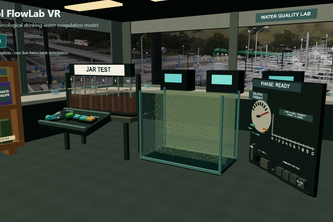
Sunol Flowlab VR is a browser-based WebXR application that simulates water treatment processes, specifically coagulation jar testing, using virtual reality. It is described as a tool for education and training in drinking water treatment, with an emphasis on visualizing floc formation and settling dynamics.
What changed
The project was developed as part of the OpenAI 2026 hackathon. It represents an experimental prototype built by one individual (boxwrench Wilkinson) using technologies like React, Three.js, and WebXR. The author states that it began as a personal exploration into what Codex could do, particularly in creating VR simulations for educational purposes.
The single most important open question
Is there evidence of traction, adoption or commercial intent beyond the hackathon submission? The description provides no indication of users, revenue, or product-market fit beyond its self-reported development and demonstration context.
What The Product Actually Is
- The description states that Sunol Flowlab VR is a browser-based WebXR experience.
- It simulates water treatment processes, specifically coagulation jar testing.
- The simulation allows users to set coagulant doses, observe results, and record data.
- It includes a reference library for learning about the process.
- Built with: React, TypeScript, Three.js, React Three Fiber, Vite, and OpenAI Codex.
- The author notes it uses a deterministic simulation model with seeded randomness.
- It supports both desktop and VR use.
Note
No evidence of actual deployment, usage metrics, or customer feedback is provided. This appears to be an experimental prototype submitted for a hackathon.
Positioning & Claim Evolution
- The project positions itself as an educational tool that makes water treatment visible through immersive simulation.
- It claims to offer a hybrid setup combining a familiar jar-test bench with a larger observation tank to enhance clarity of floc behavior.
- The author emphasizes simplicity and focus: avoiding full plant simulators or general-purpose engines in favor of one clear idea.
- There is no indication that the product has evolved from an experimental prototype into a commercial offering or platform.
Inference The positioning reflects a niche educational application, likely aimed at students or operators in water treatment. However, there's no evidence of market validation or strategic positioning beyond the hackathon submission.
Target Customer & ICP
- The description implies a target audience of individuals learning about water treatment — such as students or field operators.
- It is described as a tool for education and training within drinking water treatment.
- No specific customer segments, personas, or use cases are detailed beyond general educational needs.
- There is no evidence of segmentation or targeting of any particular industry vertical or role type.
Not evidenced No clear ICP (Ideal Customer Profile) defined. The project does not appear to have moved past the prototype stage.
Business Model & Pricing Evidence
- No business model, pricing strategy, or monetization approach is described.
- The product is presented as a hackathon submission with no indication of commercial intent or revenue streams.
- There is no mention of licensing, subscriptions, or partnerships.
Not evidenced No evidence of any business model or pricing structure. This is an unverified prototype.
Technical & Delivery Signals
- Built using React, TypeScript, Three.js, Vite, and WebXR.
- Uses a fixed timestep, typed arrays, instanced rendering, and seeded randomness for deterministic behavior.
- Designed to be performant in VR environments with constraints on transparency and lighting effects.
- The simulation is separated from the renderer and XR controls.
- OpenAI Codex was used for planning, reviewing code, and building tests.
Inference Technical architecture suggests a focus on performance and reproducibility. However, no evidence of production deployment or scalability beyond prototype level.
Traction & Maturity Signals
- Submitted to the OpenAI 2026 hackathon.
- Developed by one person (boxwrench Wilkinson).
- No mention of users, feedback loops, or adoption metrics.
- The author notes that the next step is to test with users and improve based on their understanding.
Not evidenced No traction data, user base, or product maturity indicators beyond a hackathon prototype.
Competitive Context
- No competitive analysis or market positioning is provided.
- The description does not reference existing tools in water treatment education or VR training.
- There is no indication of competitors or substitutes in the space.
Not evidenced No evidence of competitive landscape or differentiation strategy.
Open Questions & Risks
- The project is a single-person hackathon submission with no known traction or commercialization.
- Lack of any revenue, customer data, or product-market fit signals.
- No indication of scalability, performance testing, or long-term viability.
- The author’s own write-up indicates the focus was on limiting scope and experimentation — not building a product for market.
Inference High risk due to lack of commercial traction, unclear path to monetization, and absence of any evidence of real-world usage or impact.
Questions the description leaves open
- What is your intended use case beyond the hackathon?
- Have you tested this with actual users in educational or training settings?
- Are there plans to expand beyond coagulation into other water treatment processes?
- Do you have any interest in partnering with institutions or organizations involved in water treatment education?
- How do you plan to validate the accuracy of the simulation for real-world applications?
Overall Assessment
- Not evidenced No evidence of commercial traction, revenue, or customer validation.
- The project is described as a hackathon prototype with no indication of product-market fit or scalability.
- There is no evidence of a business model, pricing, or strategic direction beyond the initial concept.
Assessment This is an experimental educational tool with no demonstrated path to commercialization or investment readiness. It should be considered a proof-of-concept at best, not a viable target for investment or partnership.
User Stories BotA demo video on every pull request
Get a demo video on every new feature
GitHub App that watches your pull requests and records a narrated, captioned demo.
Save time on demo prep and make informed decisions faster with a video walkthrough of every new feature.
Source
Submitted to the OpenAI 2026 hackathon on Devpost. Project home on Devpost. Back to the full gallery on Devpost.
This competitive analysis was produced by top-founders.com (opens in a new tab)
Generated by a language model from this project's public Devpost page — its tagline, the author's own write-up and any built-with tags listed there — as captured in August 2026. Short quotations are the author's words. It is an opinion on the idea as a business, not on the people behind it, and it reflects the description as published then. If the project has moved on, request a correction below. The analysis is not independent research and contains no verified traction, revenue or customer data.
An independent guide by KFG International LLC — not affiliated with, endorsed by, or connected to Devpost or OpenAI.