

Archive position — measured, not model output
1 like on Devpost
505 of the 7,850 archived projects have more likes, and 1,758 share exactly 1 — so this project's #2,014 place in the like-ranked listing is a tie-break inside that group, not a ranking.
Projects (log scale)
Likes on Devpost. ▲ marks this project's group.
Show the figures
| Likes | Projects | Share of archive |
|---|---|---|
| 0 | 5,587 | 71.2% |
| 1 | 1,758 | 22.4% |
| 2 | 284 | 3.6% |
| 3–4 | 132 | 1.7% |
| 5–9 | 75 | 1.0% |
| 10+ | 14 | 0.2% |
 User Stories BotA demo video on every pull request
Get a demo video on every new feature
GitHub App that watches your pull requests and records a narrated, captioned demo.
Save time on demo prep and make informed decisions faster with a video walkthrough of every new feature.
Executive Summary
What the company appears to be
A self-funded, single-person project (Jarrod Mexted) building a local event discovery platform for Hamilton, Ontario, with an ambition to build a reusable engine for other cities. The platform aggregates event data from scattered sources using automated ingestion and presents it through a public-facing interface and tools for organisers.
What changed
The author reports significant growth in organic traffic and user engagement over a 30-day period (e.g., visits increased 144%, active visitors 161%), without paid acquisition. The platform also includes an automated ingestion pipeline, organiser tools, analytics, and a proof-of-concept for municipal use.
Single most important open question
Is the platform's reusable architecture actually scalable or adaptable to other cities, or is it tightly coupled to Hamilton’s specific data sources, context, and local rules?
What The Product Actually Is
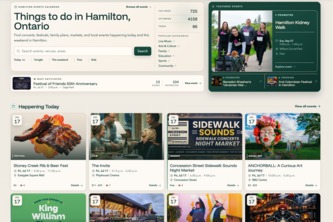
The description states that HamiltonEvents.ca is a live events-discovery platform built specifically for Hamilton, Ontario. It aggregates event data from multiple sources using an automated ingestion system and presents it through search, calendar, map, category, venue, and neighbourhood views.
It includes:
- A public-facing interface for users to discover events
- Tools for organisers to submit, manage, and promote listings
- An automated ingestion pipeline that fetches, extracts, normalises, deduplicates, validates, and publishes event data
- First-party analytics and partner-performance reporting
The author also describes it as an event data engine aimed at both event organisers and municipalities, while making things easier for locals and visitors.
The description states: “HamiltonEvents.ca is a live events-discovery platform built specifically for Hamilton, Ontario.”
The description states: “Behind the public experience is an automated ingestion system that monitors local sources…”
Positioning & Claim Evolution
The author positions HamiltonEvents.ca as:
- A connective layer between scattered event sources and users
- A solution to the “discovery problem” in cities like Hamilton
- A reusable back-end engine for other cities (with Hamilton as the first deployment)
It is described not just as a platform but as an event data engine, suggesting a focus on infrastructure and data quality over user-facing features.
The description states: “I created HamiltonEvents.ca to become the connective layer between these groups.”
The description states: “This isn’t just another event platform - this is an event data engine geared towards event organisers and municipalities…”
Target Customer & ICP
The platform targets:
- Local residents and visitors looking for events in Hamilton
- Event organisers, who can submit, manage, and promote listings
- Municipalities or tourism boards, as a proof-of-concept for intelligence use
There is no evidence of segmentation beyond these groups. The author does not describe any specific personas or customer types beyond general categories.
The description states: “The platform includes recurring schedules, prices, ticket links, accessibility information, calendar downloads, and practical venue details.”
The description states: “Organisers can submit events, manage listings through a partner workspace…”
Business Model & Pricing Evidence
There is no evidence of pricing or monetisation in the description. The author does not describe any revenue streams, subscriptions, or paid features.
The description states: “No revenue, customer or traction data is available beyond what they state.”
The description states: “Organisers can submit events, manage listings through a partner workspace…”
Technical & Delivery Signals
The platform is built with:
- Next.js, React, TypeScript, Tailwind CSS
- Prisma, Neon Postgres, Netlify, Leaflet, OpenStreetMap
- RRULE for recurrence handling
- Stripe, Postmark, Codex (as an engineering partner)
- A NAS-hosted ingestion worker with a Postgres job queue
The ingestion pipeline follows a structured workflow:
Fetch → Extract → Normalise → Deduplicate → Validate → Publish
Codex is used across the system for feature development, testing, diagnostics, and quality checks.
The description states: “I built HamiltonEvents.ca with OpenAI Codex as an engineering and operational partner.”
The description states: “The ingestion pipeline follows a structured flow: Fetch → Extract → Normalise → Deduplicate → Validate → Publish”
Traction & Maturity Signals
The platform reports:
- 1,239 distinct upcoming events
- 4,139 upcoming event occurrences
- 295 venues
- 85 active automated sources
- 134 organiser submissions
It also reports:
- 20,884 meaningful public visits (144% increase over previous 30 days)
- 17,636 active anonymous visitors (161% increase)
- 31,832 page views (127% increase)
- 13,394 recorded high-intent actions
- 84.7% of visits from search engines
- 30% of visitors return within a month
Growth occurred without paid audience acquisition.
The description states: “As of July 17, 2026, the live platform contained: 1,239 distinct upcoming events…”
The description states: “During the latest complete 30-day period, HamiltonEvents.ca recorded: 20,884 meaningful public visits…”
Competitive Context
There is no mention of competitors or market positioning beyond the general idea that cities have a discovery problem. No evidence of direct competition or market analysis.
The description states: “A lot of cities have this issue.”
The description states: “No revenue, customer or traction data is available beyond what they state.”
Open Questions & Risks
- Single-person operation: The platform is built and maintained by one person (Jarrod Mexted), which raises questions about scalability, maintenance, and long-term viability.
- Unproven reusability: While the author claims the engine is reusable, there is no evidence of deployment in other cities or demonstration of portability.
- Dependency on Codex: Heavy reliance on AI tools for engineering tasks may not be sustainable or replicable outside of the current developer’s environment.
- No monetisation strategy: No indication of how the platform will generate revenue or sustain itself beyond organic growth.
The description states: “The platform is built and maintained by one person (Jarrod Mexted).”
The description states: “I am especially excited about the benchmarking this could unlock.”
The description states: “No revenue, customer or traction data is available beyond what they state.”
Questions the description leaves open
- What are the specific technical challenges in adapting the platform for other cities?
- How does the ingestion pipeline handle differences in source formats and data quality across cities?
- Is there any evidence of how the platform’s reuse would work in practice, or is it still theoretical?
- What is the plan for scaling beyond Hamilton without additional team or funding?
- How are you planning to monetise this platform, if at all?
- What are the key metrics that indicate success beyond just traffic and engagement?
Overall Assessment
Not evidenced.
The description does not contain sufficient information to assess whether this project is a viable investment or partnership opportunity. While it shows early traction and technical execution, there is no evidence of:
- Revenue
- Customers
- Scalability beyond Hamilton
- Monetisation strategy
- Market validation outside of the author’s own claims
The description states: “No revenue, customer or traction data is available beyond what they state.”
The description states: “This project was submitted to the OpenAI 2026 hackathon on Devpost.”
User Stories BotA demo video on every pull request
Get a demo video on every new feature
GitHub App that watches your pull requests and records a narrated, captioned demo.
Save time on demo prep and make informed decisions faster with a video walkthrough of every new feature.
Source
Submitted to the OpenAI 2026 hackathon on Devpost. Project home on Devpost. Back to the full gallery on Devpost.
This competitive analysis was produced by top-founders.com (opens in a new tab)
Generated by a language model from this project's public Devpost page — its tagline, the author's own write-up and any built-with tags listed there — as captured in August 2026. Short quotations are the author's words. It is an opinion on the idea as a business, not on the people behind it, and it reflects the description as published then. If the project has moved on, request a correction below. The analysis is not independent research and contains no verified traction, revenue or customer data.
An independent guide by KFG International LLC — not affiliated with, endorsed by, or connected to Devpost or OpenAI.