

Archive position — measured, not model output
1 like on Devpost
505 of the 7,850 archived projects have more likes, and 1,758 share exactly 1 — so this project's #2,016 place in the like-ranked listing is a tie-break inside that group, not a ranking.
Projects (log scale)
Likes on Devpost. ▲ marks this project's group.
Show the figures
| Likes | Projects | Share of archive |
|---|---|---|
| 0 | 5,587 | 71.2% |
| 1 | 1,758 | 22.4% |
| 2 | 284 | 3.6% |
| 3–4 | 132 | 1.7% |
| 5–9 | 75 | 1.0% |
| 10+ | 14 | 0.2% |
 User Stories BotA demo video on every pull request
Get a demo video on every new feature
GitHub App that watches your pull requests and records a narrated, captioned demo.
Save time on demo prep and make informed decisions faster with a video walkthrough of every new feature.
Executive Summary
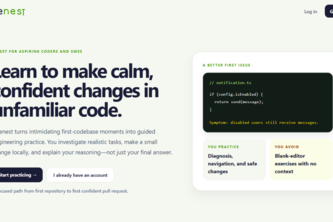
What the company appears to be: Swenest is a self-reported gamified learning platform for aspiring or junior software engineers and computer science students. It offers curated real-world tasks from open-source repositories, with a focus on helping users gain experience in navigating codebases and solving problems using hands-on practice.
What changed: The project was built as part of the OpenAI 2026 hackathon. It is described as an MVP (minimum viable product) that leverages AI tools like Codex for development and task curation, with no evidence of prior traction or revenue.
Single most important open question: Is there any evidence of user engagement, adoption, or usage beyond the author’s own account?
What The Product Actually Is
The description states that Swenest is a gamified learning platform for junior software engineers and students. It provides tasks based on real-world merged commits from GitHub repositories.
- Users select their preferred coding language and domain/stack.
- Tasks are presented with difficulty levels.
- Users work locally by cloning a repository at a given base commit hash.
- Hints are available during the process.
- Submissions include findings, location of the problem, proposed solution, and concept checks.
- A judge (LLM) grades submissions against ground truth information.
- Feedback and the correct solution are shown after submission.
The platform uses Codex for development and task generation, and integrates with tools like Supabase for backend and authentication, Vercel for frontend deployment, and FastAPI for backend services.
Claim: Swenest is a gamified learning platform that helps junior developers gain experience through real-world codebase tasks.
Evidence: Author's own write-up.
Inference: The use of LLMs and AI tools suggests automation in task creation and grading, but no evidence of actual user interaction or system performance.
Positioning & Claim Evolution
The author positions Swenest as a solution to the challenge faced by aspiring developers who struggle to find suitable open-source projects for practice. It aims to bridge the gap between theoretical knowledge and real-world experience in code navigation and problem-solving.
- The platform is described as "a nest for aspiring SWEs", implying it's a safe, guided space for learning.
- It emphasizes hands-on experience and confidence building in working with real codebases.
- The use of gamification (e.g., earning experience points) is mentioned to encourage engagement.
Claim: Swenest helps junior developers gain confidence by offering curated tasks from real open-source projects.
Evidence: Author's own write-up.
Inference: The positioning implies a focus on skill-building rather than commercial utility, but no evidence of market demand or competitive differentiation.
Target Customer & ICP
The target customer is described as:
- Aspiring software engineers
- Junior developers
- Computer science students
They are positioned as users who need to build experience in real-world codebases and want a structured way to do so.
Claim: Swenest targets junior developers and CS students looking for practical experience.
Evidence: Author's own write-up.
Inference: No evidence of segmentation or persona development beyond general categories. No data on actual users or their behavior.
Business Model & Pricing Evidence
There is no mention of a business model, pricing strategy, monetization plan, or revenue streams in the description.
Claim: No information provided.
Evidence: Not evidenced.
Inference: The project appears to be an MVP with no indication of how it will generate value or income.
Technical & Delivery Signals
- Built using:
- Backend: Python, FastAPI
- Frontend: React + TypeScript, Vite, Tailwind
- Database + Auth: Supabase (Postgres)
- LLMs: Google/Gemma-4-26b-a4b-it via OpenRouter (temporary; may switch to OpenAI later)
- Deployment: Vercel (frontend), Render (backend)
- Uses Codex for prototyping, testing, and automation.
- Task generation involves agents and scripts using Codex.
- Diff parsing uses unidiff (Python).
- Browser tool used for automation testing.
Claim: The platform is built with modern tech stack and leverages AI for development and task creation.
Evidence: Author's own write-up.
Inference: No evidence of production stability, scalability, or performance metrics. The reliance on Codex suggests a prototype-level approach.
Traction & Maturity Signals
There is no evidence of traction, user base, or adoption beyond the author’s own account. The project is described as an MVP built during a hackathon.
Claim: No traction or maturity data.
Evidence: Not evidenced.
Inference: The absence of any mention of users, usage statistics, or product iteration indicates early-stage development and lack of real-world validation.
Competitive Context
No competitive analysis is provided in the description. There is no mention of existing platforms or tools that offer similar learning experiences for junior developers or codebase navigation.
Claim: No competitive context.
Evidence: Not evidenced.
Inference: Without knowing competitors, it's unclear whether Swenest fills a gap or duplicates an existing offering.
Open Questions & Risks
- No user data or traction: The entire description is self-reported and lacks any evidence of real-world usage or impact.
- Prototype-level development: Reliance on AI tools like Codex for building the MVP suggests limited production-readiness.
- Unverified claims: All statements are from the author, with no independent verification.
- Unclear monetization path: No indication of how the platform will generate revenue or sustain itself.
- AI dependency: Heavy reliance on LLMs and AI agents raises concerns about consistency, scalability, and control.
Claim: Risks include lack of traction, prototype nature, unverified claims, unclear business model, and AI dependency.
Evidence: Self-reported description only.
Inference: These are inferred risks from the limited evidence provided.
Questions the description leaves open
- What is your definition of success for Swenest, and how do you plan to measure it?
- Have you tested the platform with actual users or students? If so, what feedback did you receive?
- How do you intend to scale task curation beyond manual seeding via Codex?
- What are the long-term plans for monetization or sustainability of the platform?
- Can you explain how the LLM judge evaluates submissions and how accurate it is in practice?
Claim: These questions aim to probe the lack of traction, scalability, and business model.
Evidence: Not evidenced.
Inference: Based on the absence of real-world data or product metrics.
Overall Assessment
There is no evidence of revenue, customers, or product-market fit. The project is described as a hackathon MVP built using AI tools and lacks any indication of traction or commercial viability.
Claim: No investment or partnership potential based on the available information.
Evidence: Not evidenced.
Inference: The lack of real-world validation and business model makes it difficult to assess value for investment or partnership.
User Stories BotA demo video on every pull request
Get a demo video on every new feature
GitHub App that watches your pull requests and records a narrated, captioned demo.
Save time on demo prep and make informed decisions faster with a video walkthrough of every new feature.
Source
Submitted to the OpenAI 2026 hackathon on Devpost. Project home on Devpost. Back to the full gallery on Devpost.
This competitive analysis was produced by top-founders.com (opens in a new tab)
Generated by a language model from this project's public Devpost page — its tagline, the author's own write-up and any built-with tags listed there — as captured in August 2026. Short quotations are the author's words. It is an opinion on the idea as a business, not on the people behind it, and it reflects the description as published then. If the project has moved on, request a correction below. The analysis is not independent research and contains no verified traction, revenue or customer data.
An independent guide by KFG International LLC — not affiliated with, endorsed by, or connected to Devpost or OpenAI.