

Archive position — measured, not model output
1 like on Devpost
505 of the 7,850 archived projects have more likes, and 1,758 share exactly 1 — so this project's #2,017 place in the like-ranked listing is a tie-break inside that group, not a ranking.
Projects (log scale)
Likes on Devpost. ▲ marks this project's group.
Show the figures
| Likes | Projects | Share of archive |
|---|---|---|
| 0 | 5,587 | 71.2% |
| 1 | 1,758 | 22.4% |
| 2 | 284 | 3.6% |
| 3–4 | 132 | 1.7% |
| 5–9 | 75 | 1.0% |
| 10+ | 14 | 0.2% |
 User Stories BotA demo video on every pull request
Get a demo video on every new feature
GitHub App that watches your pull requests and records a narrated, captioned demo.
Save time on demo prep and make informed decisions faster with a video walkthrough of every new feature.
Executive Summary
What the company appears to be
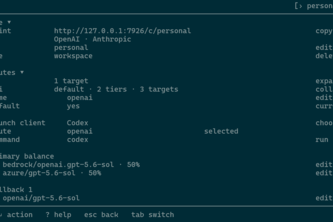
Swobu is a self-reported local AI gateway that aims to abstract provider differences for AI clients by offering one endpoint for cloud and local models. It routes requests across providers, balances traffic, translates API protocols, and handles capabilities like reasoning, tools, images, and web search.
What changed
The author reports rebuilding the system during a hackathon using LLM-assisted development, replacing an earlier prototype with a more structured implementation that supports routing, balancing, failover, and capability-aware target selection.
Single most important open question
Does Swobu have any real-world usage or adoption beyond the author's own development work?
What The Product Actually Is
The description states that Swobu is "a local AI exchange for terminal workflows." It gives AI clients one local endpoint for cloud and local models, routing requests across providers, regions, and models. It translates between supported API protocols, handles capabilities such as reasoning, tools, images, and web search, and allows the same client to move between OpenAI, Azure, Bedrock, Ollama, and other providers without changing its endpoint.
Evidence The author's own write-up describes Swobu's functionality in detail, including routing, balancing, failover, protocol translation, and capability handling. It also mentions that the system supports terminal workflows.
Inference Based on the description, Swobu appears to be a middleware or API gateway designed to simplify AI client interactions with multiple providers by abstracting away provider-specific differences.
Positioning & Claim Evolution
The author states that Swobu was built because switching between AI providers (OpenAI, Azure, Bedrock, Ollama) became increasingly annoying due to differences in authentication, endpoints, protocols, tool formats, reasoning controls, streaming, web search, model naming, and error behavior.
Claim
The client should not care where the model runs.
Evidence The author explicitly states this intent as the motivation behind Swobu's creation. They describe how they were frustrated with provider switching and wanted a solution that would allow clients to remain connected to the same endpoint while Swobu decides where requests run.
Inference This suggests Swobu positions itself as an abstraction layer or middleware for AI workflows, aiming to reduce complexity for developers working across multiple AI platforms.
Target Customer & ICP
The description states that Swobu is intended for "AI clients" and specifically mentions terminal workflows. It also notes that it supports various providers including OpenAI, Azure, Bedrock, and Ollama.
Evidence The author identifies the target audience as AI clients who need to interact with multiple AI platforms but want a consistent interface.
Inference The primary users appear to be developers or engineers building AI-powered applications or tools that require integration with multiple AI services. The focus on terminal workflows suggests a developer-oriented tool.
Business Model & Pricing Evidence
There is no evidence in the description of any business model or pricing structure for Swobu.
Evidence The author does not mention revenue, pricing, monetization, or any commercial aspects of the project.
Inference Since there is no indication of a commercial offering, it's unclear whether Swobu is intended as an open-source tool, a proprietary product, or something else entirely.
Technical & Delivery Signals
The author reports that Swobu was rebuilt during a hackathon using LLM-assisted development techniques. The original prototype had issues with generated code trust and lacked understanding of underlying systems. During the rebuild:
- Reimplemented daemon and terminal application
- Removed custom TUI framework
- Redesigned provider and protocol boundaries
- Added stronger constraints around generated code
- Implemented tiered routing, balancing, and failover
- Added reasoning, images, and web-search support
- Implemented capability-aware target selection
Evidence The author describes technical improvements made during the hackathon, including architectural changes, improved code quality, and expanded functionality.
Inference These signals suggest a developer-focused tool with increasing sophistication in its implementation. However, there is no evidence of production deployment or usage beyond the author's own development work.
Traction & Maturity Signals
There is no evidence of any traction, customers, or adoption for Swobu beyond the author’s own development efforts.
Evidence The description makes no mention of users, customers, revenue, or market presence. It only describes internal development and prototype work.
Inference The lack of traction signals indicates that Swobu is still in early stages of development and has not yet reached a point where it can be evaluated for commercial viability or market demand.
Competitive Context
The description does not provide any information about competitors or the competitive landscape for Swobu.
Evidence No mention of existing solutions, similar products, or competitive positioning.
Inference Without knowing the competitive environment, it's impossible to assess how Swobu fits into the broader market for AI API gateways or middleware tools.
Open Questions & Risks
- No commercial traction or adoption: The project appears to be a personal development effort with no evidence of real-world usage.
- Self-reported and unverified claims: All information comes from the author's own account, which lacks independent verification.
- Limited team size: Only one member (Dmytrii S.) is listed, suggesting limited resources for scaling or marketing.
- Unclear business model: No indication of how Swobu will generate revenue or sustain itself.
- Highly technical nature: The focus on terminal workflows and API protocol translation may limit its appeal to non-developer users.
Evidence These risks are inferred from the lack of any commercial data, user feedback, or market presence in the description.
Questions the description leaves open
- What specific use cases does Swobu address that aren't already covered by existing tools?
- How do you plan to monetize Swobu if it remains a developer tool?
- Have you tested Swobu with real-world AI clients or applications?
- What are the key challenges in making Swobu production-ready, and how do you plan to overcome them?
- Are there any plans for community engagement or open-source contributions?
Overall Assessment
Not evidenced.
Evidence There is no evidence of revenue, customers, traction, or a clear path to monetization. The project appears to be an early-stage development effort with no commercial validation.
Inference Given the lack of any measurable impact or market presence, it's difficult to assess whether Swobu represents a viable investment opportunity or partnership candidate at this stage.
User Stories BotA demo video on every pull request
Get a demo video on every new feature
GitHub App that watches your pull requests and records a narrated, captioned demo.
Save time on demo prep and make informed decisions faster with a video walkthrough of every new feature.
Source
Submitted to the OpenAI 2026 hackathon on Devpost. Project home on Devpost. Back to the full gallery on Devpost.
This competitive analysis was produced by top-founders.com (opens in a new tab)
Generated by a language model from this project's public Devpost page — its tagline, the author's own write-up and any built-with tags listed there — as captured in August 2026. Short quotations are the author's words. It is an opinion on the idea as a business, not on the people behind it, and it reflects the description as published then. If the project has moved on, request a correction below. The analysis is not independent research and contains no verified traction, revenue or customer data.
An independent guide by KFG International LLC — not affiliated with, endorsed by, or connected to Devpost or OpenAI.