

Archive position — measured, not model output
0 likes on Devpost
2,263 of the 7,850 archived projects have more likes, and 5,587 share exactly 0 — so this project's #5,943 place in the like-ranked listing is a tie-break inside that group, not a ranking.
Projects (log scale)
Likes on Devpost. ▲ marks this project's group.
Show the figures
| Likes | Projects | Share of archive |
|---|---|---|
| 0 | 5,587 | 71.2% |
| 1 | 1,758 | 22.4% |
| 2 | 284 | 3.6% |
| 3–4 | 132 | 1.7% |
| 5–9 | 75 | 1.0% |
| 10+ | 14 | 0.2% |
 User Stories BotA demo video on every pull request
Get a demo video on every new feature
GitHub App that watches your pull requests and records a narrated, captioned demo.
Save time on demo prep and make informed decisions faster with a video walkthrough of every new feature.
Executive Summary
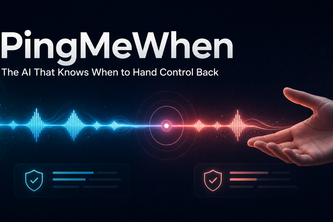
What the company appears to be: PingMeWhen is a self-reported local-first, human-supervised task agent that uses real phone calls as an action channel. The product is described as an AI system that knows when to stop automating, and only pings the user for human judgment or sensitive information.
What changed: The project description indicates a shift from generic AI automation toward a more controlled, human-authority-driven model. It positions itself not as an agent that does more, but one that knows when to stop — with explicit architecture enforcing this behavior.
Single most important open question: Is there evidence of any real-world usage or user feedback beyond the author's own account? The description is entirely self-reported and lacks any demonstration of traction, revenue, customers, or adoption.
Note: This analysis is based solely on the project description provided by the caller. All claims are self-reported and unverified. No third-party corroboration exists for any aspect of this project.
What The Product Actually Is
The description states that PingMeWhen is:
- A local-first, human-supervised task agent.
- It uses real phone calls as an action channel.
- It allows users to set a goal and optional context (PDF or text).
- It clarifies missing details, researches contact info, and creates a structured call plan.
- The user must explicitly approve the plan before any call is made.
- Once approved, it places real phone calls over Twilio, speaks naturally on behalf of the user, and clearly discloses that it is an AI.
- A Gatekeeper layer monitors conversations for moments requiring human input — such as unknown facts, offers, permissions, financial decisions, or sensitive requests.
- When escalation occurs, the system asks a focused question through a Private Workspace, and the user’s response is converted into a typed, confirmed context update.
- Users can take over at any time by typing what they want spoken.
- For protected information, it uses macOS speech synthesizer to speak values locally, ensuring no cloud audio or logging occurs.
Inference: The system appears designed to be a hybrid between AI automation and human oversight, with strong emphasis on control, transparency, and privacy. It is not a general-purpose voice assistant but a specialized tool for handling routine phone tasks while preserving user authority in critical moments.
Positioning & Claim Evolution
The description states that:
- The project started from the question: “When should an AI stop?” rather than “How much can we automate?”
- It aims to offer a third option: automating mechanical parts but bringing humans in only when needed.
- It is positioned as an agent that knows when to stop, not one that does more.
- The author emphasizes that this is not just a tagline — it’s enforced by the application architecture.
Claim vs Fact: The claim that “the AI knows when to stop” is presented as a core value proposition and architectural feature. However, there is no evidence of external validation or demonstration of this behavior beyond the author's own account.
Target Customer & ICP
The description implies:
- The target user is someone who interacts regularly with businesses via phone, such as:
- Doctors’ offices
- Handymen
- Local shops
- Landlords
- Small service providers
These users are described as being “phone-first,” meaning they do not expose APIs and rely on phone communication.
- The user is likely someone who wants to reduce time spent on repetitive phone tasks, but still needs to be involved in sensitive or consequential decisions.
- It targets individuals who value privacy, control, and transparency over full automation.
Inference: Based on the narrative, the ICP seems to be early adopters of privacy-conscious tech tools — possibly professionals or power users seeking autonomy in automated interactions. However, no explicit segmentation or customer data is provided.
Business Model & Pricing Evidence
The description does not contain any information about:
- Revenue model
- Pricing structure
- Monetization strategy
- Customer acquisition cost
- Sales process
Not evidenced: There is no indication of how the product would be monetized or whether it has a business model beyond being a personal tool.
Technical & Delivery Signals
The description provides technical details:
- Built using:
- Cloudflare (for tunneling)
- OpenAI APIs (Responses API, Realtime)
- FastAPI
- Twilio (PSTN calls, media streams)
- SQLite
- Python
- HTML/WebSockets
- Runs as a local-first macOS application
- Uses Pydantic Structured Outputs
- Implements two roles: Speaker (live audio) and Gatekeeper (text-only authority layer)
- Has a typed context-update layer to prevent accidental disclosure
- Supports protected handoffs using local speech synthesis for sensitive data
Inference: The architecture shows deliberate design around security, control, and user agency. It avoids centralized cloud models where possible, especially for sensitive operations.
Traction & Maturity Signals
The description states:
- This is a hackathon submission (OpenAI 2026)
- The team size is 1 person
- No mention of:
- Revenue
- Customers
- Users
- Product usage metrics
- Market traction
- Adoption rate
Not evidenced: There is no evidence of any real-world deployment, user base, or product maturity beyond the author’s own development.
Competitive Context
The description does not mention:
- Direct competitors
- Market landscape
- Similar products in the space
- Competitive positioning relative to existing AI agents or call automation tools
Not evidenced: No competitive analysis or market context is provided.
Open Questions & Risks
Key risks and open questions based on the self-reported description:
- Single-person team — raises concerns about scalability, maintenance, and long-term viability.
- No revenue or customer data — indicates no commercial traction or validated demand.
- Local-first architecture may limit adoption — especially if users prefer hosted solutions.
- Limited platform support (macOS only) — could restrict market reach.
- Highly specialized use case — may not appeal to broad audiences.
- Unproven trust model — while described as observable and reversible, there is no evidence of user feedback or trust validation.
Inference: The product appears experimental and niche. Its success depends heavily on adoption by a small group of early adopters who value its specific design principles.
Questions the description leaves open
- What real-world scenarios have you tested this system with?
- Have you received feedback from users beyond yourself?
- How do you plan to scale beyond a single-user, local-first model?
- What are the technical limitations of running on macOS only?
- Is there any intention to support other platforms or communication channels (e.g., SMS, email)?
- How do you envision monetizing this tool if it remains local-first and private?
- What is your roadmap for expanding beyond phone calls?
Overall Assessment
This project appears to be a proof-of-concept or hackathon prototype with strong design principles around autonomy, control, and privacy.
It is not evidenced to have traction, revenue, customers, or even a clear business model. The author's own account describes it as an experimental system built for personal use, not a commercial product.
Confidence Level: Low — due to lack of external validation, no evidence of users, revenue, or market demand.
Assessment: Not suitable for investment or partnership at this stage. It may be interesting as a concept or prototype, but lacks the commercial foundation required for due diligence beyond initial curiosity.
User Stories BotA demo video on every pull request
Get a demo video on every new feature
GitHub App that watches your pull requests and records a narrated, captioned demo.
Save time on demo prep and make informed decisions faster with a video walkthrough of every new feature.
Source
Submitted to the OpenAI 2026 hackathon on Devpost. Project home on Devpost. Back to the full gallery on Devpost.
This competitive analysis was produced by top-founders.com (opens in a new tab)
Generated by a language model from this project's public Devpost page — its tagline, the author's own write-up and any built-with tags listed there — as captured in August 2026. Short quotations are the author's words. It is an opinion on the idea as a business, not on the people behind it, and it reflects the description as published then. If the project has moved on, request a correction below. The analysis is not independent research and contains no verified traction, revenue or customer data.
An independent guide by KFG International LLC — not affiliated with, endorsed by, or connected to Devpost or OpenAI.