

Archive position — measured, not model output
1 like on Devpost
505 of the 7,850 archived projects have more likes, and 1,758 share exactly 1 — so this project's #2,019 place in the like-ranked listing is a tie-break inside that group, not a ranking.
Projects (log scale)
Likes on Devpost. ▲ marks this project's group.
Show the figures
| Likes | Projects | Share of archive |
|---|---|---|
| 0 | 5,587 | 71.2% |
| 1 | 1,758 | 22.4% |
| 2 | 284 | 3.6% |
| 3–4 | 132 | 1.7% |
| 5–9 | 75 | 1.0% |
| 10+ | 14 | 0.2% |
 User Stories BotA demo video on every pull request
Get a demo video on every new feature
GitHub App that watches your pull requests and records a narrated, captioned demo.
Save time on demo prep and make informed decisions faster with a video walkthrough of every new feature.
Executive Summary
What the company appears to be
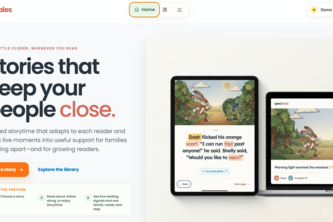
SyncTales is a self-reported family-led AI-assisted shared-reading companion designed for parents and children who are apart. The product enables live voice-following reading sessions between adults and children, with optional AI-generated learning moments and insights.
What changed
The author reports building SyncTales as a personal solution to the challenge of remote parenting during story time, using AI tools like Codex and GPT-5.6 for development, and incorporating educational research into its design.
Single most important open question
Is there evidence of product-market fit or early traction with families, or is this a prototype that has not yet been tested in real-world use?
Note: This analysis is based entirely on the self-reported project description provided by the author. No external verification, revenue data, customer base, or traction metrics are available.
What The Product Actually Is
- The description states SyncTales is a family-led, AI-assisted shared-reading companion.
- It supports live voice-following reading, where an adult reads aloud to a child while the system highlights words on screen.
- It includes:
- A story selection and rendering engine using GPT-5.6 for schema-constrained planning.
- Optional AI Moments (rooted in science of reading) embedded during reading.
- A short optional retell, transcribed and analyzed by GPT-5.6 into structured parent-facing observations.
- A parent insight summary at the end, covering what was practiced, what to revisit, and a next-read ritual.
- It avoids:
- AI-generated child voices.
- Open-ended chatbot interactions.
- Child scoring or labeling.
- The system uses:
- React, TypeScript, Vite, deployed on Vercel.
- Supabase for data management.
- OpenAI Realtime API for live transcription.
- Codex and GPT-5.6 for development and content planning.
- NanoBanana for visual asset generation.
Inference: The product is described as a web-based tool with AI-powered reading support, but no evidence of actual user testing or adoption exists in the description.
Positioning & Claim Evolution
- The author states SyncTales was built to help families apart reconnect through shared reading.
- It positions itself as:
- A supportive companion, not a replacement for parents.
- Rooted in science of reading principles.
- Focused on preserving family connection and learning scaffolding.
- The author emphasizes:
- Restraint in AI use: GPT-5.6 is used for planning, not control.
- Privacy-conscious design, especially around child data.
- Educational grounding, not just UI polish.
Claim vs Fact: These are self-reported claims about intent and values, not evidence of traction or success.
Target Customer & ICP
- The target customer is:
- Parents (or caregivers) of young children (ages 2–12).
- Families who are physically apart during reading moments.
- The ICP includes:
- Parents seeking to maintain connection with their child during story time.
- Those interested in evidence-based learning support.
- Users concerned about privacy and AI overreach.
Not evidenced: No data on actual users, demographics, or customer segments beyond the author’s personal experience.
Business Model & Pricing Evidence
- The description does not state:
- A pricing model.
- Revenue streams.
- Monetization strategy.
- Subscription or one-time purchase details.
Not evidenced: No indication of how SyncTales intends to make money.
Technical & Delivery Signals
- Built with:
- React, TypeScript, Vite.
- Deployed on Vercel.
- Data stored via Supabase.
- Uses:
- OpenAI Realtime API for live transcription.
- GPT-5.6 for content planning and analysis.
- Codex for coding assistance.
- NanoBanana for visual assets.
- Technical challenges addressed:
- Sequence alignment for live word highlighting.
- Handling of mispronunciations, pauses, and repeated words in transcription.
- The system avoids storing unnecessary data (e.g., retell audio is transient).
Inference: The technical stack suggests a modern, lightweight web app with AI integration. However, no evidence of production deployment or scalability.
Traction & Maturity Signals
- The description states:
- It is a prototype.
- The author built it for the OpenAI 2026 hackathon.
- It’s not yet in production-ready form.
- No mention of:
- Users or customers.
- Revenue or monetization.
- Product-market fit validation.
- Retention or usage metrics.
Not evidenced: No traction, adoption, or user feedback data is provided.
Competitive Context
- The description does not reference:
- Direct competitors.
- Existing shared reading or edtech tools.
- Market positioning relative to other AI-assisted learning platforms.
Not evidenced: No competitive analysis or market context is included.
Open Questions & Risks
- No traction or user validation — it’s a prototype, not a tested product.
- Unverified AI integration claims — GPT-5.6 is described as a runtime component, but no evidence of its actual use or performance in the app.
- Privacy concerns: The system handles child voice data and transcription; no clear privacy policy or compliance details are mentioned.
- Limited scalability: Built for a single developer (1-person team), with no indication of team expansion or infrastructure support.
- Unclear monetization path — no business model is described.
Inference: The lack of user testing, revenue, or market validation raises questions about viability and product-market fit.
Questions the description leaves open
- What specific feedback have you received from families using the prototype?
- How do you plan to validate the educational effectiveness of AI Moments and derived insights?
- What are your plans for privacy compliance (e.g., COPPA, GDPR) in handling child data?
- Have you tested the system with real children and parents? If so, what were the results?
- What is your roadmap for scaling beyond a single developer?
- How do you plan to monetize SyncTales, if at all?
- Are there any partnerships or content agreements in place with illustrators, writers, or publishers?
Overall Assessment
- Not evidenced: No data on financials, traction, or market validation.
- The author describes a personal solution to a real challenge (remote parenting and shared reading), but the product is currently a prototype.
- It shows strong intent, technical execution, and educational grounding, but lacks:
- Product-market fit evidence.
- Revenue or customer data.
- Clear monetization strategy.
Assessment: SyncTales is an early-stage prototype with potential, but not yet a validated product. It requires further testing, user feedback, and traction before investment or partnership consideration. The author’s personal motivation and technical approach are strong signals, but the lack of external validation makes it a high-risk, early-stage opportunity.
User Stories BotA demo video on every pull request
Get a demo video on every new feature
GitHub App that watches your pull requests and records a narrated, captioned demo.
Save time on demo prep and make informed decisions faster with a video walkthrough of every new feature.
Source
Submitted to the OpenAI 2026 hackathon on Devpost. Project home on Devpost. Back to the full gallery on Devpost.
This competitive analysis was produced by top-founders.com (opens in a new tab)
Generated by a language model from this project's public Devpost page — its tagline, the author's own write-up and any built-with tags listed there — as captured in August 2026. Short quotations are the author's words. It is an opinion on the idea as a business, not on the people behind it, and it reflects the description as published then. If the project has moved on, request a correction below. The analysis is not independent research and contains no verified traction, revenue or customer data.
An independent guide by KFG International LLC — not affiliated with, endorsed by, or connected to Devpost or OpenAI.