

Archive position — measured, not model output
5 likes on Devpost
54 of the 7,850 archived projects have more likes, and 35 share exactly 5 — so this project's #56 place in the like-ranked listing is a tie-break inside that group, not a ranking.
Projects (log scale)
Likes on Devpost. ▲ marks this project's group.
Show the figures
| Likes | Projects | Share of archive |
|---|---|---|
| 0 | 5,587 | 71.2% |
| 1 | 1,758 | 22.4% |
| 2 | 284 | 3.6% |
| 3–4 | 132 | 1.7% |
| 5–9 | 75 | 1.0% |
| 10+ | 14 | 0.2% |
 User Stories BotA demo video on every pull request
Get a demo video on every new feature
GitHub App that watches your pull requests and records a narrated, captioned demo.
Save time on demo prep and make informed decisions faster with a video walkthrough of every new feature.
Executive Summary
What the company appears to be
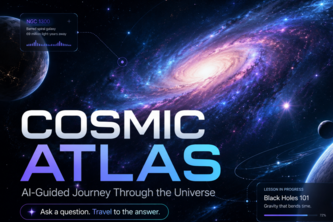
Astro Learner is a self-reported educational tool that uses AI and 3D visualization to guide users through astronomy content. It is described as a project submitted to the OpenAI 2026 hackathon.
What changed
The description does not indicate any prior version or evolution of the product; it is presented as a single submission.
The single most important open question
Is there evidence of traction, revenue, or user adoption beyond the hackathon submission?
What The Product Actually Is
The description states that Astro Learner "turns astronomy questions into AI-guided journeys through a 3D universe, with adaptive lessons, visual exploration, and quizzes powered by GPT-5.6." It is built using technologies including Three.js, WebGL, Node.js, and OpenAI's GPT models.
Evidence The author describes the product as an educational platform that uses AI to guide users through a 3D universe of astronomy content, incorporating adaptive lessons and quizzes.
Inference The product appears to be a web-based learning tool with gamification elements and AI-driven personalization. However, no details on functionality, interface, or user experience are provided beyond the tagline.
Positioning & Claim Evolution
The description states that Astro Learner is an educational platform for astronomy content using AI and 3D visualization. It positions itself as a tool that turns questions into guided journeys through space.
Evidence The tagline and author's own write-up describe it as an AI-guided journey through a 3D universe with adaptive lessons, quizzes, and visual exploration powered by GPT-5.6.
Inference The positioning is focused on gamified, AI-enhanced STEM education in astronomy. However, there is no indication of prior versions or evolution of the product's positioning.
Target Customer & ICP
The description does not specify target customers or an ideal customer profile (ICP). It only states that the tool is for "astronomy questions" and uses AI to guide users through a 3D universe.
Evidence No explicit mention of user demographics, educational levels, or specific use cases beyond general astronomy learning.
Inference The product likely targets students or learners interested in astronomy. However, no evidence supports claims about specific age groups, institutions, or usage contexts.
Business Model & Pricing Evidence
There is no evidence of a business model or pricing structure in the description. The project is presented as a hackathon submission with no mention of monetization or sales channels.
Evidence No information on how the product would be sold, licensed, or funded.
Inference The product may be in early development and not yet monetized. There is no indication of whether it will be free, subscription-based, or otherwise priced.
Technical & Delivery Signals
The project is built using technologies such as Three.js, WebGL, Node.js, JavaScript, HTML5, CSS3, JSON, and OpenAI’s GPT models. It was submitted to the OpenAI 2026 hackathon on Devpost.
Evidence The author lists several technical components including 3D rendering (Three.js, WebGL), backend (Node.js), AI integration (GPT-5.6), and frontend (HTML5, CSS3, JavaScript).
Inference The tool is likely a web-based application with 3D visualization capabilities and AI-driven content generation. However, no details on delivery mechanism or scalability are provided.
Traction & Maturity Signals
The description indicates that this is a hackathon submission to the OpenAI 2026 event. No evidence of traction, user adoption, revenue, or product maturity beyond the initial prototype is present.
Evidence The project was submitted to a hackathon and has no mention of users, customers, or product development beyond its initial form.
Inference There is no indication that the product has moved past the prototype stage or achieved any measurable traction.
Competitive Context
The description does not provide information on competitors or market positioning. It does not reference existing tools in the astronomy education space or AI-powered learning platforms.
Evidence No mention of competitors, similar products, or market analysis.
Inference The competitive landscape is unknown. The product may be novel or part of a broader category of educational technology, but no evidence supports either claim.
Open Questions & Risks
- Lack of traction: The project is only described as a hackathon submission with no evidence of adoption or user engagement.
- Unverified claims: The use of GPT-5.6 and other technologies are self-reported without verification.
- No business model: No indication of how the product will be monetized or scaled.
- Small team: Only two members listed, which may limit development capacity.
Evidence All risks stem from the lack of information in the description beyond a hackathon submission.
Questions the description leaves open
- What is the intended user base for Astro Learner?
- How does the product plan to scale beyond the hackathon prototype?
- Are there any plans for monetization or commercialization?
- What are the key features that differentiate this from existing educational tools?
- Has there been any feedback or testing with users?
Overall Assessment
Not evidenced.
The description provides no information on revenue, customers, traction, or business model. It is a single hackathon submission with no indication of commercial viability or product maturity.
Confidence Low. The evidence base is extremely thin and self-reported only.
User Stories BotA demo video on every pull request
Get a demo video on every new feature
GitHub App that watches your pull requests and records a narrated, captioned demo.
Save time on demo prep and make informed decisions faster with a video walkthrough of every new feature.
Source
Submitted to the OpenAI 2026 hackathon on Devpost. Project home on Devpost. Back to the full gallery on Devpost.
This competitive analysis was produced by top-founders.com (opens in a new tab)
Generated by a language model from this project's public Devpost page — its tagline and any built-with tags listed there, since the author published no write-up — as captured in August 2026. Short quotations are the author's words. It is an opinion on the idea as a business, not on the people behind it, and it reflects the description as published then. If the project has moved on, request a correction below. The analysis is not independent research and contains no verified traction, revenue or customer data.
An independent guide by KFG International LLC — not affiliated with, endorsed by, or connected to Devpost or OpenAI.