

Archive position — measured, not model output
0 likes on Devpost
2,263 of the 7,850 archived projects have more likes, and 5,587 share exactly 0 — so this project's #3,979 place in the like-ranked listing is a tie-break inside that group, not a ranking.
Projects (log scale)
Likes on Devpost. ▲ marks this project's group.
Show the figures
| Likes | Projects | Share of archive |
|---|---|---|
| 0 | 5,587 | 71.2% |
| 1 | 1,758 | 22.4% |
| 2 | 284 | 3.6% |
| 3–4 | 132 | 1.7% |
| 5–9 | 75 | 1.0% |
| 10+ | 14 | 0.2% |
 User Stories BotA demo video on every pull request
Get a demo video on every new feature
GitHub App that watches your pull requests and records a narrated, captioned demo.
Save time on demo prep and make informed decisions faster with a video walkthrough of every new feature.
Executive Summary
What the company appears to be
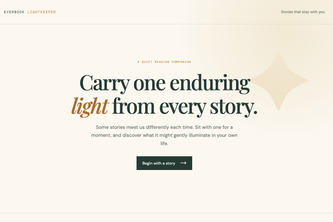
EverBook Lightkeeper is a self-reported AI reading companion built as part of an OpenAI hackathon submission. The project is described as a tool that helps readers connect timeless stories with their own lives through structured reflection and personal action.
What changed
The description indicates this is a new product (Lightkeeper) built during the OpenAI Build Week, extending an existing literary project called EverBook. It was developed by a solo founder using AI tools like GPT-5.6 and Codex, without traditional software development background.
Single most important open question
Is there evidence of any traction, revenue, or user adoption beyond the demo and self-reported claims?
Note: This analysis is based solely on the author's own description. No external verification or data exists to confirm any of the stated features, usage, or outcomes.
What The Product Actually Is
- The description states that EverBook Lightkeeper is an AI reading companion.
- It allows users to:
- Choose a story
- Share a feeling, question, or situation
- Receive a structured reading reflection
- Discover one enduring light from the story
- Take away one small action for real life
- Create and save a personal “Light Card”
- The experience is structured around four elements:
- What the story reveals
- What it may illuminate in the reader’s life
- One light worth carrying forward
- One gentle, practical next step
- It is not designed to replace reading or human judgment but to help one story remain alive in one human life.
- The product was built using Next.js, TypeScript, React, Vercel, GitHub, OpenAI (GPT-5.6), Codex, html2canvas, and api.
Inference: Based on the author’s description, it appears to be a web-based interactive application with AI-generated content flows tailored for personal reflection around literature.
Positioning & Claim Evolution
- The project is positioned as an AI reading companion that brings timeless stories into modern life.
- It aims to make reading personal again—not just summaries or chatbots—but a quiet encounter between a story and a human life.
- The tagline reads: “An AI reading companion that helps readers connect timeless stories with their own lives—and carry one enduring light from every reading experience.”
- The author describes the product as evolving from a bilingual digital library (EverBook) into a new interactive experience (Lightkeeper).
- It is framed as not replacing human judgment but enhancing it through AI.
Claim: The positioning is centered on emotional resonance, personalization, and literary depth.
Inference: This suggests an intent to differentiate from generic AI tools by focusing on meaning-making rather than just content generation.
Target Customer & ICP
- The description does not clearly define a specific customer segment or ideal customer profile (ICP).
- It implies the product targets readers who value timeless stories and seek personal reflection.
- There is no mention of age groups, reading habits, educational levels, or geographic regions.
- The project mentions potential future expansion to include schools, libraries, and lifelong readers.
Claim: The target audience seems to be individuals interested in literature and self-reflection.
Inference: Without explicit segmentation, the ICP remains undefined beyond a general interest in reading and storytelling.
Business Model & Pricing Evidence
- No business model or pricing information is provided in the description.
- There is no mention of monetization strategies, subscription tiers, or paid features.
- The demo runs in deterministic mock mode; an optional server-side OpenAI API path exists but no details on how this would be monetized.
Claim: No evidence of a business model or pricing structure.
Inference: This is likely an early-stage prototype with unclear commercial viability.
Technical & Delivery Signals
- Built during OpenAI Build Week using:
- GPT-5.6 and Codex
- Next.js, TypeScript, React
- Vercel deployment
- GitHub integration
- html2canvas
- API integrations with OpenAI
- The application includes:
- Story selector
- Personal reflection workflow
- Structured result page
- Downloadable Light Card
- Responsive interface
- Server-side reflection route
- The demo is currently in deterministic mock mode.
- Documentation and repository are included.
Claim: The technical stack and delivery approach suggest a lightweight, AI-assisted development process.
Inference: The use of AI tools like Codex and GPT-5.6 indicates rapid prototyping without traditional engineering teams.
Traction & Maturity Signals
- Not evidenced.
- No mention of users, customers, downloads, or usage metrics.
- The project was submitted as part of a hackathon (OpenAI Build Week).
- The demo is limited to mock mode and does not reflect real-world deployment or engagement.
- No data on retention, conversion, or feedback loops.
Claim: There is no evidence of traction or user adoption beyond the prototype phase.
Competitive Context
- Not evidenced.
- No mention of competitors or market positioning relative to other reading or AI reflection tools.
- The description does not reference similar products in the marketplace.
- The author does not compare Lightkeeper to existing platforms or services.
Claim: No competitive landscape is described or implied.
Open Questions & Risks
- Solo founder with no technical background may struggle with scaling or maintaining product quality.
- Heavy reliance on AI tools (GPT-5.6, Codex) raises concerns about consistency, control, and long-term sustainability.
- The demo runs in mock mode; lack of real-world testing or user feedback is a risk.
- No evidence of monetization strategy or business model.
- The product’s focus on emotional resonance and reflection may not translate into scalable commercial value.
- The project is described as a hackathon submission, suggesting it is still in early development.
Inference: Risks include lack of traction, unclear path to revenue, and dependency on AI tooling that could change or become unavailable.
Questions the description leaves open
- What specific user problems are you solving, and how do you know?
- How will you validate the effectiveness of the structured reflection process?
- Are there any plans for monetization or revenue generation beyond the demo?
- What is your roadmap for scaling beyond the current prototype?
- How do you plan to maintain quality and consistency in AI-generated content?
- Have you tested this with real users, and what were their reactions?
- What are the key assumptions underlying the product’s design and functionality?
Overall Assessment
- Not evidenced.
- No financials, funding rounds, or investment history are mentioned.
- The project is described as a hackathon submission with no indication of prior traction or commercial progress.
- The author states they are a non-technical founder working with AI tools, which may limit scalability or long-term viability.
Claim: There is insufficient evidence to assess whether this represents a viable investment opportunity or partnership candidate.
Inference: Given the lack of traction, revenue, or validated user engagement, any strategic move would be highly speculative at this stage.
User Stories BotA demo video on every pull request
Get a demo video on every new feature
GitHub App that watches your pull requests and records a narrated, captioned demo.
Save time on demo prep and make informed decisions faster with a video walkthrough of every new feature.
Source
Submitted to the OpenAI 2026 hackathon on Devpost. Project home on Devpost. Back to the full gallery on Devpost.
This competitive analysis was produced by top-founders.com (opens in a new tab)
Generated by a language model from this project's public Devpost page — its tagline, the author's own write-up and any built-with tags listed there — as captured in August 2026. Short quotations are the author's words. It is an opinion on the idea as a business, not on the people behind it, and it reflects the description as published then. If the project has moved on, request a correction below. The analysis is not independent research and contains no verified traction, revenue or customer data.
An independent guide by KFG International LLC — not affiliated with, endorsed by, or connected to Devpost or OpenAI.