

Archive position — measured, not model output
0 likes on Devpost
2,263 of the 7,850 archived projects have more likes, and 5,587 share exactly 0 — so this project's #3,977 place in the like-ranked listing is a tie-break inside that group, not a ranking.
Projects (log scale)
Likes on Devpost. ▲ marks this project's group.
Show the figures
| Likes | Projects | Share of archive |
|---|---|---|
| 0 | 5,587 | 71.2% |
| 1 | 1,758 | 22.4% |
| 2 | 284 | 3.6% |
| 3–4 | 132 | 1.7% |
| 5–9 | 75 | 1.0% |
| 10+ | 14 | 0.2% |
 User Stories BotA demo video on every pull request
Get a demo video on every new feature
GitHub App that watches your pull requests and records a narrated, captioned demo.
Save time on demo prep and make informed decisions faster with a video walkthrough of every new feature.
Executive Summary
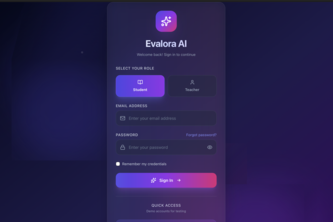
Evalora AI is an AI-powered education platform described by its authors as a smart evaluation system that automates answer sheet grading, provides personalized feedback, and offers performance analytics for teachers and students. The platform uses OpenAI's GPT-5.5 for evaluation and feedback generation, OCR for text extraction, and integrates with MongoDB, React, Express.js, and other technologies.
The description states the project was built as part of an OpenAI 2026 hackathon submission. No evidence of revenue, customers, or traction is provided beyond the authors' own account. The platform appears to be in early development, with no commercial deployment or user base described.
Most important open question
What is the actual accuracy and reliability of AI-based answer evaluation for educational purposes, particularly given that the system relies on GPT-5.5 without evidence of fine-tuning or validation?
What The Product Actually Is
The description states Evalora AI is an "AI-powered Smart Evaluation Platform designed for both teachers and students." It includes:
- Teacher features:
- Upload question papers, rubrics, and answer sheets
- AI extracts text using OCR
- Evaluates answers against rubric
- Assigns marks with confidence scores
- Generates question-wise feedback
- Highlights mistakes and improvement suggestions
- Stores evaluations for future review
- Student features:
- View detailed evaluation reports
- Track performance over time
- Identify strengths and weak areas
- Access AI Study Agent for personalized learning assistance
- Receive AI-generated study recommendations
The system is built using React (Vite), Tailwind CSS, Framer Motion, Recharts, Axios, Node.js, Express.js, MongoDB, JWT Authentication, Multer, Tesseract OCR, OpenAI GPT-5.5, and OpenAI Responses API.
Positioning & Claim Evolution
The authors state their inspiration was to "transform traditional examinations into an intelligent learning experience where AI acts as both an evaluator and a personal tutor." They claim the platform automates evaluation while helping students understand mistakes and improve continuously.
The positioning appears to be:
- An automated answer sheet evaluation tool
- A personalized learning assistant
- A performance analytics dashboard for educators
- An educational technology platform integrating AI with traditional assessment
The claim evolution shows a progression from addressing manual grading inefficiencies to proposing a complete transformation of the educational experience through AI integration.
Target Customer & ICP
The description states Evalora AI targets "both teachers and students" as its primary users. The authors describe two distinct user groups:
- Teachers: who upload question papers, rubrics, and answer sheets; receive evaluation results with confidence scores and feedback
- Students: who view detailed reports, track performance, identify strengths/weaknesses, access study assistance, and receive recommendations
The platform appears to be positioned for educational institutions or individual educators using traditional assessment methods that require manual grading.
Business Model & Pricing Evidence
Not evidenced. The description does not contain any information about pricing models, monetization strategies, revenue streams, or business model details beyond the authors' own account of what the system does.
Technical & Delivery Signals
The platform is described as built with:
- Frontend: React (Vite), Tailwind CSS, Framer Motion, Recharts, Axios
- Backend: Node.js, Express.js, MongoDB, JWT Authentication, Multer, Tesseract OCR
- AI components: OpenAI GPT-5.5 for evaluation, OpenAI Responses API for feedback, OCR pipeline
The system uses:
- OCR (Tesseract) for text extraction from answer sheets
- OpenAI GPT-5.5 for answer evaluation and feedback generation
- JWT authentication for role-based access control
- REST APIs for communication between frontend and backend
Traction & Maturity Signals
Not evidenced. The description states this was a hackathon project submitted to the OpenAI 2026 hackathon, with no mention of any users, customers, revenue, or traction beyond the authors' own account.
Competitive Context
Not evidenced. No information is provided about existing competitors, market positioning, or competitive landscape in the educational technology space.
Open Questions & Risks
- Reliance on GPT-5.5 for answer evaluation without evidence of validation, fine-tuning, or accuracy testing
- OCR pipeline may struggle with handwriting recognition quality
- No evidence of real-world testing or user feedback
- Platform appears to be in early development stage (hackathon project)
- Lack of information about data privacy, security, or compliance
- No mention of scalability considerations for educational institutions
Questions the description leaves open
- What validation or testing has been done on the accuracy of GPT-5.5 for educational evaluation?
- How does the system handle edge cases in OCR processing (e.g., poor quality scans, handwriting)?
- What is the expected accuracy rate for rubric-based grading using AI?
- Have you tested the platform with actual teachers and students?
- What are your plans for data privacy and compliance with educational regulations?
- How will the system handle different question formats or subject areas?
- What is the current state of development beyond the hackathon prototype?
Overall Assessment
Not evidenced. The description provides no information about funding, valuation, or commercial traction to assess investment potential or partnership viability. The platform appears to be in early development stage with no demonstrated market adoption or revenue generation.
User Stories BotA demo video on every pull request
Get a demo video on every new feature
GitHub App that watches your pull requests and records a narrated, captioned demo.
Save time on demo prep and make informed decisions faster with a video walkthrough of every new feature.
Source
Submitted to the OpenAI 2026 hackathon on Devpost. Project home on Devpost. Back to the full gallery on Devpost.
This competitive analysis was produced by top-founders.com (opens in a new tab)
Generated by a language model from this project's public Devpost page — its tagline, the author's own write-up and any built-with tags listed there — as captured in August 2026. Short quotations are the author's words. It is an opinion on the idea as a business, not on the people behind it, and it reflects the description as published then. If the project has moved on, request a correction below. The analysis is not independent research and contains no verified traction, revenue or customer data.
An independent guide by KFG International LLC — not affiliated with, endorsed by, or connected to Devpost or OpenAI.