

Archive position — measured, not model output
6 likes on Devpost
35 of the 7,850 archived projects have more likes, and 19 share exactly 6 — so this project's #53 place in the like-ranked listing is a tie-break inside that group, not a ranking.
Projects (log scale)
Likes on Devpost. ▲ marks this project's group.
Show the figures
| Likes | Projects | Share of archive |
|---|---|---|
| 0 | 5,587 | 71.2% |
| 1 | 1,758 | 22.4% |
| 2 | 284 | 3.6% |
| 3–4 | 132 | 1.7% |
| 5–9 | 75 | 1.0% |
| 10+ | 14 | 0.2% |
 User Stories BotA demo video on every pull request
Get a demo video on every new feature
GitHub App that watches your pull requests and records a narrated, captioned demo.
Save time on demo prep and make informed decisions faster with a video walkthrough of every new feature.
Executive Summary
What the company appears to be
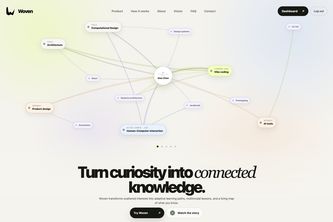
Woven is a self-reported personal learning platform that uses AI to turn scattered interests into adaptive, multimodal courses. The author describes it as a tool for curious individuals who want to learn across disciplines and see their knowledge accumulate into a connected "knowledge map."
What changed
The project was built by one person (Zhongyuan Fu) over the course of a hackathon, using AI models like GPT-5.6 and tools such as Next.js, TypeScript, Supabase, and Codex. It is described as a full-stack application with structured reasoning layers behind its AI functionality.
Single most important open question
Is there evidence that Woven has traction or adoption beyond the author's own use case? The description does not mention any users, customers, revenue, or market validation beyond the personal experience of the founder.
Note: This analysis is based solely on the self-reported project description provided by the author. No external verification or historical data are available.
What The Product Actually Is
The description states that Woven is a full-stack application built with Next.js and TypeScript, using GPT-5.6 as its core intelligence engine. It allows learners to describe learning goals in natural language, generate adaptive courses over 5–30 days, and visualize knowledge growth through a "living knowledge graph."
Key features include:
- Natural language input for learning goals
- Multimodal lessons (text, audio, slides)
- AI tutor that provides structured reasoning
- Exportable PDFs
- Knowledge graph integration upon course completion
The system is described as using Codex for engineering and GPT-5.6 for runtime intelligence.
Claim: The product is a personal learning platform with an AI-driven course generator.
Evidence: Author’s own write-up.
Positioning & Claim Evolution
The author positions Woven as a tool that helps people learn across disciplines, connecting their existing knowledge to new interests in a way traditional platforms do not. It aims to make learning cumulative and visible rather than isolated.
It evolves from a personal curiosity-driven system into an envisioned social platform where users can share courses and discover others through overlapping knowledge intersections.
Claim: Woven is designed for curious individuals who want to learn across fields.
Evidence: Author’s write-up.
Target Customer & ICP
The description implies the target customer is a self-directed learner with diverse interests, such as architectural designers or people who teach themselves multiple subjects. The author identifies himself as someone who has learned Korean, dance, finance, real estate investing, vibe coding, astrology, and Bazi.
There is no explicit segmentation beyond this profile. No specific personas, buyer types, or market segments are defined.
Claim: Target customer is a curious individual with multidisciplinary interests.
Evidence: Author’s write-up.
Business Model & Pricing Evidence
No business model or pricing information is provided in the description. The project is described as a personal learning tool and not as a commercial product or service offering.
Claim: No evidence of a business model or pricing structure.
Evidence: Not evidenced.
Technical & Delivery Signals
Woven is built using:
- Frontend: React, Next.js, TypeScript
- Backend: Node.js, Supabase, PostgreSQL
- AI models: GPT-5.6, Codex
- Other technologies: GitHub, Vercel, OpenAI APIs, Zod, Remotion, Resend
The system uses typed contracts and validated structured outputs to manage AI actions. It supports background jobs for heavy media generation and includes recovery states and authentication.
Claim: Woven is a full-stack application with robust AI integration.
Evidence: Author’s write-up.
Traction & Maturity Signals
There is no evidence of traction, customers, or revenue. The project was built by one person in a hackathon setting and has no mention of user engagement, retention metrics, or usage data.
Claim: No evidence of traction or maturity.
Evidence: Not evidenced.
Competitive Context
The description does not reference competitors or existing solutions in the learning space. It focuses on how Woven differs from traditional platforms by creating a connected knowledge graph and allowing cross-disciplinary exploration.
Claim: No competitive landscape described.
Evidence: Not evidenced.
Open Questions & Risks
- Single founder: The entire project was built by one person, raising questions about scalability or long-term maintenance.
- Unverified claims: All descriptions are self-reported and unverified; no third-party validation exists.
- No commercialization path: No indication of monetization strategy or market fit beyond personal use.
- AI dependency risks: Heavy reliance on GPT-5.6 and Codex may pose risks if these tools change or become unavailable.
Inference: The lack of traction, customers, or revenue suggests a high risk of failure without further development or validation.
Evidence: Author’s write-up.
Questions the description leaves open
- What specific problems do you observe in current learning tools that Woven solves?
- How does Woven ensure data privacy and user control over their knowledge graph?
- Have you tested the system with others outside of your own use case?
- Is there a plan to monetize or scale this beyond personal learning?
- What are the technical limitations or trade-offs in using GPT-5.6 for core functionality?
Note: These questions aim to probe deeper into unverified claims and assumptions.
Overall Assessment
There is no evidence of a viable business, revenue, or customer base. The project appears to be an experimental prototype built by one person during a hackathon. It lacks commercial traction, market validation, or clear monetization strategy.
Inference: Not ready for investment or partnership at this stage.
Evidence: Author’s write-up.
User Stories BotA demo video on every pull request
Get a demo video on every new feature
GitHub App that watches your pull requests and records a narrated, captioned demo.
Save time on demo prep and make informed decisions faster with a video walkthrough of every new feature.
Source
Submitted to the OpenAI 2026 hackathon on Devpost. Project home on Devpost. Back to the full gallery on Devpost.
This competitive analysis was produced by top-founders.com (opens in a new tab)
Generated by a language model from this project's public Devpost page — its tagline, the author's own write-up and any built-with tags listed there — as captured in August 2026. Short quotations are the author's words. It is an opinion on the idea as a business, not on the people behind it, and it reflects the description as published then. If the project has moved on, request a correction below. The analysis is not independent research and contains no verified traction, revenue or customer data.
An independent guide by KFG International LLC — not affiliated with, endorsed by, or connected to Devpost or OpenAI.