

Archive position — measured, not model output
0 likes on Devpost
2,263 of the 7,850 archived projects have more likes, and 5,587 share exactly 0 — so this project's #5,940 place in the like-ranked listing is a tie-break inside that group, not a ranking.
Projects (log scale)
Likes on Devpost. ▲ marks this project's group.
Show the figures
| Likes | Projects | Share of archive |
|---|---|---|
| 0 | 5,587 | 71.2% |
| 1 | 1,758 | 22.4% |
| 2 | 284 | 3.6% |
| 3–4 | 132 | 1.7% |
| 5–9 | 75 | 1.0% |
| 10+ | 14 | 0.2% |
 User Stories BotA demo video on every pull request
Get a demo video on every new feature
GitHub App that watches your pull requests and records a narrated, captioned demo.
Save time on demo prep and make informed decisions faster with a video walkthrough of every new feature.
Executive Summary
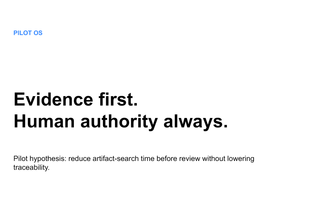
PILOT OS is a self-reported personal AI operations console built with Codex and GPT-5.6 that claims to unify scattered files, AI outputs, and workflows into one searchable workspace for business owners. The project is described as a local-first system designed to make decision-making chains visible by turning evidence packages into citation-linked "Decision Briefs" with human-gated next actions.
The author states that the system enforces fail-closed runtime boundaries, rejects stale or tampered inputs (via hash validation), and preserves provenance across AI-generated outputs. It is built using TypeScript, React, Next.js, Node.js, SQLite, and schema-based validation, with Codex as the primary engineering collaborator.
The project does not demonstrate revenue, customers, or traction beyond a fictional demo. The author claims to have tested its functionality through adversarial testing and synthetic fixtures but does not report real-world usage or impact.
Key open question: Does PILOT OS actually solve a problem that business owners face in practice, or is it an abstract technical exercise with no commercial relevance?
What The Product Actually Is
The description states that PILOT OS is a "local-first AI command center" built with Codex and GPT-5.6. It claims to unify scattered files, AI outputs, and workflows into one visible, searchable, action-ready workspace for business owners.
It builds on the concept of a “Decision Brief” — a structured output that includes:
- The problem
- Alternatives
- Supporting and counter-evidence
- Risks
- Known unknowns
- Human-gated next actions
The system is described as:
- Using versioned Decision Brief contracts
- Implementing provenance controls
- Enforcing schema validation
- Including replay protection
- Testing for adversarial inputs
- Maintaining a fail-closed runtime boundary
It also includes a synthetic judge experience and uses a stale-hash attack to demonstrate rejection of tampered data.
Not evidenced: No actual product, no real-world deployment, no customer feedback or usage metrics. The system is described as being tested in a demo environment with fictional records only.
Positioning & Claim Evolution
The author states that PILOT OS aims to solve the problem of teams lacking a trustworthy path from scattered sources to decisions. It positions itself as a tool that makes AI-generated outputs visible, traceable, and human-gated.
It claims to:
- Make decision chains visible
- Preserve authority and provenance across boundaries
- Prevent AI summaries from hiding contradictions or unknowns
- Offer a fail-closed system that rejects stale or tampered inputs
The positioning is framed around trust, transparency, and human control over AI outputs. It does not claim to automate decision-making, but rather to structure and validate it.
Inference: The project seems to be addressing concerns about AI hallucinations or lack of accountability in decision-making workflows — a common theme in AI governance discussions.
Target Customer & ICP
The description states that PILOT OS is built for business owners, who are described as the target users. It aims to provide them with a workspace where they can:
- Unify scattered files
- Review AI outputs
- Make decisions based on structured evidence
It does not specify any细分 customer segments, such as departments or roles within an organization.
Not evidenced: No indication of specific personas, use cases, or customer interviews. The target audience is inferred from the tagline and positioning, but no data supports a defined ICP.
Business Model & Pricing Evidence
The description does not contain any information about:
- Revenue model
- Pricing structure
- Monetization strategy
- Customer acquisition plans
It only describes the product's functionality and technical architecture.
Not evidenced: No evidence of a business model or pricing strategy. The project is described as a hackathon submission with no commercial plan.
Technical & Delivery Signals
The system is built using:
- Codex (as primary collaborator)
- GPT-5.6
- Next.js, React, Node.js
- TypeScript, SQLite, JSON schema
- SHA-256 hashing, RFC standards, schema validation
It includes:
- Versioned Decision Brief contracts
- Isolated synthetic judge experience
- Provenance controls
- Schema validation
- Replay protection
- Adversarial tests
- Fail-closed runtime boundary
The demo is described as a no-login, no-key interface with eight fictional records.
Inference: The technical stack suggests a focus on local-first architecture and data integrity. The use of hashing and schema validation implies an emphasis on trust and auditability.
Traction & Maturity Signals
The project is described as a hackathon submission (OpenAI 2026) and includes:
- A working demo
- Synthetic fixtures
- Adversarial testing
- Stale-hash attack demonstration
It does not report:
- Real-world usage
- Customer feedback
- Revenue or ARR
- Product adoption metrics
- Market traction
The author states that real-world business impact has not yet been measured.
Not evidenced: No evidence of traction, adoption, or commercial viability beyond the demo and fictional test cases.
Competitive Context
The description does not mention any competitors. It is unclear whether PILOT OS is positioned against existing AI governance tools, decision-making platforms, or workflow systems.
It appears to be a novel concept within the AI operations space — one that emphasizes:
- Human-gated decision-making
- Provenance and authority
- Fail-closed systems
No direct competitors are named or described.
Not evidenced: No competitive landscape analysis. The project does not reference existing tools or platforms in this domain.
Open Questions & Risks
Key risks and open questions include:
- No real-world testing or customer feedback
- Self-reported only, no independent verification
- Hackathon submission with fictional data
- No commercial model or monetization strategy
- No evidence of traction or adoption
- Focus on technical architecture over user needs
- Use of GPT-5.6 (not a real model) — likely a placeholder
Inference: The project may be an experimental idea with limited commercial potential unless it evolves beyond the demo stage.
Questions the description leaves open
- What specific business problems are you solving for business owners?
- How do you plan to validate that your solution works in real-world settings?
- What is your roadmap for transitioning from a demo to a product with customers?
- Are there any existing tools or platforms that address the same problem?
- How will you monetize this product, and what is your go-to-market strategy?
- What are the key assumptions about user behavior and adoption?
Overall Assessment
The project is described as a hackathon submission with no evidence of traction, revenue, or customer validation. It is built around a self-reported concept that emphasizes trust, transparency, and human control in AI workflows.
There is no indication of:
- A functional product
- Real-world usage
- Commercial viability
- Market demand
The description is self-reported, unverified, and limited to a demo environment with fictional data.
Assessment: Not ready for investment or partnership. The project lacks commercial evidence, traction, or a clear path to market. It may be an interesting technical exploration but does not yet demonstrate a viable business opportunity.
User Stories BotA demo video on every pull request
Get a demo video on every new feature
GitHub App that watches your pull requests and records a narrated, captioned demo.
Save time on demo prep and make informed decisions faster with a video walkthrough of every new feature.
Source
Submitted to the OpenAI 2026 hackathon on Devpost. Project home on Devpost. Back to the full gallery on Devpost.
This competitive analysis was produced by top-founders.com (opens in a new tab)
Generated by a language model from this project's public Devpost page — its tagline, the author's own write-up and any built-with tags listed there — as captured in August 2026. Short quotations are the author's words. It is an opinion on the idea as a business, not on the people behind it, and it reflects the description as published then. If the project has moved on, request a correction below. The analysis is not independent research and contains no verified traction, revenue or customer data.
An independent guide by KFG International LLC — not affiliated with, endorsed by, or connected to Devpost or OpenAI.