

Archive position — measured, not model output
0 likes on Devpost
2,263 of the 7,850 archived projects have more likes, and 5,587 share exactly 0 — so this project's #3,978 place in the like-ranked listing is a tie-break inside that group, not a ranking.
Projects (log scale)
Likes on Devpost. ▲ marks this project's group.
Show the figures
| Likes | Projects | Share of archive |
|---|---|---|
| 0 | 5,587 | 71.2% |
| 1 | 1,758 | 22.4% |
| 2 | 284 | 3.6% |
| 3–4 | 132 | 1.7% |
| 5–9 | 75 | 1.0% |
| 10+ | 14 | 0.2% |
 User Stories BotA demo video on every pull request
Get a demo video on every new feature
GitHub App that watches your pull requests and records a narrated, captioned demo.
Save time on demo prep and make informed decisions faster with a video walkthrough of every new feature.
Executive Summary
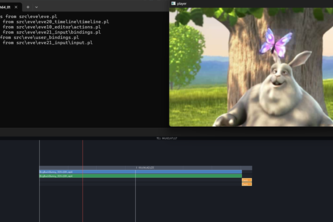
What the company appears to be: The description states that Eve is a video editor built using a Prolog-like language (Artemis) and native C code, with SDL3 for interaction and FFmpeg for media handling. It is presented as a proof of concept developed during a hackathon.
What changed: The author reports building upon prior prototypes and using Codex to structure the project. The project evolved from an experimental idea into a working prototype with timeline, audio/video playback, editing operations, and serialization features.
The single most important open question: Is there evidence that the Prolog-based approach offers practical advantages over conventional C-based video editing tools in terms of maintainability or development speed?
Analysis basis: This analysis is based entirely on the self-reported project description provided by the author. No external verification, traction data, revenue figures, customer information, or independent sources are available.
What The Product Actually Is
The description states that Eve is a video editor built with:
- SDL3 for interaction and rendering
- FFmpeg for media decoding and playback
- A Prolog-like engine called Artemis (developed separately)
- Native C predicates
It is described as a "self-contained" tool with timeline, synchronized audio/video playback, editing operations, project serialization, and a self-contained project structure.
The author notes that the system uses a "two-dimensional array of 64-bit cells" for heap representation in Artemis, which is unusual for Prolog implementations.
Inference: The product appears to be a hybrid system combining traditional C-based media processing with logic programming for some aspects of editing logic. However, this is not evidenced beyond the author's own account.
Positioning & Claim Evolution
The description states that Eve was built as a proof-of-concept to test whether "we can build fast applications using Prolog-like syntax." The author also mentions that they are trying to understand how a Prolog engine works and whether it simplifies development.
The project is positioned as an experimental exploration of using logic programming for video editing rather than a commercial product. The author explicitly states this is not primarily about winning a hackathon but about sharing ideas.
Inference: The positioning appears to be exploratory and academic in nature, focused on demonstrating feasibility of Prolog-based systems for media processing. No claims about market readiness or competitive advantage are evident.
Target Customer & ICP
Not evidenced. The description does not identify any specific customer segments or personas. It only describes the author's personal background as a film/video editor and their interest in how editors should work, but no target audience is defined.
Absence of evidence: No information about who would use this tool or whether it addresses real user needs beyond the author's own preferences.
Business Model & Pricing Evidence
Not evidenced. There is no mention of pricing models, monetization strategies, or business models in the description. The project is described as a proof-of-concept and not intended for commercial deployment.
Absence of evidence: No indication of how this would generate revenue or be sold to users.
Technical & Delivery Signals
The description states:
- Built with SDL3, FFmpeg, and Artemis (a Prolog-like engine)
- Uses Codex in Visual Studio Code for development
- Combines Artemis rules with native C predicates
- Implements timeline, synchronized audio/video playback, editing operations, project serialization
- Has a self-contained project structure
The author mentions that Artemis was developed separately and not during the hackathon window. They also note that they are working on extending both Eve and Artemis.
Inference: The technical approach involves hybrid development combining C for performance-critical components with logic programming for control flow. However, no evidence of scalability or production readiness is provided.
Traction & Maturity Signals
Not evidenced. There is no mention of users, customers, adoption metrics, or usage data. The project is described as a proof-of-concept developed in a hackathon setting and not intended for commercial use.
Absence of evidence: No signs of traction, user engagement, or product maturity beyond the initial prototype stage.
Competitive Context
Not evidenced. The description does not mention any competitors or existing solutions in the video editing space. It focuses on the novelty of using Prolog-like syntax rather than comparing with other tools.
Absence of evidence: No competitive landscape or market positioning is described.
Open Questions & Risks
- Unproven approach: The use of Prolog for video editing is experimental and untested in production environments.
- Limited scope: The project is described as a proof-of-concept, not a finished product.
- Single-person development: Only one team member is mentioned (the author), which raises questions about scalability and long-term maintenance.
- No commercial viability: No indication of how the tool would be monetized or distributed.
Inference: The project's experimental nature and lack of commercial focus suggest significant risk in terms of practical utility and market adoption.
Questions the description leaves open
- What specific problems with current video editing tools does this approach aim to solve?
- How does the Prolog-based logic compare to traditional C-based approaches in terms of performance, maintainability, and development speed?
- Are there any known limitations or trade-offs of using Artemis for real-time media processing?
- What are the plans for scaling beyond the current prototype?
- Is there any intention to make this commercially available, and if so, how?
Note: These questions are based on the self-reported description and reflect areas where more information would be needed to assess commercial viability.
Overall Assessment
Not evidenced. The project is described as a proof-of-concept with no indication of commercial potential or strategic value for investment or partnership. It lacks any evidence of traction, revenue, or customer demand.
Inference: Given the experimental nature and lack of commercial focus, there is insufficient evidence to support an investment or partnership decision at this stage.
User Stories BotA demo video on every pull request
Get a demo video on every new feature
GitHub App that watches your pull requests and records a narrated, captioned demo.
Save time on demo prep and make informed decisions faster with a video walkthrough of every new feature.
Source
Submitted to the OpenAI 2026 hackathon on Devpost. Project home on Devpost. Back to the full gallery on Devpost.
This competitive analysis was produced by top-founders.com (opens in a new tab)
Generated by a language model from this project's public Devpost page — its tagline, the author's own write-up and any built-with tags listed there — as captured in August 2026. Short quotations are the author's words. It is an opinion on the idea as a business, not on the people behind it, and it reflects the description as published then. If the project has moved on, request a correction below. The analysis is not independent research and contains no verified traction, revenue or customer data.
An independent guide by KFG International LLC — not affiliated with, endorsed by, or connected to Devpost or OpenAI.