

Archive position — measured, not model output
1 like on Devpost
505 of the 7,850 archived projects have more likes, and 1,758 share exactly 1 — so this project's #2,015 place in the like-ranked listing is a tie-break inside that group, not a ranking.
Projects (log scale)
Likes on Devpost. ▲ marks this project's group.
Show the figures
| Likes | Projects | Share of archive |
|---|---|---|
| 0 | 5,587 | 71.2% |
| 1 | 1,758 | 22.4% |
| 2 | 284 | 3.6% |
| 3–4 | 132 | 1.7% |
| 5–9 | 75 | 1.0% |
| 10+ | 14 | 0.2% |
 User Stories BotA demo video on every pull request
Get a demo video on every new feature
GitHub App that watches your pull requests and records a narrated, captioned demo.
Save time on demo prep and make informed decisions faster with a video walkthrough of every new feature.
Executive Summary
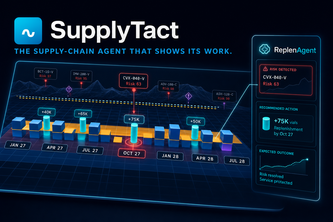
SupplyTact, as described by its author, is an agentic supply-chain planning system designed for pharmaceutical operations. The project was built during a hackathon and centers around ReplenAgent, a specialized AI agent powered by GPT-5.6 Luna, that investigates risks, runs deterministic simulations, and shows the evidence behind every recommendation.
The author states that SupplyTact is not a general-purpose chatbot but an agent embedded within a structured planning workflow. It integrates with a deterministic engine to ensure numerical accuracy while allowing ReplenAgent to explore scenarios, trace causality, and propose recoveries—without modifying baseline data directly.
Key features include:
- Risk analysis at portfolio and SKU levels
- Deterministic monthly planning engine
- Reversible scenario modeling
- 3D inventory runway visualization
- Evidence-based recommendation system
The author emphasizes that the system is built on real-world supply-chain experience, not abstract AI experimentation. It uses GPT-5.6 Luna for reasoning, tool selection, and explanation, but delegates numerical authority to validated tools.
The single most important open question: Is there sufficient evidence of real-world traction or customer validation to suggest that this system has commercial viability beyond a hackathon prototype?
What The Product Actually Is
The description states:
- SupplyTact is an agentic supply-and-inventory planning system.
- It includes ReplenAgent, a specialized agent powered by GPT-5.6 Luna.
- ReplenAgent works within a deterministic planning engine, not inventing inventory calculations or providing unsupported recommendations.
- The system allows planners to ask questions like:
- “Which product is facing the most serious supply risk, and why?”
- “Why does Bactrel 1 g stock out in March? Show me the evidence.”
- It supports:
- Risk ranking
- Scenario creation and comparison
- Evidence tracing
- Deterministic simulation
- Reversible actions
Inferred from the description: The system is designed for pharmaceutical supply chain planning, particularly around inventory, demand forecasting, safety stock, expiry, quality release, and customer allocation.
Not evidenced:
- Whether SupplyTact has been tested in live environments.
- Whether it supports real-time data integration or API connections.
- Whether ReplenAgent can be extended beyond the described use case.
Positioning & Claim Evolution
The author states:
- The system was built from a personal, professional need, not a generic tech idea.
- It is positioned as an AI agent that shows its work—not a chatbot giving advice.
- The goal was to create an agent that works inside the planning process, inspecting structured data and calling analytical tools.
The evolution of the product:
- Started with a panoramic visualization tool called SupplyScape.
- Evolved into Planorama, then SupplyTact.
- The name change reflects a shift from visual tool to planning agent as the core value.
Inferred:
- The positioning is rooted in operational workflow integration, not just AI novelty.
- It aims to reduce time spent on investigation and increase transparency in decision-making.
Not evidenced:
- No claims about market fit or competitive differentiation beyond the author’s personal experience.
- No evidence of prior versions or feedback loops from users outside the author.
Target Customer & ICP
The description states:
- The system targets supply-chain professionals, especially those working in pharmaceutical operations.
- It addresses a problem faced by planners who still rely heavily on Excel-based planning.
- The demo uses a fictional pharmaceutical product (Bactrel 1 g) to simulate real-world challenges.
Inferred:
- The ICP likely includes supply chain planners, logistics managers, and procurement specialists in regulated industries like pharma or medical devices.
- It may appeal to organizations with complex inventory and demand planning needs, especially where compliance and traceability are critical.
Not evidenced:
- No stated customer segments beyond the author’s own experience.
- No evidence of actual customers or pilot programs.
- No indication of whether the system supports other industries (e.g., manufacturing, retail).
Business Model & Pricing Evidence
The description states:
- The project is a hackathon submission, not a commercial product.
- There is no mention of pricing models, licensing, or monetization strategies.
Inferred:
- If commercialized, it might follow a SaaS model for enterprise users in regulated industries.
- It could be priced per user, SKU, or scenario.
Not evidenced:
- No business model, pricing structure, or revenue assumptions.
- No evidence of any sales process or go-to-market strategy.
Technical & Delivery Signals
The description states:
- Built using GPT-5.6 Luna, Codex, and ChatGPT for design and implementation.
- Uses technologies such as:
- React, TypeScript, Node.js
- OpenAI APIs (Sol and Luna)
- SQLite-wasm, Playwright, Vercel, Three.js
- CSV/XLSX import workflows
- Browser-local persistence
Inferred:
- The system is a browser-based application, likely using local storage for data.
- It integrates AI tools into a structured planning workflow.
- It supports scenario versioning and reversibility.
Not evidenced:
- No evidence of scalability or cloud infrastructure beyond Vercel hosting.
- No evidence of API integrations, real-time data feeds, or multi-user support.
- No mention of security or compliance features (e.g., HIPAA, GDPR).
Traction & Maturity Signals
The description states:
- This is a hackathon project submitted to the OpenAI 2026 hackathon.
- The author spent significant time in ChatGPT before coding.
- It was built using Codex as an engineering collaborator, not a one-shot prompt.
Inferred:
- The system has maturity in concept and design, but no evidence of deployment or user feedback.
- It is likely at the prototype stage.
Not evidenced:
- No customer data, usage metrics, or adoption rates.
- No evidence of product-market fit or real-world testing.
- No indication of future roadmap or development plans beyond the hackathon.
Competitive Context
The description states:
- The author did not begin with a technology-first approach but with a real-world problem.
- It is not positioned as a general-purpose AI assistant for supply chain.
- It contrasts itself with chatbots attached to spreadsheets, emphasizing structured planning and deterministic simulation.
Inferred:
- It competes with traditional Excel-based planning tools or basic ERP systems.
- It may compete with AI-powered planning platforms that lack transparency or deterministic logic.
- It is likely a niche solution for highly regulated, complex supply chains.
Not evidenced:
- No mention of competitors or market analysis.
- No evidence of competitive advantages beyond the described architecture.
- No indication of pricing, distribution, or positioning relative to existing tools.
Open Questions & Risks
The description states:
- The system is not a commercial product, but a hackathon submission.
- It uses GPT-5.6 Luna, which may not be suitable for production-level reliability.
- The author emphasizes that the AI agent does not perform inventory arithmetic—this is a strength, but also a limitation.
Open questions:
- No real-world validation or customer feedback.
- Limited scalability and infrastructure (browser-based, local storage).
- Dependence on GPT-5.6 Luna, which may not be available in production environments.
- No evidence of integration with enterprise systems or APIs.
- Highly specialized for pharmaceutical use case, limiting broader applicability.
Not evidenced:
- No risk assessment or mitigation strategies.
- No indication of how the system would scale to larger portfolios or more complex planning needs.
Questions the description leaves open
- What are your plans for transitioning from a hackathon prototype to a commercial product?
- How do you intend to integrate SupplyTact with existing ERP, WMS, or planning systems?
- Have you tested the system with actual supply-chain professionals beyond yourself?
- What is the expected performance and latency of ReplenAgent in real-world scenarios?
- How does the deterministic engine handle edge cases or data inconsistencies?
- Are there any plans to support multi-user collaboration or role-based access control?
- What are the long-term plans for AI model availability, especially if GPT-5.6 Luna is not available?
Overall Assessment
The description states that SupplyTact is a hackathon submission, and no evidence of traction, revenue, or customer validation exists.
Inferred:
- The project shows strong conceptual design and alignment with real-world needs.
- It has potential for commercialization, especially in regulated industries like pharma.
- However, it is currently at the prototype stage, with no demonstrated market fit or product-market traction.
Not evidenced:
- No financials, revenue model, or customer base.
- No indication of team size beyond one person (Samson Kang).
- No evidence of partnerships, funding, or go-to-market strategy.
Assessment: The project is a conceptually strong prototype with clear value for a niche market, but lacks commercial readiness. It would require significant development and validation before investment or partnership consideration.
User Stories BotA demo video on every pull request
Get a demo video on every new feature
GitHub App that watches your pull requests and records a narrated, captioned demo.
Save time on demo prep and make informed decisions faster with a video walkthrough of every new feature.
Source
Submitted to the OpenAI 2026 hackathon on Devpost. Project home on Devpost. Back to the full gallery on Devpost.
This competitive analysis was produced by top-founders.com (opens in a new tab)
Generated by a language model from this project's public Devpost page — its tagline, the author's own write-up and any built-with tags listed there — as captured in August 2026. Short quotations are the author's words. It is an opinion on the idea as a business, not on the people behind it, and it reflects the description as published then. If the project has moved on, request a correction below. The analysis is not independent research and contains no verified traction, revenue or customer data.
An independent guide by KFG International LLC — not affiliated with, endorsed by, or connected to Devpost or OpenAI.