

Archive position — measured, not model output
0 likes on Devpost
2,263 of the 7,850 archived projects have more likes, and 5,587 share exactly 0 — so this project's #3,975 place in the like-ranked listing is a tie-break inside that group, not a ranking.
Projects (log scale)
Likes on Devpost. ▲ marks this project's group.
Show the figures
| Likes | Projects | Share of archive |
|---|---|---|
| 0 | 5,587 | 71.2% |
| 1 | 1,758 | 22.4% |
| 2 | 284 | 3.6% |
| 3–4 | 132 | 1.7% |
| 5–9 | 75 | 1.0% |
| 10+ | 14 | 0.2% |
 User Stories BotA demo video on every pull request
Get a demo video on every new feature
GitHub App that watches your pull requests and records a narrated, captioned demo.
Save time on demo prep and make informed decisions faster with a video walkthrough of every new feature.
Executive Summary
EvalForge is a self-reported tool for generating reproducible evaluation suites for coding agents. The author states it uses GPT-5.6 to generate test cases constrained by JSON Schema, runs them in clean Git workspaces, and produces structured evidence reports. It is presented as a CLI and web console with Python backend and React frontend.
The project appears to be a single-person hackathon submission with no demonstrated traction or commercial use. The author claims the tool can evaluate agent quality using deterministic graders and avoid circularity by separating creative design from verification layers. However, there is no evidence of revenue, customers, or adoption beyond the demo.
Most important open question
What is the actual utility of EvalForge for real-world agent evaluation? The description states it generates eval suites but does not demonstrate whether these are actually used or valued by developers or teams outside the author's own workflow.
What The Product Actually Is
The description states EvalForge:
- Reads SKILL.md, issue specifications, and fixture inventory
- Uses Codex with GPT-5.6 to generate three-case evaluation suite (requirement completion, regression coverage, scope control)
- Constrains generated suites with JSON Schema
- Runs in clean Git workspace with deterministic graders inspecting test exit codes and changed files
- Exports JSON and Markdown reports showing why each case passed or failed
- Has a responsive React/vinext web console
- Is built with Python (no runtime dependencies) and React/TypeScript
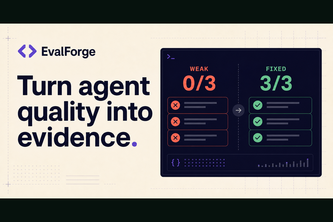
The author claims it generates "Codex-generated, human-editable eval suite" that can distinguish between weak (0/3) and real (3/3) agent performance using one portable suite.
Positioning & Claim Evolution
The description states EvalForge is positioned to:
- Turn coding-agent quality into reproducible evidence
- Make evaluation itself a reusable engineering artifact
- Address the problem of "evaluating them still starts with a blank page"
- Provide structured outputs rather than opaque LLM scores
The author's claim evolution shows:
- Initial problem: "many agent demos rely on happy paths or an opaque LLM quality score"
- Proposed solution: "the evaluation itself to become a reusable engineering artifact"
- Technical approach: "Codex with GPT-5.6 generates a three-case evaluation suite"
- Key innovation: separating creative scenario design from deterministic verification
The positioning appears to be about making agent evaluation more systematic and reproducible, but the description does not indicate how this differs from existing evaluation frameworks or whether it addresses a market need beyond the author's own use case.
Target Customer & ICP
Not evidenced. The description does not state who the target customer is, what their needs are, or how they would use EvalForge beyond the author's own workflow.
Business Model & Pricing Evidence
Not evidenced. The description does not contain any information about pricing, monetization strategy, or business model.
Technical & Delivery Signals
The description states:
- CLI and evaluation engine written in Python with no runtime dependencies
- Evidence console is a responsive React/vinext site
- Codex CLI provides read-only suite-generation adapter and workspace-write coding-agent adapter
- Generated suites constrained by JSON Schema and validated before execution
- Uses Git for clean workspaces
- Deterministic graders inspect test exit codes and changed files
- Structured outputs in JSON and Markdown
- Fourteen automated tests and production deployment
The author claims the system prevents circularity by using GPT-5.6 for test design but ordinary code for final evidence, and that it distinguishes agent failures from runner failures through infrastructure_error handling.
Traction & Maturity Signals
Not evidenced. The description states this is a hackathon submission (OpenAI 2026) with only one team member (Yasuaki Yoshii). No revenue, customers, or adoption data are provided beyond the author's own demonstration.
The author mentions "fourteen automated tests and a production deployment" but does not indicate whether these represent real usage or just development infrastructure.
Competitive Context
Not evidenced. The description does not mention any competitors, existing solutions in this space, or how EvalForge would fit into the broader agent evaluation ecosystem.
Open Questions & Risks
- Single-person project with no demonstrated traction or commercial use
- Self-reported claims about technical capabilities without independent verification
- No evidence of customer needs or market demand beyond author's own workflow
- The description states "the author states X" rather than proving X is true
- No evidence of revenue, customers, or adoption metrics
- The tool appears to be built for a specific hackathon context with no indication it would scale to real-world use
Questions the description leaves open
- What specific problems are you trying to solve that existing evaluation frameworks don't address?
- How do you plan to validate that the generated test cases are actually meaningful and comprehensive?
- What is your target customer persona, and how did you identify their needs?
- How would you monetize this tool if you were to commercialize it?
- What evidence do you have that developers would pay for or use this tool beyond personal experimentation?
- How does EvalForge handle edge cases in agent behavior that might not be captured by the three-case framework?
- What are your plans for scaling beyond a single-person hackathon project?
Overall Assessment
Not evidenced. The description provides no information about valuation, funding rounds, or investment interest. It is unclear whether this represents a viable business opportunity or just an experimental tool.
The author states this is a hackathon submission with no demonstrated traction or commercial use. The claims made are self-reported and unverified. There is no evidence of revenue, customers, or adoption beyond the author's own demonstration.
User Stories BotA demo video on every pull request
Get a demo video on every new feature
GitHub App that watches your pull requests and records a narrated, captioned demo.
Save time on demo prep and make informed decisions faster with a video walkthrough of every new feature.
Source
Submitted to the OpenAI 2026 hackathon on Devpost. Project home on Devpost. Back to the full gallery on Devpost.
This competitive analysis was produced by top-founders.com (opens in a new tab)
Generated by a language model from this project's public Devpost page — its tagline, the author's own write-up and any built-with tags listed there — as captured in August 2026. Short quotations are the author's words. It is an opinion on the idea as a business, not on the people behind it, and it reflects the description as published then. If the project has moved on, request a correction below. The analysis is not independent research and contains no verified traction, revenue or customer data.
An independent guide by KFG International LLC — not affiliated with, endorsed by, or connected to Devpost or OpenAI.