

Archive position — measured, not model output
0 likes on Devpost
2,263 of the 7,850 archived projects have more likes, and 5,587 share exactly 0 — so this project's #3,976 place in the like-ranked listing is a tie-break inside that group, not a ranking.
Projects (log scale)
Likes on Devpost. ▲ marks this project's group.
Show the figures
| Likes | Projects | Share of archive |
|---|---|---|
| 0 | 5,587 | 71.2% |
| 1 | 1,758 | 22.4% |
| 2 | 284 | 3.6% |
| 3–4 | 132 | 1.7% |
| 5–9 | 75 | 1.0% |
| 10+ | 14 | 0.2% |
 User Stories BotA demo video on every pull request
Get a demo video on every new feature
GitHub App that watches your pull requests and records a narrated, captioned demo.
Save time on demo prep and make informed decisions faster with a video walkthrough of every new feature.
Executive Summary
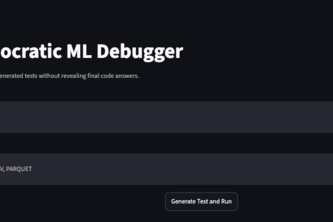
EvalGuard is a self-reported educational tool designed to help students and teachers identify silent machine learning bugs in Python scripts. The author states it detects issues like data leakage, misuse of accuracy on imbalanced datasets, and validation leakage during model selection. It provides Socratic feedback, generated tests, and exportable teacher reports. The tool uses Python, Streamlit, and optionally OpenAI models for diagnosis. It was built as part of an OpenAI 2026 hackathon submission.
The description states that EvalGuard is a debugging lab partner for ML education, but there is no evidence of actual users, customers, or revenue. The author describes the tool's functionality in detail, but does not provide any data on adoption, usage, or impact.
The single most important open question
Is there any evidence of real-world use or testing beyond the author’s own development and demo cases?
What The Product Actually Is
The description states that EvalGuard is a Socratic ML debugging lab partner for students and teachers. It analyzes Python machine learning scripts and detects silent bugs such as:
- data leakage before train/test split,
- accuracy misuse on imbalanced datasets,
- validation leakage during hyperparameter tuning or model selection.
It provides:
- bug type detection,
- confidence score,
- evidence lines from the code,
- Socratic hints,
- why the issue matters,
- generated validation tests,
- sandbox test execution output,
- downloadable teacher reports.
The tool is built using Python and Streamlit. It can optionally use OpenAI models for structured diagnosis, falling back to local rule-based detection if the API path is unavailable.
It also supports:
- uploading or pasting a Python script,
- optionally uploading a dataset,
- generating pytest-style validation tests that run in a sandbox,
- teacher mode for creating exportable reports with evidence and explanations.
The author notes it includes demo cases for leaky preprocessing, A/B testing metric misuse, and validation leakage.
Inference The tool appears to be a prototype or proof-of-concept built for an educational hackathon. It is not described as having been deployed in production or used by real students or educators.
Positioning & Claim Evolution
The author states that EvalGuard was inspired by their experience as a Graduate Teaching Assistant in Artificial Intelligence, where they observed students writing ML code that runs but produces unreliable results due to silent bugs.
The core positioning is:
- An educational debugging tool for machine learning,
- Focused on catching "silent evaluation bugs" that are not syntax errors,
- Designed to provide Socratic feedback rather than direct fixes,
- Aims to teach students about valid model evaluation and ML principles.
The author claims the tool helps students reason toward fixes, not just provides answers. It also supports teachers with evidence-based reports and explanations.
Inference The positioning reflects a focus on pedagogy over automation. However, there is no evidence that this approach has been tested or validated in real classrooms.
Target Customer & ICP
The description states that EvalGuard targets:
- Students learning machine learning,
- Teachers instructing ML courses.
It is designed for use in educational settings where students write Python ML scripts and need feedback on evaluation practices.
The author notes that the tool must balance AI assistance with academic integrity, suggesting it is intended for student use without direct code rewriting.
Inference The primary customer segment appears to be educators and learners in machine learning education. However, no evidence of actual users or adoption exists beyond the author's own development and demo cases.
Business Model & Pricing Evidence
The description does not contain any information about:
- Revenue streams,
- Pricing models,
- Monetization strategy,
- Subscription plans,
- Customer acquisition costs,
- Unit economics.
Not evidenced.
Technical & Delivery Signals
The author states that EvalGuard is built using:
- Python,
- Streamlit,
- Optionally OpenAI models (GPT-5.6 mentioned),
- Codex for development assistance,
- AST-based code analysis (mentioned as future improvement).
It includes features such as:
- Upload or paste of Python scripts,
- Optional dataset upload,
- Rule-based and AI-assisted diagnosis,
- Sandbox execution of generated tests,
- Teacher mode with exportable reports.
The author mentions challenges in balancing AI assistance with academic integrity, and in making feedback evidence-based.
Inference The tool is a web-based prototype built for educational purposes. It uses modern tools like Streamlit and OpenAI but lacks any indication of scalability or enterprise-grade delivery infrastructure.
Traction & Maturity Signals
The description does not include:
- Any user base,
- Customer testimonials,
- Revenue data,
- Product adoption metrics,
- Usage statistics,
- Market traction,
- Product maturity indicators.
It is described as a hackathon submission, and the only evidence of use comes from the author’s own development and demo cases.
Not evidenced.
Competitive Context
The description does not mention:
- Competitors in the ML education space,
- Existing tools for debugging ML code,
- Market positioning relative to similar products,
- Differentiation strategy,
- Competitive advantages.
Not evidenced.
Open Questions & Risks
Key risks and open questions based on the self-reported description:
- No real-world testing or user feedback: The tool is described as a hackathon submission with no evidence of actual deployment or usage.
- Unproven pedagogical effectiveness: While it claims to offer Socratic feedback, there is no data on whether this improves learning outcomes.
- Limited technical depth: The author mentions future improvements such as AST-based analysis and notebook support, suggesting current implementation may be basic.
- Dependency on AI APIs: If OpenAI API access becomes unavailable or expensive, the tool’s functionality could degrade significantly.
- Academic integrity concerns: Balancing AI assistance with educational goals is challenging, and there's no evidence of how this balance was validated.
Inference The project appears to be a conceptual prototype rather than a mature product, raising questions about its readiness for real-world deployment or commercialization.
Questions the description leaves open
- What specific educational institutions or courses have used EvalGuard?
- How many students or teachers have interacted with the tool beyond the author’s own development and demos?
- Has there been any pilot testing or feedback from educators or learners?
- What is the current architecture of the tool, and how does it scale to handle multiple users or large datasets?
- Are there plans to integrate with existing LMS platforms (e.g., Canvas, Moodle)?
- How does EvalGuard ensure that its Socratic hints are effective in improving student understanding?
- What are the technical limitations of the current rule-based vs. AI-assisted detection methods?
- Is there a plan for monetization or commercial deployment beyond the hackathon context?
Overall Assessment
The description states that EvalGuard is a self-reported educational tool built as part of an OpenAI 2026 hackathon submission. There is no evidence of:
- Revenue,
- Customers,
- Traction,
- Product-market fit,
- Scalability,
- Commercial viability.
It is described as a prototype with potential in the ML education space, but lacks any data to support claims of impact or market readiness.
Inference At this stage, EvalGuard appears to be an early-stage idea or proof-of-concept. It has no demonstrated commercial value or traction and would require significant further development before being considered for investment or partnership.
User Stories BotA demo video on every pull request
Get a demo video on every new feature
GitHub App that watches your pull requests and records a narrated, captioned demo.
Save time on demo prep and make informed decisions faster with a video walkthrough of every new feature.
Source
Submitted to the OpenAI 2026 hackathon on Devpost. Project home on Devpost. Back to the full gallery on Devpost.
This competitive analysis was produced by top-founders.com (opens in a new tab)
Generated by a language model from this project's public Devpost page — its tagline, the author's own write-up and any built-with tags listed there — as captured in August 2026. Short quotations are the author's words. It is an opinion on the idea as a business, not on the people behind it, and it reflects the description as published then. If the project has moved on, request a correction below. The analysis is not independent research and contains no verified traction, revenue or customer data.
An independent guide by KFG International LLC — not affiliated with, endorsed by, or connected to Devpost or OpenAI.