

Archive position — measured, not model output
6 likes on Devpost
35 of the 7,850 archived projects have more likes, and 19 share exactly 6 — so this project's #46 place in the like-ranked listing is a tie-break inside that group, not a ranking.
Projects (log scale)
Likes on Devpost. ▲ marks this project's group.
Show the figures
| Likes | Projects | Share of archive |
|---|---|---|
| 0 | 5,587 | 71.2% |
| 1 | 1,758 | 22.4% |
| 2 | 284 | 3.6% |
| 3–4 | 132 | 1.7% |
| 5–9 | 75 | 1.0% |
| 10+ | 14 | 0.2% |
 User Stories BotA demo video on every pull request
Get a demo video on every new feature
GitHub App that watches your pull requests and records a narrated, captioned demo.
Save time on demo prep and make informed decisions faster with a video walkthrough of every new feature.
Executive Summary
What the company appears to be
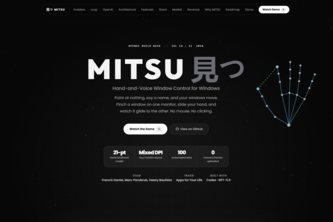
Mitsu is a self-reported prototype desktop window manager that uses webcam-based hand-and-voice gesture control for Windows. The project was built as part of the OpenAI 2026 hackathon and is described as a functional, test-driven proof-of-concept rather than a commercial product.
What changed
The description indicates this is an early-stage prototype with no evidence of revenue, customers or adoption. It was built in Python using OpenCV, MediaPipe, pywin32, and GPT-5.6 for optional reasoning. The team has not yet launched a product to market.
Single most important open question
Is there any evidence that Mitsu has moved beyond the prototype stage into a viable commercial or partnership opportunity?
What The Product Actually Is
The description states that Mitsu is a Windows hand-and-voice window manager built around a webcam, designed for multi-monitor desktops. It allows users to:
- Grip and continuously move real application windows across multiple monitors.
- Restore and move minimized windows using voice commands such as “Please show MITSU Messages on the upper monitor.”
- Use physical-pixel hand gestures (e.g., two-fingertip click, V-sign shelf) for window interaction.
- Support navigation gestures like Back and Forward using pinky or ring fingers.
- Validate window targets and include a global kill switch for safe recovery.
It uses OpenCV, MediaPipe Hand Landmarker, pywin32, and OpenAI transcription. A GPT-5.6 function-calling layer is included but intentionally gated behind configuration to avoid network dependency in core interaction loops.
Inference The product is a desktop control tool that combines computer vision, gesture recognition, voice input, and OS-level window manipulation — all within a Windows environment.
Positioning & Claim Evolution
The description states that Mitsu was inspired by the friction of multi-monitor setups where users must break focus to move windows. It positions itself as an alternative to mouse-based control, aiming to make window management feel like handling physical objects.
It claims to offer:
- A continuous grip-and-drag interaction instead of snap-only movement.
- Voice commands for restoring and relocating minimized windows.
- A safe design with validation, integrity checks, and a kill switch.
- A test suite covering core behaviors, including gesture logic, window control, voice parsing, and safety.
It also notes that the team learned to prioritize restraint in interaction design and that cloud reasoning should complement local interaction, not dominate it.
Inference Mitsu positions itself as a tool for improving desktop productivity through hands-free control, with an emphasis on reliability and accessibility. It is not described as a commercial product or platform but as a prototype built for a hackathon.
Target Customer & ICP
The description does not name specific customer segments or personas. However, it implies that Mitsu targets users working in multi-monitor environments who experience friction when managing windows.
It also suggests a potential audience of people interested in:
- Reducing repetitive mouse movement.
- Improving accessibility through non-mouse control methods.
- Using voice and gesture to interact with desktop applications.
Inference The ICP is likely power users or professionals working on dual or multi-monitor setups, possibly including those seeking more ergonomic or accessible computing options. No explicit customer data or user research is provided.
Business Model & Pricing Evidence
There is no evidence of a business model or pricing strategy in the description. The project is described as a prototype, not a product with a monetization plan.
Inference No commercial revenue, licensing, or subscription models are evident from the self-reported account.
Technical & Delivery Signals
The project is built in Python for Windows, using:
- OpenCV for camera capture.
- MediaPipe Hand Landmarker for on-device hand landmarks.
- pywin32 for direct Windows API interaction.
- One Euro Filter to reduce jitter.
- GPT-5.6 used for optional, non-real-time reasoning.
- A gesture state machine managing IDLE, TRACKING, GRIPPED, and RELEASING states.
It includes:
- DPI-aware virtual desktop implementation.
- Per-monitor DPI awareness.
- Test suite covering gesture behavior, coordinate math, window control, voice parsing, safety controls, and cloud fallback behavior.
The system is designed to be local-first, with optional GPT integration for flexibility rather than core dependency.
Inference The technical stack suggests a functional prototype built with modern tools for real-time interaction. It shows attention to detail in handling complex desktop environments like multi-monitor setups and DPI issues.
Traction & Maturity Signals
The description states that this is a prototype, not a product, and was submitted to the OpenAI 2026 hackathon. There is no evidence of:
- Revenue
- Customers
- Adoption
- Product-market fit
- Market traction or usage data
Inference The project has not yet reached a commercial or market-ready stage.
Competitive Context
The description does not mention any competitors or direct market comparisons. It is unclear whether similar tools exist in the market for gesture-based desktop control, voice-assisted window management, or multi-monitor productivity tools.
Inference No competitive landscape is described, and no evidence of existing solutions or market positioning is provided.
Open Questions & Risks
- The project is a prototype, not a product.
- No revenue, customers, or adoption data are reported.
- The use of GPT-5.6 is noted as optional and gated — but its inclusion raises questions about scalability, latency, or dependency on external services.
- The system is built for Windows only, limiting potential market reach.
- The team size is small (4 members), which may limit development velocity or commercialization capacity.
- No mention of IP, patents, or proprietary technology beyond the codebase.
Inference The biggest risk is that Mitsu remains a hackathon prototype with no clear path to product-market fit or commercial viability.
Questions the description leaves open
- What is the current status of Mitsu — is it still under development, or has it been shelved?
- Has there been any user testing or feedback from real users beyond the team?
- Are there plans to expand beyond Windows or support other operating systems?
- How does the team plan to monetize or commercialize this tool if at all?
- What are the technical limitations of the current prototype, and how might they be addressed in a full product?
- Is there any intention to pursue partnerships with hardware or software vendors?
Overall Assessment
Not evidenced.
The description indicates that Mitsu is a hackathon prototype, not a commercial product. There is no evidence of:
- Revenue
- Customers
- Market traction
- Product-market fit
- Commercial strategy
It is described as a functional, test-driven proof-of-concept built for a hackathon. The team has not yet launched or scaled the project.
Inference At this stage, Mitsu does not present a viable investment or partnership opportunity. It may be of interest if the team plans to commercialize it, but there is no evidence of that in the description.
User Stories BotA demo video on every pull request
Get a demo video on every new feature
GitHub App that watches your pull requests and records a narrated, captioned demo.
Save time on demo prep and make informed decisions faster with a video walkthrough of every new feature.
Source
Submitted to the OpenAI 2026 hackathon on Devpost. Project home on Devpost. Back to the full gallery on Devpost.
This competitive analysis was produced by top-founders.com (opens in a new tab)
Generated by a language model from this project's public Devpost page — its tagline, the author's own write-up and any built-with tags listed there — as captured in August 2026. Short quotations are the author's words. It is an opinion on the idea as a business, not on the people behind it, and it reflects the description as published then. If the project has moved on, request a correction below. The analysis is not independent research and contains no verified traction, revenue or customer data.
An independent guide by KFG International LLC — not affiliated with, endorsed by, or connected to Devpost or OpenAI.