

Archive position — measured, not model output
1 like on Devpost
505 of the 7,850 archived projects have more likes, and 1,758 share exactly 1 — so this project's #2,006 place in the like-ranked listing is a tie-break inside that group, not a ranking.
Projects (log scale)
Likes on Devpost. ▲ marks this project's group.
Show the figures
| Likes | Projects | Share of archive |
|---|---|---|
| 0 | 5,587 | 71.2% |
| 1 | 1,758 | 22.4% |
| 2 | 284 | 3.6% |
| 3–4 | 132 | 1.7% |
| 5–9 | 75 | 1.0% |
| 10+ | 14 | 0.2% |
 User Stories BotA demo video on every pull request
Get a demo video on every new feature
GitHub App that watches your pull requests and records a narrated, captioned demo.
Save time on demo prep and make informed decisions faster with a video walkthrough of every new feature.
Executive Summary
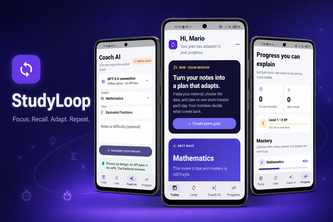
StudyLoop, as described by its author, is a mobile learning application for Android that uses AI to generate adaptive study missions from a learner’s own notes and exam dates. The app claims to create personalized, grounded practice through structured micro-lessons and spaced-review mechanisms, with an emphasis on privacy and offline functionality.
The product appears to be built around a hybrid approach: deterministic scheduling and review logic powered by a local engine, while generative AI (specifically GPT-5.6 Sol) is used only for creating structured learning content. It includes features like a mistake-rescue queue, explainable topic ordering, and offline fallbacks.
The author states that the project was built end-to-end with human-AI collaboration using tools such as Flutter, FastAPI, Codex, and OpenAI APIs. The team size is listed as one (Pro Pino), and it was submitted to the OpenAI 2026 hackathon.
Key commercial due-diligence question: Is there evidence of user adoption or engagement beyond the single developer’s self-reported experience? There is no traction data, revenue, or customer base described — only a prototype built in a hackathon context.
What The Product Actually Is
The description states that StudyLoop:
- Turns learner notes and exam dates into adaptive daily missions.
- Creates focused micro-lessons using GPT-5.6 Sol.
- Provides distraction-free sessions with three grounded retrieval questions at the end.
- Uses a local rescue queue for missed questions, which reappear until correctly answered.
- Updates mastery levels, readiness, and next review intervals based on answers.
- Explains why topics are recommended instead of hiding decisions behind AI scores.
- Offers an optional offline fallback that does not require backend or API keys.
It is described as an Android app built with Flutter and FastAPI, using SharedPreferences for local data storage and Pydantic Structured Outputs to validate learning content. The system separates generative AI use from scheduling logic, ensuring transparency in decision-making.
Inference: The product seems designed to support spaced repetition and retrieval practice, but the actual mechanics of how this works beyond the prototype are not detailed.
Positioning & Claim Evolution
The author claims StudyLoop:
- Rewards learning outcomes over time spent.
- Focuses on what becomes stronger and why a specific topic should come back next.
- Uses AI to generate grounded practice from learner input, rather than generic content.
- Prioritizes privacy with local storage and no API key shipping in the APK.
- Offers explainable topic ordering and readiness evidence.
The positioning evolves from a general "study app" to one focused on adaptive learning, personalization, and learner agency — emphasizing that the learner knows what they’ve strengthened and why something returns next.
Inference: The claim of “grounded practice” implies some form of alignment between content and learning objectives, but no evidence is provided about how this grounding occurs outside of the AI generation step.
Target Customer & ICP
The description states:
- The app targets learners preparing for exams.
- Learners add subjects, topics, deadlines, and study material.
- It supports both individual users and potentially future integrations with school platforms.
There is no explicit mention of age groups, educational levels, or institutional use cases beyond the general idea of exam preparation.
Inference: The ICP likely includes students (possibly high school or college-level) who are self-directed in their learning and want structured, adaptive support. However, there is no evidence of segmentation or targeting beyond this broad category.
Business Model & Pricing Evidence
The description does not contain any information about:
- Revenue model
- Pricing strategy
- Monetization plans
- Subscription tiers
- Paid features
It mentions optional teacher-created curricula and future integrations with LMS platforms, but no commercial structure is described.
Inference: No business model or pricing evidence is present. The app appears to be a prototype built for a hackathon, not a commercial product.
Technical & Delivery Signals
The author states:
- Built using Flutter (Android), FastAPI backend, and GPT-5.6 Sol.
- Uses SharedPreferences for local progress tracking.
- Employs Pydantic Structured Outputs for reliable lesson contracts.
- Integrates OpenAI Responses API with store=False to prevent data leakage.
- Includes a complete offline demo labeled clearly as such.
- Codex was used throughout development, including UI design, backend implementation, testing, and documentation.
Inference: The technical stack suggests a lightweight, privacy-conscious solution. However, the lack of production-scale infrastructure or deployment details indicates this is a prototype, not a scalable product.
Traction & Maturity Signals
The description contains no evidence of:
- Users or customer base
- Revenue or monetization
- Product usage metrics
- Customer feedback or retention
- Market traction or adoption
It was submitted to a hackathon and built in a short timeframe by one developer. The app is described as a prototype.
Inference: There is no indication of product maturity or market traction beyond the single developer’s experience.
Competitive Context
The description does not reference any competitors, nor does it describe how StudyLoop differentiates from existing tools like Anki, Quizlet, Khan Academy, or other adaptive learning platforms.
Inference: No competitive positioning or differentiation is evident in the self-reported write-up. The author does not discuss prior art or strategic advantages.
Open Questions & Risks
- Unverified claims: All descriptions are self-reported and unverified.
- No traction or revenue: No evidence of users, adoption, or monetization.
- Single developer team: Limited capacity for scaling or iteration beyond prototype stage.
- Prototype nature: Built in a hackathon context; no indication of long-term viability or market fit.
- AI dependency without validation: While GPT-5.6 is used, there’s no evidence that the generated content meets educational standards or effectiveness benchmarks.
- Limited scope: The app only supports English and small-screen Android devices.
Questions the description leaves open
- What specific learning outcomes or performance metrics have you observed in test users?
- How do you plan to validate the quality of AI-generated content against educational standards?
- Have you conducted any user research or usability testing beyond your own experience?
- What is your roadmap for transitioning from a hackathon prototype to a viable product?
- Are there any plans to integrate with existing LMS or school systems, and what are the technical challenges involved?
- How do you intend to monetize this product if it becomes widely adopted?
- What kind of feedback have you received from educators or students who tried the app?
Overall Assessment
The description indicates that StudyLoop is a prototype built during a hackathon, with no evidence of traction, revenue, or customer adoption.
It is described as a privacy-first, adaptive learning tool using AI to generate structured content and manage spaced review. However, the lack of any commercial data, user base, or scalability indicators makes it difficult to assess its viability for investment or partnership.
Assessment: Not ready for investment or strategic partnership at this stage. The project shows potential in concept but lacks evidence of real-world usage or business model development. A follow-up evaluation would be needed after proof-of-concept testing and early user feedback.
User Stories BotA demo video on every pull request
Get a demo video on every new feature
GitHub App that watches your pull requests and records a narrated, captioned demo.
Save time on demo prep and make informed decisions faster with a video walkthrough of every new feature.
Source
Submitted to the OpenAI 2026 hackathon on Devpost. Project home on Devpost. Back to the full gallery on Devpost.
This competitive analysis was produced by top-founders.com (opens in a new tab)
Generated by a language model from this project's public Devpost page — its tagline, the author's own write-up and any built-with tags listed there — as captured in August 2026. Short quotations are the author's words. It is an opinion on the idea as a business, not on the people behind it, and it reflects the description as published then. If the project has moved on, request a correction below. The analysis is not independent research and contains no verified traction, revenue or customer data.
An independent guide by KFG International LLC — not affiliated with, endorsed by, or connected to Devpost or OpenAI.