

Archive position — measured, not model output
0 likes on Devpost
2,263 of the 7,850 archived projects have more likes, and 5,587 share exactly 0 — so this project's #6,899 place in the like-ranked listing is a tie-break inside that group, not a ranking.
Projects (log scale)
Likes on Devpost. ▲ marks this project's group.
Show the figures
| Likes | Projects | Share of archive |
|---|---|---|
| 0 | 5,587 | 71.2% |
| 1 | 1,758 | 22.4% |
| 2 | 284 | 3.6% |
| 3–4 | 132 | 1.7% |
| 5–9 | 75 | 1.0% |
| 10+ | 14 | 0.2% |
 User Stories BotA demo video on every pull request
Get a demo video on every new feature
GitHub App that watches your pull requests and records a narrated, captioned demo.
Save time on demo prep and make informed decisions faster with a video walkthrough of every new feature.
Executive Summary
What the company appears to be
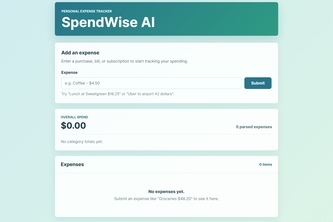
SpendWise AI is a self-reported personal finance tool that allows users to log expenses via natural language input (e.g., “spent 200 on groceries”) and automatically categorizes them without requiring traditional form inputs. It was built as a hackathon submission by one developer using React, Vite, and local rule-based parsing logic.
What changed
The project is described as an early-stage prototype submitted to the OpenAI 2026 hackathon. No evidence of prior development or commercial activity exists beyond this self-reported write-up.
Single most important open question
Is there any evidence that this product has been used by users, or that it generates revenue, customers, or traction? The description contains no data on adoption, usage, monetization, or even a functional demo beyond the author’s own claims.
What The Product Actually Is
The description states that SpendWise AI is a personal expense-tracking application where users can type expenses in natural language such as “spent 200 on groceries” or “uber to airport 42 dollars.” It claims to automatically extract amounts and assign categories (Food, Travel, Shopping, etc.) using a local rule-based engine. The app displays a list of expenses and a real-time dashboard showing total spend and category breakdowns.
The frontend was built with React + Vite, styled with CSS, and uses no external APIs for parsing or categorization. It is described as fully functional without reliance on paid services.
Evidence Self-reported by the author; no independent verification.
Confidence Low — this is a prototype, not a product in production.
Positioning & Claim Evolution
The project positions itself as an alternative to traditional expense-tracking apps that require manual form inputs. The tagline emphasizes ease of use: “Just type 'spent 200 on food' and let AI auto-categorize and track your daily expenses — no forms, no hassle, just chat.”
It claims to offer a faster, more intuitive way to log spending by leveraging natural language processing (NLP) through rule-based parsing rather than machine learning or AI models.
Evidence Self-reported.
Confidence Low — the description does not confirm that any AI or ML is used beyond rule-based matching; it may be overpromising on capabilities.
Target Customer & ICP
The author states that the app targets individuals who find traditional expense-tracking apps tedious due to their multi-step input process. The primary user persona appears to be someone looking for a simple, fast way to log daily spending without filling out forms or navigating dropdown menus.
Evidence Self-reported.
Confidence Low — no evidence of market research, customer interviews, or actual user feedback is provided.
Business Model & Pricing Evidence
There is no mention in the description of how SpendWise AI intends to monetize its service. The app is described as free to run and fully functional without external APIs, suggesting it may not have a paid model at this stage.
No pricing information, subscription tiers, or revenue streams are stated.
Evidence Self-reported.
Confidence Very low — no indication of business model or monetization strategy.
Technical & Delivery Signals
The project was built using React with Vite for frontend development. The parsing logic is described as a local rule-based engine that uses pattern matching and keyword detection to extract amounts and assign categories.
It is claimed to be mobile-responsive, fast, and functional without external APIs or paid services.
Evidence Self-reported.
Confidence Low — the technical approach is not validated; no code review, performance metrics, or scalability data are provided.
Traction & Maturity Signals
There is no evidence of traction, adoption, or user engagement beyond the author’s own description. The project was submitted to a hackathon and is described as a prototype built by one person. No revenue, customers, or usage statistics are mentioned.
Evidence Self-reported.
Confidence Very low — no signs of product-market fit or real-world use.
Competitive Context
The author does not reference any existing competitors or market positioning beyond stating that current apps are tedious to use. The app is positioned as a faster alternative, but there is no competitive analysis or differentiation strategy described.
Evidence Self-reported.
Confidence Low — no evidence of awareness of existing personal finance tools or their features.
Open Questions & Risks
- Unproven technology claims: The description implies AI-driven parsing but uses rule-based logic; this could mislead users.
- No commercial traction: No evidence of users, revenue, or adoption.
- Single-person team: Limited capacity for scaling or iterating quickly.
- Hackathon prototype: Likely not production-ready or tested in real-world conditions.
- No monetization strategy: Unclear how the product will generate value or revenue.
Evidence Self-reported.
Confidence Medium to high — based on lack of evidence, these are reasonable concerns.
Questions the description leaves open
- What is the actual parsing mechanism used? Is it truly AI-based or rule-based?
- Have you tested this with real users or collected any feedback?
- How do you plan to scale beyond a single developer?
- Are there any plans for monetization or revenue generation?
- What are your long-term goals for the product — is it intended to be a standalone app or part of a larger platform?
Overall Assessment
There is no evidence that SpendWise AI has achieved any commercial traction, customer base, or revenue. It is described as a hackathon submission by one developer with no external validation or data on performance, adoption, or monetization.
Assessment Not evidenced — no basis for investment or partnership consideration at this time.
Confidence Very low — the description lacks any signal of product-market fit, commercial viability, or strategic positioning.
User Stories BotA demo video on every pull request
Get a demo video on every new feature
GitHub App that watches your pull requests and records a narrated, captioned demo.
Save time on demo prep and make informed decisions faster with a video walkthrough of every new feature.
Source
Submitted to the OpenAI 2026 hackathon on Devpost. Project home on Devpost. Back to the full gallery on Devpost.
This competitive analysis was produced by top-founders.com (opens in a new tab)
Generated by a language model from this project's public Devpost page — its tagline, the author's own write-up and any built-with tags listed there — as captured in August 2026. Short quotations are the author's words. It is an opinion on the idea as a business, not on the people behind it, and it reflects the description as published then. If the project has moved on, request a correction below. The analysis is not independent research and contains no verified traction, revenue or customer data.
An independent guide by KFG International LLC — not affiliated with, endorsed by, or connected to Devpost or OpenAI.