

Archive position — measured, not model output
0 likes on Devpost
2,263 of the 7,850 archived projects have more likes, and 5,587 share exactly 0 — so this project's #6,900 place in the like-ranked listing is a tie-break inside that group, not a ranking.
Projects (log scale)
Likes on Devpost. ▲ marks this project's group.
Show the figures
| Likes | Projects | Share of archive |
|---|---|---|
| 0 | 5,587 | 71.2% |
| 1 | 1,758 | 22.4% |
| 2 | 284 | 3.6% |
| 3–4 | 132 | 1.7% |
| 5–9 | 75 | 1.0% |
| 10+ | 14 | 0.2% |
 User Stories BotA demo video on every pull request
Get a demo video on every new feature
GitHub App that watches your pull requests and records a narrated, captioned demo.
Save time on demo prep and make informed decisions faster with a video walkthrough of every new feature.
Executive Summary
What the company appears to be
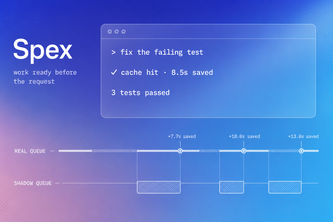
Spex is a speculative execution system for coding agents that predicts and pre-runs verification actions (like tests, linting, type-checking, builds) while the agent is reasoning. It aims to reduce latency by running predictable verification work in the background before it's explicitly requested.
What changed
The project description indicates this was built as part of a hackathon submission (OpenAI 2026 hackathon). It describes a working prototype with evaluation data, but no evidence of commercial traction or product-market fit beyond the benchmarked use case.
Single most important open question
Is there evidence that Spex can be scaled to real-world coding environments outside of controlled benchmarks like SWE-bench and OpenHands?
What The Product Actually Is
The description states that Spex is a system designed to bring CPU-style branch prediction to coding-agent tools. It watches Codex through an app-server event stream, predicts the next safe verification action (e.g., test, lint, type-check, build), and starts that work in the background while Codex is still reasoning.
Spex uses:
- A mined pattern table from real coding-agent trajectories.
- A PrefixSpan-style pipeline to turn recurring tool sequences into transition probabilities.
- A two-slot shadow queue for speculative execution.
- A cache system keyed by source epoch, which invalidates older results.
- A dynamic tool (
prefetch_verify) that allows Codex to retrieve precomputed verification results.
It is built with:
- Codex and Codex app-server
- Node.js, Python
- JSON-RPC, JSONL event traces
- SWE-bench Verified, OpenHands, and SWE-agent trajectories
The system does not inject unrequested results into the conversation; it only serves cached results via a pull-only mechanism.
Positioning & Claim Evolution
The description states that Spex addresses inefficiencies in current coding agents that run a serial loop: think → call tool → wait → read result → think again. It positions itself as solving latency issues by enabling speculative execution without adding another LLM inference step.
Claims made:
- Spex brings CPU-style branch prediction to coding-agent tools.
- It predicts verification actions based on session trajectory and uses a map lookup for runtime prediction (no second model call).
- It pre-runs repository verifiers in the background, reducing wall time by 13.9% in benchmarks.
- It achieves an 80% serve rate of speculative verification calls.
- It avoids contaminating Codex's context with wrong predictions through a pull-only tool boundary.
These claims are self-reported and not independently verified.
Target Customer & ICP
The description does not explicitly state the target customer or ideal customer profile (ICP). However, it implies that Spex is intended for developers using coding agents like Codex, particularly those working in environments where verification latency is a bottleneck.
It targets:
- Developers using AI-powered coding tools.
- Teams seeking to optimize agent performance and reduce wait times during code editing.
No evidence of specific customer segments, personas, or adoption data is provided.
Business Model & Pricing Evidence
There is no evidence of any business model or pricing structure in the description. The project is presented as a prototype built for a hackathon, with no indication of monetization strategy, revenue streams, or commercialization plans.
Technical & Delivery Signals
The description provides technical details:
- Built using Codex and Codex app-server.
- Implemented with Node.js, Python, JSON-RPC, and JSONL traces.
- Uses sequential-pattern mining (PrefixSpan-style) to build a predictor.
- Implements a shadow queue for speculative execution.
- Includes source-epoch fencing to prevent stale results from entering the conversation.
- Has a dynamic tool (
prefetch_verify) that integrates with Codex.
The authors report:
- A working prototype with evaluation data.
- An acceptance gate-driven development process.
- A full suite of tests, benchmark harnesses, and analyzers.
- Commitment to trace-based auditing and reproducibility.
This suggests a strong engineering foundation but no evidence of production deployment or scalability beyond the benchmarked environment.
Traction & Maturity Signals
There is no evidence of traction or maturity beyond the hackathon submission:
- No customers, users, or adoption metrics.
- No revenue or funding data.
- No product-market fit indicators.
- No live deployments or real-world usage reported.
- The project was built for a single hackathon event.
The evaluation includes only benchmarked runs on SWE-bench and OpenHands datasets, with no indication of broader deployment or user feedback.
Competitive Context
The description does not mention competitors or competitive positioning. It focuses on the technical innovation of speculative execution in coding agents but does not place Spex within a larger market landscape.
No evidence of existing solutions addressing similar latency issues in AI-assisted coding environments is provided.
Open Questions & Risks
- Benchmark contamination: The authors acknowledge that early benchmarks had contamination issues and had to rebuild the evaluation harness.
- Limited scope: Spex currently only speculates on verification actions; it does not yet handle source edits, shell commands, API calls, or model calls.
- Platform focus: The current environment is macOS-focused, with limited platform or project-type coverage.
- No commercialization path: No evidence of a business model, pricing, or go-to-market strategy.
- Prototype-only status: The system is described as a hackathon prototype with no indication of production readiness or scalability.
Questions the description leaves open
- What are the key assumptions underlying your prediction model? How robust is it across different types of repositories?
- Can Spex be extended to other tool calls beyond verification (e.g., source edits, shell commands)?
- How does Spex handle edge cases where predictions fail or misalign with actual needs?
- Are there plans to support more platforms and project types beyond macOS?
- What is the current level of integration with Codex? Is it a standalone tool or deeply embedded in the agent architecture?
- Do you have any internal metrics or feedback from users beyond the benchmarked runs?
Overall Assessment
Not evidenced.
The description presents Spex as a hackathon prototype with strong technical execution and promising early results in controlled benchmarks. However, there is no evidence of commercial traction, customer adoption, revenue, or scalability beyond the specific use case tested. The project lacks clear commercialization plans or business model indicators.
Given the self-reported nature of all data and the absence of any external validation, this analysis cannot support a conclusion about investment or partnership viability at this stage.
User Stories BotA demo video on every pull request
Get a demo video on every new feature
GitHub App that watches your pull requests and records a narrated, captioned demo.
Save time on demo prep and make informed decisions faster with a video walkthrough of every new feature.
Source
Submitted to the OpenAI 2026 hackathon on Devpost. Project home on Devpost. Back to the full gallery on Devpost.
This competitive analysis was produced by top-founders.com (opens in a new tab)
Generated by a language model from this project's public Devpost page — its tagline, the author's own write-up and any built-with tags listed there — as captured in August 2026. Short quotations are the author's words. It is an opinion on the idea as a business, not on the people behind it, and it reflects the description as published then. If the project has moved on, request a correction below. The analysis is not independent research and contains no verified traction, revenue or customer data.
An independent guide by KFG International LLC — not affiliated with, endorsed by, or connected to Devpost or OpenAI.