

Archive position — measured, not model output
0 likes on Devpost
2,263 of the 7,850 archived projects have more likes, and 5,587 share exactly 0 — so this project's #2,976 place in the like-ranked listing is a tie-break inside that group, not a ranking.
Projects (log scale)
Likes on Devpost. ▲ marks this project's group.
Show the figures
| Likes | Projects | Share of archive |
|---|---|---|
| 0 | 5,587 | 71.2% |
| 1 | 1,758 | 22.4% |
| 2 | 284 | 3.6% |
| 3–4 | 132 | 1.7% |
| 5–9 | 75 | 1.0% |
| 10+ | 14 | 0.2% |
 User Stories BotA demo video on every pull request
Get a demo video on every new feature
GitHub App that watches your pull requests and records a narrated, captioned demo.
Save time on demo prep and make informed decisions faster with a video walkthrough of every new feature.
Executive Summary
What the company appears to be
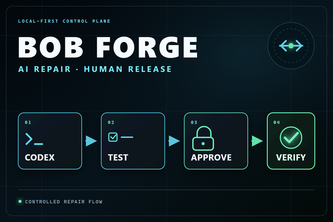
BOB Forge is a self-reported local-first release control plane for incident response and patch deployment. The author states it isolates and tests patches locally, binds phone approval to exact bytes, deploys, verifies, and rolls back changes — all within a Windows PC environment with mobile phone interaction.
What changed
The project was built during an OpenAI 2026 hackathon as a vertical slice demonstrating one workflow: diagnosing a broken reconnect service, applying a patch via local Codex/GPT-5.6, validating and deploying it in Docker containers, and recording evidence for rollback or review.
Single most important open question
Does BOB Forge demonstrate a viable product that can be scaled beyond a single developer’s hackathon prototype, or is it a proof-of-concept with no commercial traction?
What The Product Actually Is
The description states:
- BOB Forge is a local-first release control plane for incident response.
- It runs on a Windows PC and supports mobile phone interaction via Wi-Fi.
- It uses Codex and GPT-5.6 to diagnose incidents and propose patches.
- Patches are validated, tested in Docker containers, and deployed only after human approval.
- The system records integrity digests (plan, artifact, baseline, candidate, manifest) for traceability and rollback.
- It exports a portable evidence pack with semantic assessments.
Inference The product is not a general-purpose CI/CD tool or SaaS platform but a developer-focused local workflow for patching broken services in controlled environments.
Positioning & Claim Evolution
The description states:
- The author’s inspiration was an HTTP health check showing service alive, but WebSocket feed stopped.
- BOB Forge explores whether AI can repair incidents without becoming the release authority.
- It focuses on what must be true after a patch looks plausible — not just whether it works.
- It is positioned for solo developers and small teams lacking dedicated SRE or release engineering functions.
Inference The positioning is narrow: a local, human-in-the-loop patching tool for developers who want agentic speed but need control over deployment. The claim has evolved from a hackathon demo to a concept of trustable local-first incident response.
Target Customer & ICP
The description states:
- It targets solo developers and small teams without dedicated SRE or release engineering functions.
- It is built for those who want agentic speed but need deterministic control over patching.
Inference The ICP appears to be individual developers or small engineering teams working in local environments, not enterprise or production-scale users.
Business Model & Pricing Evidence
Not evidenced.
The description does not state anything about pricing, monetization, or business model. It is a self-reported hackathon project with no indication of commercial viability or revenue streams.
Technical & Delivery Signals
The description states:
- Built in Python, using SQLite for durable storage.
- Uses HTML/CSS/JS for responsive HUD on desktop and mobile.
- Integrates Codex and GPT-5.6 for diagnosis and patch generation.
- Patches are validated using file-boundary checks, hash comparisons, and AST restrictions.
- Docker containers are used for testing and deployment.
- Approval is bound to five integrity digests.
- Evidence pack can be verified without Codex, Docker, or API keys.
Inference The technical stack is local-first, with strong emphasis on deterministic validation and traceability. The architecture suggests a focus on security, auditability, and developer control.
Traction & Maturity Signals
Not evidenced.
There is no mention of users, customers, revenue, adoption, or product usage beyond the single hackathon demo. No evidence of traction or maturity in the description.
Competitive Context
Not evidenced.
The description does not reference competitors, market positioning, or competitive landscape. It does not state whether similar tools exist or how BOB Forge compares to them.
Open Questions & Risks
Inference
- The product is described as a single vertical slice from a hackathon project — no indication of scalability or production readiness.
- It is built for local Windows environments and mobile phone interaction, limiting its applicability.
- The use of GPT-5.6 implies dependency on proprietary models, which may not be sustainable.
- No evidence of commercial viability, monetization, or customer feedback.
- The system does not claim to support arbitrary repositories or production deployment — it is limited in scope.
Questions the description leaves open
- What is the intended evolution from this hackathon prototype to a product that can be used at scale?
- Is there any plan for broader repository support, or is it limited to one-file patching as described?
- How does BOB Forge handle edge cases in patch validation or rollback?
- Are there plans to support other deployment targets beyond Docker containers?
- What are the long-term implications of relying on local Codex/GPT-5.6 for diagnosis and patch generation?
- Is there any intention to commercialize this, and if so, how?
Overall Assessment
Not evidenced.
There is no evidence of revenue, funding, or traction to support an investment or partnership decision. The project is described as a single developer’s hackathon effort with no indication of commercial viability or scalability. It is not clear whether this is a product in development or just a proof-of-concept.
User Stories BotA demo video on every pull request
Get a demo video on every new feature
GitHub App that watches your pull requests and records a narrated, captioned demo.
Save time on demo prep and make informed decisions faster with a video walkthrough of every new feature.
Source
Submitted to the OpenAI 2026 hackathon on Devpost. Project home on Devpost. Back to the full gallery on Devpost.
This competitive analysis was produced by top-founders.com (opens in a new tab)
Generated by a language model from this project's public Devpost page — its tagline, the author's own write-up and any built-with tags listed there — as captured in August 2026. Short quotations are the author's words. It is an opinion on the idea as a business, not on the people behind it, and it reflects the description as published then. If the project has moved on, request a correction below. The analysis is not independent research and contains no verified traction, revenue or customer data.
An independent guide by KFG International LLC — not affiliated with, endorsed by, or connected to Devpost or OpenAI.