

Archive position — measured, not model output
0 likes on Devpost
2,263 of the 7,850 archived projects have more likes, and 5,587 share exactly 0 — so this project's #6,901 place in the like-ranked listing is a tie-break inside that group, not a ranking.
Projects (log scale)
Likes on Devpost. ▲ marks this project's group.
Show the figures
| Likes | Projects | Share of archive |
|---|---|---|
| 0 | 5,587 | 71.2% |
| 1 | 1,758 | 22.4% |
| 2 | 284 | 3.6% |
| 3–4 | 132 | 1.7% |
| 5–9 | 75 | 1.0% |
| 10+ | 14 | 0.2% |
 User Stories BotA demo video on every pull request
Get a demo video on every new feature
GitHub App that watches your pull requests and records a narrated, captioned demo.
Save time on demo prep and make informed decisions faster with a video walkthrough of every new feature.
Executive Summary
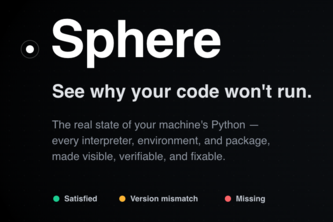
What the company appears to be: Sphere (Orbis) is a self-reported developer tool that visualizes and fixes Python environment issues for beginners. The author states it shows the real state of a machine's Python setup as an interactive graph, diagnoses problems by running commands against interpreters, and proposes fixes while proving them with evidence.
What changed: The project description indicates this is a hackathon submission (Devpost entry) that was built in a short timeframe. It represents a single-person effort with no external funding or traction evidenced. The author describes the tool as a proof-of-concept for an idea they wish they'd had as a beginner programmer.
The single most important open question: Is there any evidence of actual user adoption, revenue, or market traction beyond the author's self-description? The description states no such data exists.
What The Product Actually Is
The description states that Sphere is:
- A Python backend and React front-end tool
- A "truth engine" that discovers interpreters across multiple install methods (PATH, pyenv, uv, Homebrew, conda)
- Capable of reading each interpreter's packages by running isolated subprocesses
- Designed to show the real state of a machine's Python setup as a live, interactive graph
- A tool that figures out which interpreter a folder resolves to and checks whether it can satisfy project requirements
- Not just diagnostic but also capable of fixing broken environments and verifying fixes
The author claims the tool "turns a broken environment into a working one" by creating isolated environments where needed rather than polluting global Python.
Inference: The tool appears to be focused on solving beginner-level Python setup issues, particularly ModuleNotFoundError, through visualization and automated fix mechanisms.
Positioning & Claim Evolution
The description states that Sphere is positioned as:
- A solution for beginner programmers who are "constantly confused and discouraged by ModuleNotFoundError"
- A tool that makes the "invisible state of your machine visible"
- A replacement for "copy-pasting" solutions, aiming to teach users instead
- A tool that "shows you, visibly, where your machine is broken and how to fix it"
The author claims this addresses a "canon event" in beginner programming — not just an example but a widespread problem.
Inference: The positioning evolved from a personal pain point (the author's own experience) into a broader claim about solving a common barrier to entry for programming beginners. The tool is positioned as educational, trustworthy, and beginner-friendly.
Target Customer & ICP
The description states that Sphere targets:
- Beginner programmers who are "constantly confused and discouraged by ModuleNotFoundError"
- Users who struggle with Python setup issues
- People who get stuck before they even begin coding due to environment problems
Inference: The target customer is likely early-stage developers or students learning Python, particularly those using multiple interpreters or environments.
Not evidenced: No specific customer segments, personas, or usage patterns beyond the author's personal experience are described.
Business Model & Pricing Evidence
The description states:
- There is no explicit mention of pricing
- The tool is described as a single-person hackathon project
- No revenue model, monetization strategy, or pricing structure is presented
Inference: Given that this is a hackathon submission with no evidence of commercial traction, the business model has not been developed or disclosed.
Not evidenced: No information on how the product would be sold, licensed, or monetized.
Technical & Delivery Signals
The description states:
- Built with codex, css, html, javascript, python, react, shell
- Backend is a "truth engine" that discovers interpreters across install methods
- Reads packages by running isolated subprocesses to get ground truth data
- Front-end renders as a spherical graph with evidence layers and fix loops
- Uses GPT-5.6 for plain-English diagnosis layer
- Designed to be deterministic, working offline without API keys or network access
- Built with AI as an enhancement, not a crutch
Inference: The technical approach shows strong engineering focus on correctness and trustworthiness, especially in handling complex interpreter resolution and environment isolation.
Not evidenced: No information about scalability, deployment architecture, or performance metrics beyond the author's own claims.
Traction & Maturity Signals
The description states:
- This is a hackathon submission (Devpost entry)
- Built by one person (Ryan Whalen)
- No revenue, customers, or adoption data provided
- The tool is described as a "beginning to a tool that never lies about your machine"
Inference: There is no evidence of traction, user feedback, or market validation beyond the author's own account.
Not evidenced: No metrics on usage, retention, customer acquisition, or product-market fit.
Competitive Context
The description states:
- The tool addresses the "why doesn't this run on my machine" problem
- It extends naturally to other ecosystems (JavaScript/node_modules, CUDA toolchains, Docker images, Kubernetes)
- The author mentions that "as AI does more to our systems, the layer that lets us see and trust what it changed only becomes more essential"
Inference: Sphere is positioned in a competitive space of developer tools for environment management and debugging. It may compete with or complement existing tools like pipenv, conda, pyenv, and others.
Not evidenced: No direct competitors named, no market size estimates, or competitive positioning data provided.
Open Questions & Risks
The description states:
- The hardest problems were about trust — Sphere's whole value is being provably correct
- The tool had to avoid contaminating environments it inspects (e.g., its own dependencies)
- A subtle but critical bug was found in rendering a failed fix as green "success"
- The tool is described as working offline with zero API keys and zero network access
Inference: Key risks include:
- Trustworthiness of the tool — if users don't trust it, adoption will be low
- Complexity of environment resolution across multiple systems (PATH, pyenv, etc.)
- Risk of false positives or negatives in diagnostics
- The tool is described as a hackathon project with no commercial traction
Open questions:
- No evidence of user testing or feedback
- No clear path to monetization or product-market fit
- Single-person development suggests limited scalability
Questions the description leaves open
- What specific user feedback have you received from early adopters?
- How do you plan to validate the correctness of your tool across different operating systems and Python versions?
- Have you tested the tool with real-world projects beyond your own?
- What is your roadmap for monetization or commercial viability?
- How do you intend to scale beyond a single-person development effort?
- What are the key assumptions in your product-market fit, and how have you validated them?
Overall Assessment
The description states:
- This is a hackathon submission
- Built by one person (Ryan Whalen)
- No evidence of revenue, customers, or traction
- The tool is described as a "beginning to a tool that never lies about your machine"
Inference: At this stage, the project appears to be an early-stage idea with strong technical execution but no commercial validation. It shows promise in solving a real problem for beginners, but lacks evidence of market demand or scalability.
Assessment: Not ready for investment or partnership at this time. The tool demonstrates potential and engineering rigor, but there is no evidence of traction, revenue, or validated customer need beyond the author's own experience. A follow-up evaluation would be warranted after proof-of-concept testing with users and early-stage market validation.
User Stories BotA demo video on every pull request
Get a demo video on every new feature
GitHub App that watches your pull requests and records a narrated, captioned demo.
Save time on demo prep and make informed decisions faster with a video walkthrough of every new feature.
Source
Submitted to the OpenAI 2026 hackathon on Devpost. Project home on Devpost. Back to the full gallery on Devpost.
This competitive analysis was produced by top-founders.com (opens in a new tab)
Generated by a language model from this project's public Devpost page — its tagline, the author's own write-up and any built-with tags listed there — as captured in August 2026. Short quotations are the author's words. It is an opinion on the idea as a business, not on the people behind it, and it reflects the description as published then. If the project has moved on, request a correction below. The analysis is not independent research and contains no verified traction, revenue or customer data.
An independent guide by KFG International LLC — not affiliated with, endorsed by, or connected to Devpost or OpenAI.