

Archive position — measured, not model output
0 likes on Devpost
2,263 of the 7,850 archived projects have more likes, and 5,587 share exactly 0 — so this project's #6,903 place in the like-ranked listing is a tie-break inside that group, not a ranking.
Projects (log scale)
Likes on Devpost. ▲ marks this project's group.
Show the figures
| Likes | Projects | Share of archive |
|---|---|---|
| 0 | 5,587 | 71.2% |
| 1 | 1,758 | 22.4% |
| 2 | 284 | 3.6% |
| 3–4 | 132 | 1.7% |
| 5–9 | 75 | 1.0% |
| 10+ | 14 | 0.2% |
 User Stories BotA demo video on every pull request
Get a demo video on every new feature
GitHub App that watches your pull requests and records a narrated, captioned demo.
Save time on demo prep and make informed decisions faster with a video walkthrough of every new feature.
Executive Summary
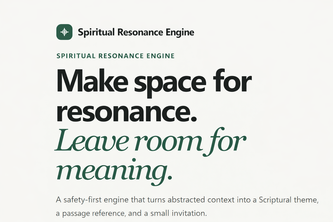
The description states that Spiritual Resonance Engine is a project submitted to the OpenAI 2026 hackathon. It presents itself as a tool for exploring meaning in moments without collecting sensitive or person-level data. The system uses a deterministic Python pipeline with safety filters and curated content, wrapped in a FastAPI service and MapLibre UI. It claims to avoid profiling by rejecting raw sensing data, identity, and predictive inputs.
Key commercial due-diligence read: What is the actual product’s utility, and how does it differ from existing spiritual or mindfulness tools? The author states that the system maps abstracted context to Scripture references and reflections, but no evidence of real-world usage or customer feedback exists. The project appears to be a prototype with strong privacy design principles, but its commercial viability, scalability, or market traction are not evidenced.
What The Product Actually Is
The description states:
- It is a deterministic Python pipeline that accepts only declared, abstracted moment metadata.
- It returns a bounded, structured response: theme, Scripture reference, pastoral reflection, micro-action, and safety information.
- It uses FastAPI to expose the engine via POST /resonate.
- It includes a MapLibre UI, which centers on city/US ZIP search but does not send coordinates or map queries to the engine.
- The system is built with GPT-5.6 and OpenAI Codex during development, but does not use any AI API calls at runtime.
Inference: The product appears to be a privacy-preserving spiritual reflection engine, designed for minimal data capture and structured output.
Positioning & Claim Evolution
The description states:
- It was built with a safety-first approach, aiming to avoid turning people into data profiles.
- It maps abstracted context to Scriptural themes, curated passages, reflections, and micro-actions.
- It is designed around the principle: “describe the moment, never the person.”
- The engine enforces strict safety gates before and after theme mapping.
Inference: The positioning is that of a responsible, privacy-first spiritual tool, distinct from traditional AI-driven personalization or profiling systems. It evolved from a hackathon project with an emphasis on responsible capture and legible sensing.
Target Customer & ICP
The description states:
- The system is designed for people who want to explore meaning in moments without being profiled.
- It maps abstracted context to spiritual content, not identity or diagnosis.
- It includes a MapLibre interface, suggesting a visual, user-facing experience.
Inference: The target customer appears to be individuals seeking reflective or spiritual guidance, particularly those concerned with privacy and data ethics. The ICP is not clearly defined beyond this general audience.
Business Model & Pricing Evidence
The description states:
- The project is open source.
- It includes setup, tests, deployment instructions, and a public input schema in the repository.
- There is no mention of pricing or monetization strategy.
- The live demo is available at a public URL.
Not evidenced: No evidence of revenue model, pricing tiers, or commercial use cases beyond the open-source demo.
Technical & Delivery Signals
The description states:
- Built with FastAPI, Python, and MapLibre.
- Uses GPT-5.6 and OpenAI Codex for development, but no runtime API calls.
- The engine is deterministic, with small, auditable modules.
- Includes safety filters, theme mapping, Scripture selection, reflection prompts, and gentle nudges.
- The UI centers on ZIP search; coordinates are not sent to the engine.
Inference: The technical architecture is privacy-preserving, deterministic, and modular. It signals a focus on auditable, safe-by-design systems.
Traction & Maturity Signals
The description states:
- It was submitted to the OpenAI 2026 hackathon.
- It is open source with documentation and deployment instructions.
- The live demo is available at a public URL.
- No evidence of revenue, customers, or adoption beyond the demo.
Not evidenced: No traction data, user base, or commercial adoption is provided. The project appears to be in early-stage prototype form.
Competitive Context
The description states:
- It avoids profiling and predictive inference.
- It maps abstracted context to Scripture references and reflections.
- It includes a MapLibre UI for visual exploration.
Inference: It competes with privacy-focused spiritual or mindfulness tools, but no direct competitors are named. The approach is unique in its emphasis on deterministic, non-profiling systems.
Open Questions & Risks
The description states:
- It is a hackathon project.
- No revenue, customers, or traction data are provided.
- The system is open source, suggesting no commercial focus.
- It uses GPT-5.6 and Codex for development, but not at runtime.
Open questions:
- No commercial viability or monetization strategy is evident.
- No user feedback or real-world usage is reported.
- The project’s scope is limited to a demo and open-source codebase.
- The system may be too niche or experimental for broader adoption.
Questions the description leaves open
- What are the actual use cases beyond the demo? Is there any user feedback or testing?
- How does the engine handle edge cases in abstracted context input?
- Are there plans to expand beyond Scriptural themes or integrate with other spiritual or wellness platforms?
- What is the long-term vision for this project — is it intended to evolve into a commercial product or remain open source?
- How do you plan to scale or monetize if the system remains deterministic and non-personalizing?
Overall Assessment
The description states:
- It is an open-source, hackathon submission.
- It is built with privacy-first principles and a deterministic pipeline.
- No evidence of traction, revenue, or commercialization.
Not evidenced: No basis for investment or partnership. The project appears to be a prototype with strong privacy design, but lacks any demonstrated market need, user base, or monetization strategy. It may be of interest as a research or experimental tool, but not as a commercial venture at this stage.
User Stories BotA demo video on every pull request
Get a demo video on every new feature
GitHub App that watches your pull requests and records a narrated, captioned demo.
Save time on demo prep and make informed decisions faster with a video walkthrough of every new feature.
Source
Submitted to the OpenAI 2026 hackathon on Devpost. Project home on Devpost. Back to the full gallery on Devpost.
This competitive analysis was produced by top-founders.com (opens in a new tab)
Generated by a language model from this project's public Devpost page — its tagline, the author's own write-up and any built-with tags listed there — as captured in August 2026. Short quotations are the author's words. It is an opinion on the idea as a business, not on the people behind it, and it reflects the description as published then. If the project has moved on, request a correction below. The analysis is not independent research and contains no verified traction, revenue or customer data.
An independent guide by KFG International LLC — not affiliated with, endorsed by, or connected to Devpost or OpenAI.