

Archive position — measured, not model output
0 likes on Devpost
2,263 of the 7,850 archived projects have more likes, and 5,587 share exactly 0 — so this project's #2,979 place in the like-ranked listing is a tie-break inside that group, not a ranking.
Projects (log scale)
Likes on Devpost. ▲ marks this project's group.
Show the figures
| Likes | Projects | Share of archive |
|---|---|---|
| 0 | 5,587 | 71.2% |
| 1 | 1,758 | 22.4% |
| 2 | 284 | 3.6% |
| 3–4 | 132 | 1.7% |
| 5–9 | 75 | 1.0% |
| 10+ | 14 | 0.2% |
 User Stories BotA demo video on every pull request
Get a demo video on every new feature
GitHub App that watches your pull requests and records a narrated, captioned demo.
Save time on demo prep and make informed decisions faster with a video walkthrough of every new feature.
Executive Summary
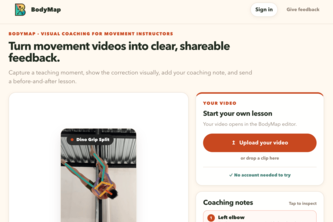
What the company appears to be: BodyMap is a computer-vision-based tool designed for movement instructors (e.g., pole dance, dance, weightlifting teachers) to provide visual coaching feedback by overlaying recommended body poses on student videos. The author describes it as an application that allows instructors to capture a moment from a student’s movement video, adjust a pose overlay to demonstrate the correct position, and share this as an animated review or downloadable video.
What changed: The project was built as part of a hackathon submission (OpenAI 2026) by one developer, Steven Chu. It represents a self-contained prototype with no evidence of prior traction, revenue, or customer adoption.
Single most important open question: Is there any evidence that movement instructors are interested in using this tool beyond the author’s personal experience as a pole dance instructor?
What The Product Actually Is
The description states that BodyMap is a React and TypeScript application built with Vite, using MediaPipe Pose Landmarker for body landmark detection. It allows instructors to:
- Upload a movement video
- Capture a key moment
- Confirm or adjust detected pose landmarks
- Create a recommended pose overlay
- Annotate changes with coaching notes
- Generate an animated review or downloadable MP4
The tool integrates Supabase for authentication, media storage, and project management, and uses a separate FFmpeg rendering service to produce shareable videos.
Inference: The system is a hybrid of computer vision (for pose detection), UI editing (for overlay adjustment), and video rendering (for output). It is not described as a SaaS platform or marketplace but rather a desktop/mobile tool for individual instructors.
Positioning & Claim Evolution
The author claims that BodyMap helps movement teachers provide more effective coaching by turning verbal feedback into visual coaching artifacts. The core idea is to help students better understand corrections through animated transitions between original and recommended poses, instead of relying on static diagrams or written instructions.
Inference: The positioning is rooted in improving learning retention and clarity in movement instruction, especially for disciplines where visual feedback is critical but often delivered verbally.
There is no evidence of prior branding, marketing claims, or customer testimonials. The description is self-reported and unverified.
Target Customer & ICP
The author states that BodyMap is intended for movement instructors such as:
- Pole dance teachers
- Dance instructors
- Weightlifting coaches
- Aerial sports trainers
These users are described as those who currently give feedback verbally, often through video recordings, and struggle with students retaining the coaching after lessons.
Inference: The ICP appears to be individual or small group movement instructors working in niche disciplines where visual correction is essential but not well-supported by existing tools.
No evidence of segmentation beyond this broad category.
Business Model & Pricing Evidence
There is no evidence of a business model, pricing structure, monetization strategy, or revenue streams. The project is described as a hackathon submission with no indication that it has moved beyond prototype stage or is being offered for sale or use by others.
Inference: If this tool were to be commercialized, the author implies it would be used in one-on-one or small group instruction settings, but no pricing model or distribution plan is described.
Technical & Delivery Signals
The system is built using:
- React and TypeScript
- Vite for build tooling
- MediaPipe Pose Landmarker for pose detection
- Supabase for backend services (auth, storage)
- FFmpeg for video rendering
- AI tools like Codex for prototyping and implementation
The author notes that:
- The interface is responsive, adapting to both desktop and mobile workflows.
- Challenges included making pose detection editable, ensuring consistency between browser preview and exported MP4s, and handling mobile Safari issues.
- AI was used for prototyping, debugging, and accelerating repetitive tasks but was not fully reliable without clear sources of truth.
Inference: The technical stack is modern and appropriate for a web-based tool with media processing. However, the author also highlights limitations in AI use and edge-case handling, suggesting early-stage development.
Traction & Maturity Signals
There is no evidence of traction, customers, or adoption beyond the author’s own experience as an instructor. The project is described as a hackathon submission with no indication that it has been used by others or scaled beyond one person’s use case.
Inference: This is a prototype or proof-of-concept tool, not yet a product in active use or market-ready form.
Competitive Context
The description does not mention any competitors, nor does it describe how BodyMap compares to existing tools for movement instruction or visual feedback. No market analysis or competitive positioning is provided.
Inference: The author has not identified or described existing solutions in this space, which may indicate either a lack of awareness or an unproven niche.
Open Questions & Risks
- No traction or customer data: The tool exists only as a prototype and has no evidence of real-world use.
- Single-person development: With only one team member (Steven Chu), there is limited capacity for scaling or iterating quickly.
- Unclear commercial viability: No pricing, monetization, or go-to-market strategy is evident.
- AI dependency risks: The author notes that AI tools were helpful but also introduced technical debt and unreliable results without clear sources of truth.
- Limited scope: The tool targets a narrow set of disciplines (pole dance, aerial, etc.) and may not generalize well.
Questions the description leaves open
- What specific movement disciplines do you see as most suitable for this tool? Are there any that are harder to support?
- Have you tested BodyMap with other instructors beyond yourself? If so, what feedback did they give?
- How do you plan to scale beyond a single developer and prototype stage?
- What is your vision for monetization or distribution if this were to become a product?
- Are there any known edge cases or technical limitations that could prevent adoption in real-world settings?
Overall Assessment
Not evidenced.
There is no evidence of revenue, customers, traction, or even a clear go-to-market strategy. The project is described as a hackathon submission with no indication of commercial viability or product-market fit beyond the author’s personal use case.
This is a pre-product prototype, not yet a business. Any investment or partnership would be speculative and based on potential rather than demonstrated value.
User Stories BotA demo video on every pull request
Get a demo video on every new feature
GitHub App that watches your pull requests and records a narrated, captioned demo.
Save time on demo prep and make informed decisions faster with a video walkthrough of every new feature.
Source
Submitted to the OpenAI 2026 hackathon on Devpost. Project home on Devpost. Back to the full gallery on Devpost.
This competitive analysis was produced by top-founders.com (opens in a new tab)
Generated by a language model from this project's public Devpost page — its tagline, the author's own write-up and any built-with tags listed there — as captured in August 2026. Short quotations are the author's words. It is an opinion on the idea as a business, not on the people behind it, and it reflects the description as published then. If the project has moved on, request a correction below. The analysis is not independent research and contains no verified traction, revenue or customer data.
An independent guide by KFG International LLC — not affiliated with, endorsed by, or connected to Devpost or OpenAI.