

Archive position — measured, not model output
0 likes on Devpost
2,263 of the 7,850 archived projects have more likes, and 5,587 share exactly 0 — so this project's #2,980 place in the like-ranked listing is a tie-break inside that group, not a ranking.
Projects (log scale)
Likes on Devpost. ▲ marks this project's group.
Show the figures
| Likes | Projects | Share of archive |
|---|---|---|
| 0 | 5,587 | 71.2% |
| 1 | 1,758 | 22.4% |
| 2 | 284 | 3.6% |
| 3–4 | 132 | 1.7% |
| 5–9 | 75 | 1.0% |
| 10+ | 14 | 0.2% |
 User Stories BotA demo video on every pull request
Get a demo video on every new feature
GitHub App that watches your pull requests and records a narrated, captioned demo.
Save time on demo prep and make informed decisions faster with a video walkthrough of every new feature.
Executive Summary
What the company appears to be
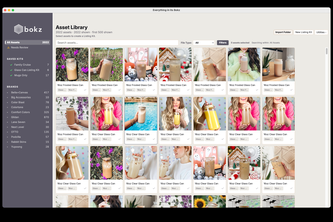
Bokz is a self-reported local desktop application for creative businesses, particularly print-on-demand sellers, that organizes scattered mockups into a searchable asset library. It runs locally on users' machines and claims to automate parts of the workflow by identifying metadata from files and enabling fast retrieval.
What changed
The author states that Bokz was built through an iterative collaboration with Codex (an AI coding partner) during OpenAI Build Week, incorporating feedback from alpha testers to improve import behavior, colour recognition, tag filtering, model browsing, and performance. This suggests a product evolution driven by user input and AI-assisted development.
Single most important open question
Is there evidence of real traction or usage beyond the author’s own testing and that of one alpha tester?
Analysis basis
The entire report is based on the self-reported project description provided by the caller — no external verification, archived data, or third-party sources. All claims are treated as stated by the author, not proven facts.
What The Product Actually Is
The description states:
- Bokz is a local desktop app for creative businesses.
- It helps users import folders of assets, identify products, models, colours, and presentation types automatically, and allows searching and filtering thousands of files.
- Users can browse assets by brand and model, apply custom tags, keep reference guides separate from mockups, locate the exact original file path, and create ordered Listing Kits for production workflows.
- It runs locally, so users retain control of their files without uploading to cloud platforms.
Inference The product is described as a desktop asset manager with metadata extraction capabilities and workflow integration features. However, it does not appear to be a SaaS or cloud-based solution — it’s local-first.
Positioning & Claim Evolution
The author states:
- Bokz was built by someone without traditional coding skills, using AI (Codex) as a technical partner.
- It started as a personal problem-solving tool and evolved into something more structured through feedback loops.
- The author emphasizes that Bokz is not a demo but a working product used by real alpha testers.
Inference The positioning has shifted from a personal tool to a scalable solution for creative professionals, especially those in print-on-demand. The evolution shows an emphasis on user feedback and AI-assisted development as key differentiators.
Target Customer & ICP
The description states:
- Bokz is aimed at print-on-demand sellers and other creative businesses.
- These users accumulate thousands of mockups, reference guides, product images, and listing assets over time.
- The tool helps them find files quickly, build listing kits, and integrate with downstream tools.
Inference The target customer is a creative professional who works with large volumes of digital assets and needs efficient retrieval. There's no indication of segmentation beyond this broad category.
Business Model & Pricing Evidence
The description does not contain any information about:
- Revenue streams
- Pricing models
- Monetization strategy
- Customer acquisition costs
- Sales process or channels
Not evidenced
Technical & Delivery Signals
The description states:
- Bokz was built using Electron, Node.js, JavaScript, and Codex.
- It supports local-first architecture, metadata parsing, import workflows, search/filtering, keyboard interactions, listing-kit creation, and cross-platform packaging.
- Features like tag sanitization, filename-colour recognition, performance optimization, and optional model-colour browsing were added based on user feedback.
Inference The technical stack indicates a desktop application built with modern tools, including AI-assisted development. The iterative improvements suggest attention to performance and usability.
Traction & Maturity Signals
The description states:
- There is one alpha tester who used Bokz to filter mockups by colour, locate source paths, and load them into automation tools.
- The author notes that Bokz moved beyond being an "organized image viewer" to becoming a retrieval layer between the asset library and production tools.
- Bokz existed before Build Week and was refined during it.
Not evidenced No data on actual users, revenue, or adoption metrics. No mention of paid customers or market traction.
Competitive Context
The description does not include:
- Any mention of competitors
- Market size or competitive landscape
- Differentiation from existing tools in the space
Not evidenced
Open Questions & Risks
The description states:
- The author has no formal coding background.
- The product is built by one person with an AI partner, which may limit scalability or depth of engineering.
- There is no mention of a team beyond the founder.
- The tool is described as local-first, which could be a limitation for collaborative workflows or remote teams.
Inference A single-founder model raises concerns about long-term maintenance and scaling. The local-first approach may also limit adoption among users who prefer cloud-based solutions or collaboration features.
Questions the description leaves open
- What is the actual usage rate of Bokz among alpha testers?
- How many real-world creative-business owners are currently using Bokz?
- Are there any plans to monetize the product, and what pricing strategy is being considered?
- Has the founder considered how Bokz might integrate with existing design or production tools used by print-on-demand sellers?
- What are the long-term technical challenges of maintaining a local-first desktop app at scale?
- How does the AI-assisted development model scale beyond the current scope?
Overall Assessment
The description states:
- Bokz is a working product built by one person using AI assistance.
- It addresses a real pain point in creative workflows.
- There is no evidence of revenue, customers, or traction.
Assessment This is an early-stage idea with strong potential for solving a niche problem. However, due to the lack of verified traction, customer data, or business model clarity, it does not yet present a compelling investment opportunity. The product shows promise but requires further validation and evidence of real-world usage before any strategic move can be made.
User Stories BotA demo video on every pull request
Get a demo video on every new feature
GitHub App that watches your pull requests and records a narrated, captioned demo.
Save time on demo prep and make informed decisions faster with a video walkthrough of every new feature.
Source
Submitted to the OpenAI 2026 hackathon on Devpost. Project home on Devpost. Back to the full gallery on Devpost.
This competitive analysis was produced by top-founders.com (opens in a new tab)
Generated by a language model from this project's public Devpost page — its tagline, the author's own write-up and any built-with tags listed there — as captured in August 2026. Short quotations are the author's words. It is an opinion on the idea as a business, not on the people behind it, and it reflects the description as published then. If the project has moved on, request a correction below. The analysis is not independent research and contains no verified traction, revenue or customer data.
An independent guide by KFG International LLC — not affiliated with, endorsed by, or connected to Devpost or OpenAI.