

Archive position — measured, not model output
0 likes on Devpost
2,263 of the 7,850 archived projects have more likes, and 5,587 share exactly 0 — so this project's #6,906 place in the like-ranked listing is a tie-break inside that group, not a ranking.
Projects (log scale)
Likes on Devpost. ▲ marks this project's group.
Show the figures
| Likes | Projects | Share of archive |
|---|---|---|
| 0 | 5,587 | 71.2% |
| 1 | 1,758 | 22.4% |
| 2 | 284 | 3.6% |
| 3–4 | 132 | 1.7% |
| 5–9 | 75 | 1.0% |
| 10+ | 14 | 0.2% |
 User Stories BotA demo video on every pull request
Get a demo video on every new feature
GitHub App that watches your pull requests and records a narrated, captioned demo.
Save time on demo prep and make informed decisions faster with a video walkthrough of every new feature.
Executive Summary
Splitto is a personal finance tool built as a hackathon project by one developer (David Yong). The author states that Splitto uses AI to extract structured financial data from receipts and payments, but emphasizes that the AI does not write money directly — instead, deterministic code validates and finalizes transactions after human review. The product is described as a way to remove tedious manual entry while maintaining user control over financial decisions.
The project appears to be an experimental prototype focused on personal finance organization using AI for data extraction and structured validation. It is not evidenced to have any revenue, customers, or traction beyond the author's own development effort.
Most important open question
Is there a viable commercial product or business model behind this concept, or is it purely a technical experiment?
What The Product Actually Is
The description states that Splitto:
- Turns receipt or payment images into strict, editable financial drafts
- Uses AI (GPT-5.6) to extract structured data from images via a JSON schema
- Requires human review and confirmation before transactions are finalized
- Does not write money directly; deterministic code validates integer MYR sen, discounts, tax treatment, rounding, and allocation
- Keeps four financial domains separate: Shared receipts, personal Money, Portfolio snapshots, and Things
- Prevents shared obligations from becoming personal spending or portfolio values from being mistaken for cash flow
The product is described as a "financial draft" system where AI proposes structured facts and uncertainty is made visible. Final commitment remains deterministic and reviewable.
Inference The tool appears to be an experimental prototype focused on personal finance data entry automation, not a full financial management platform.
Positioning & Claim Evolution
The author states:
- Splitto addresses the problem of inconsistent spending recording across multiple sources (receipts, shared purchases, cards, e-wallets, investments, durable goods)
- The core question is: "what would personal finance look like if AI removed the tedious entry without taking control away from the user?"
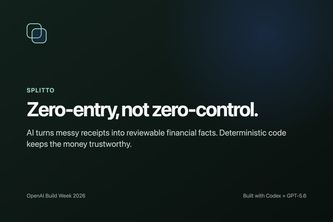
- The product aims to provide "zero-entry, not zero-control" — AI proposes structured facts but users retain control
- It is positioned as a way to make financial correctness, authorization, reconciliation, and final commitment deterministic and reviewable
Inference This is a self-described personal finance tool that attempts to solve the problem of fragmented financial data entry by combining AI with deterministic validation. The positioning is not yet market-tested or validated.
Target Customer & ICP
The description states:
- Splitto was built because the author was not consistently recording their own spending
- It targets individuals who manage personal finances and deal with multiple sources of income and expense (receipts, shared purchases, cards, e-wallets, investments, durable goods)
- The tool is described as a way to organize financial data from various domains
Inference The target customer is likely an individual user managing personal finances across multiple platforms or payment methods. No evidence suggests a specific ICP beyond this general category.
Business Model & Pricing Evidence
The description states:
- There is no mention of pricing, subscriptions, or monetization
- The author says the next step involves a "short weekly review inbox for statements, screenshots, and eventually authorized financial APIs"
- Bank sync, automatic card/provider data, and personalized financial advice are mentioned as future work, not current offerings
Inference No business model or pricing information is evidenced. The project appears to be an experimental prototype with no commercialization strategy described.
Technical & Delivery Signals
The description states:
- Built with React, TypeScript, Next.js-compatible Vinext routing
- Uses Cloudflare Workers, D1, R2, Drizzle ORM
- Leverages OpenAI Responses API and GPT-5.6 for image processing
- AI output is constrained to a strict JSON schema
- Uses Codex as an engineering collaborator during development
- Includes typecheck, lint, build, tests, and responsive QA before changes are treated as complete
Inference The technical stack indicates a modern, serverless approach with strong emphasis on validation and quality control. However, this is a prototype built in a hackathon context.
Traction & Maturity Signals
The description states:
- The project was submitted to the OpenAI 2026 hackathon
- It is described as an experimental prototype built by one person (David Yong)
- No revenue, customers, or adoption data are provided
- The author notes that real receipts exposed unexpected edge cases and required iterative fixes
Inference There is no evidence of traction, revenue, or customer adoption. This is a single-developer hackathon project with no commercial history.
Competitive Context
The description states:
- No mention of competitors or market positioning
- The author references the problem that most finance apps still expect repetitive manual entry
- The tool aims to address fragmentation in financial data sources (receipts, shared purchases, cards, e-wallets, investments, durable goods)
Inference There is no evidence of competitive landscape analysis. No competitors or market positioning beyond general personal finance tools are mentioned.
Open Questions & Risks
The description states:
- The tool does not write money directly; it only proposes drafts
- The author notes that real receipts exposed edge cases like rounding errors, tax inclusion, large photos hitting framework limits, and mobile touch targets
- The hardest product decision was refusing an easy shortcut: shared receipts do not automatically become personal expenses
- The project is described as a hackathon prototype with no commercial traction
Inference Key risks include lack of commercial viability, limited functionality beyond prototype stage, and potential technical edge-case handling issues. No evidence of market validation or scalable business model.
Questions the description leaves open
- What specific financial data sources does Splitto currently support?
- How does the AI extraction process handle ambiguous or unclear receipt details?
- Are there plans to integrate with existing financial institutions or APIs?
- What is the expected user journey from receipt upload to final transaction confirmation?
- Has the author considered how shared spending would scale beyond personal use cases?
- What are the technical limitations of the current prototype that would need to be addressed for production use?
Overall Assessment
The description states:
- Splitto is a hackathon project built by one developer
- No revenue, customers, or traction data are provided
- The author describes it as an experimental prototype focused on personal finance organization
- Future work includes bank sync and financial advice — not yet implemented
Inference This is a single-developer prototype with no commercial evidence. It lacks any demonstrated traction, revenue, or customer base. While the concept shows some technical sophistication, there is no basis for investment or partnership consideration at this stage. The project appears to be an experimental exploration rather than a viable product or business model.
User Stories BotA demo video on every pull request
Get a demo video on every new feature
GitHub App that watches your pull requests and records a narrated, captioned demo.
Save time on demo prep and make informed decisions faster with a video walkthrough of every new feature.
Source
Submitted to the OpenAI 2026 hackathon on Devpost. Project home on Devpost. Back to the full gallery on Devpost.
This competitive analysis was produced by top-founders.com (opens in a new tab)
Generated by a language model from this project's public Devpost page — its tagline, the author's own write-up and any built-with tags listed there — as captured in August 2026. Short quotations are the author's words. It is an opinion on the idea as a business, not on the people behind it, and it reflects the description as published then. If the project has moved on, request a correction below. The analysis is not independent research and contains no verified traction, revenue or customer data.
An independent guide by KFG International LLC — not affiliated with, endorsed by, or connected to Devpost or OpenAI.