

Archive position — measured, not model output
0 likes on Devpost
2,263 of the 7,850 archived projects have more likes, and 5,587 share exactly 0 — so this project's #4,942 place in the like-ranked listing is a tie-break inside that group, not a ranking.
Projects (log scale)
Likes on Devpost. ▲ marks this project's group.
Show the figures
| Likes | Projects | Share of archive |
|---|---|---|
| 0 | 5,587 | 71.2% |
| 1 | 1,758 | 22.4% |
| 2 | 284 | 3.6% |
| 3–4 | 132 | 1.7% |
| 5–9 | 75 | 1.0% |
| 10+ | 14 | 0.2% |
 User Stories BotA demo video on every pull request
Get a demo video on every new feature
GitHub App that watches your pull requests and records a narrated, captioned demo.
Save time on demo prep and make informed decisions faster with a video walkthrough of every new feature.
Executive Summary
The company appears to be a solo developer project that builds a wireless control system for legacy DSLR cameras using open-source tools and AI-assisted development. The author states the goal is to bring modern wireless convenience to older Nikon D810 cameras without modifying them. No commercial traction, revenue or customer data is evidenced.
The single most important open question is: What is the actual commercial viability of this system as a product, and how does it compare to existing solutions for wireless camera control?
What The Product Actually Is
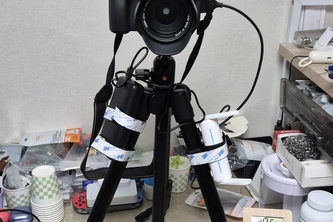
- The description states that Legacy-DSLR-Remote-Control turns a Nikon D810 into a wireless field camera system.
- Users can access live view, autofocus, shutter control, captured-image preview, and session-aware recovery from a mobile or desktop browser.
- The system uses a GL.iNet Opal router, USB/PTP connection to the camera, and software components including ddserver, WebSocket streaming, CGI endpoints, and AI tools like OpenAI Codex for development.
- It is described as an alpha-stage prototype focused on the Nikon D810 with support for more cameras planned later.
This is a self-reported technical demonstration of a remote control system for legacy DSLR cameras using open-source software and hardware integration. The author does not state whether this has been commercialized or deployed beyond their own use.
Positioning & Claim Evolution
- The description states the project's tagline: "Bringing modern wireless convenience to older cameras."
- It positions itself as a way to enhance legacy camera workflows without physical modification.
- The author claims they built a working prototype that supports live view, autofocus, and image preview over wireless connections.
- They also claim performance improvements in live-view delivery from 2 FPS to 20 FPS under normal operation.
- The long-term goal is described as providing a "practical compatibility layer" that gives legacy cameras a more modern wireless workflow.
These claims are self-reported and unverified. There is no evidence of market positioning, branding, or differentiation from competitors in the description.
Target Customer & ICP
- Not evidenced.
- The description does not name specific customer segments or personas.
- No indication of whether this targets photographers, professionals, hobbyists, or technical users.
- No evidence of a defined ideal customer profile (ICP).
Business Model & Pricing Evidence
- Not evidenced.
- There is no mention of pricing, monetization strategy, or business model in the description.
- The project is described as an alpha-stage prototype with no indication of commercial intent.
Technical & Delivery Signals
- The system uses a GL.iNet Opal router and connects via USB/PTP to a Nikon D810.
- Software components include ddserver for low-level camera transport, a camera bridge for coordination, WebSocket for live view streaming, and CGI endpoints for browser-facing actions.
- AI tools like OpenAI Codex were used during development.
- The developer notes challenges with hardware-software integration, including inconsistent camera responses, connection recovery, and memory usage on the router.
- Performance metrics are reported: live-view improved from ~2 FPS to ~20 FPS, with a peak of 26.3 FPS; end-to-end delivery time for 9MP JPEGs is ~5.2 seconds.
These technical details suggest a working prototype but do not indicate scalability or commercial readiness.
Traction & Maturity Signals
- Not evidenced.
- The project is described as an alpha-stage prototype.
- No evidence of user adoption, customer feedback, revenue, or product-market fit.
- No mention of testing, deployment, or usage beyond the developer’s own environment.
Competitive Context
- Not evidenced.
- No information about existing competitors or market players in wireless camera control.
- The description does not compare this solution to other products or services in the space.
Open Questions & Risks
- Solo development: Only one team member is listed, which raises concerns about scalability and long-term maintenance.
- Prototype stage: The project is described as an alpha-stage prototype with no commercial traction.
- Limited scope: Currently focused only on the Nikon D810; support for other cameras is "planned later."
- Hardware dependency: Relies heavily on specific hardware (Nikon D810, GL.iNet Opal router), limiting flexibility and potential market reach.
- Unverified commercial viability: No evidence of product-market fit or demand from users.
Questions the description leaves open
- What is the actual cost of building and deploying this system for end users?
- Are there any existing competitors in the wireless camera control space, and how does your solution differ?
- How do you plan to scale beyond a single camera model (Nikon D810)?
- Have you tested this system with real-world users or photographers?
- What is the roadmap for monetization or commercialization?
- Is there any interest from camera manufacturers or retailers in adopting or supporting this solution?
Overall Assessment
- Not evidenced.
- The project is described as a solo developer effort and an alpha prototype with no commercial traction, revenue, or customer data.
- No indication of whether the founder intends to build a business around this idea or if there is sufficient market demand for such a solution.
User Stories BotA demo video on every pull request
Get a demo video on every new feature
GitHub App that watches your pull requests and records a narrated, captioned demo.
Save time on demo prep and make informed decisions faster with a video walkthrough of every new feature.
Source
Submitted to the OpenAI 2026 hackathon on Devpost. Project home on Devpost. Back to the full gallery on Devpost.
This competitive analysis was produced by top-founders.com (opens in a new tab)
Generated by a language model from this project's public Devpost page — its tagline, the author's own write-up and any built-with tags listed there — as captured in August 2026. Short quotations are the author's words. It is an opinion on the idea as a business, not on the people behind it, and it reflects the description as published then. If the project has moved on, request a correction below. The analysis is not independent research and contains no verified traction, revenue or customer data.
An independent guide by KFG International LLC — not affiliated with, endorsed by, or connected to Devpost or OpenAI.