

Archive position — measured, not model output
1 like on Devpost
505 of the 7,850 archived projects have more likes, and 1,758 share exactly 1 — so this project's #1,012 place in the like-ranked listing is a tie-break inside that group, not a ranking.
Projects (log scale)
Likes on Devpost. ▲ marks this project's group.
Show the figures
| Likes | Projects | Share of archive |
|---|---|---|
| 0 | 5,587 | 71.2% |
| 1 | 1,758 | 22.4% |
| 2 | 284 | 3.6% |
| 3–4 | 132 | 1.7% |
| 5–9 | 75 | 1.0% |
| 10+ | 14 | 0.2% |
 User Stories BotA demo video on every pull request
Get a demo video on every new feature
GitHub App that watches your pull requests and records a narrated, captioned demo.
Save time on demo prep and make informed decisions faster with a video walkthrough of every new feature.
Executive Summary
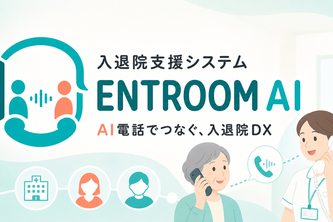
What the company appears to be: ENTROOM AI is a self-reported AI-powered coordination platform for hospital discharge and transfer workflows. It uses phone calls and shared digital workspaces to connect medical teams and reduce information burden on families. The platform is built as a web application with AI-assisted voice capabilities, using Next.js, React, TypeScript, and AWS infrastructure.
What changed: The project was submitted to the OpenAI 2026 hackathon by one founder (RI Z). It represents a prototype built over a short timeframe using AI tools like Codex and GPT-5.6 for development, with no evidence of prior traction or commercial deployment.
Single most important open question: Is there sufficient evidence that ENTROOM AI has a viable path to adoption in real hospitals, given the complexity of healthcare workflows and regulatory requirements?
What The Product Actually Is
The description states that ENTROOM AI is a shared discharge and transfer coordination workspace built on four principles:
- No information burden on families
- Less internal communication overhead inside the hospital
- Fine-grained, hospital-level control through node-based workflows
- A clear, readable UI
It enables role-specific views of patient timelines with decisions, blockers, and next actions. The system supports AI-assisted phone calls via Twilio SIP and OpenAI Realtime API, allowing families to answer natural voice prompts without needing new accounts or interfaces.
The platform includes a no-code, node-based workflow editor that allows hospitals to configure steps such as confirmation, approval, notification, and branching. Each node is bound to a real application action and responsible role, with validation for reachability, cycles, and runtime safety.
Evidence: The description states this is the product's function and architecture.
Positioning & Claim Evolution
The project positions itself as an AI-powered solution that connects hospital teams through phone calls and shared workflows. It emphasizes:
- Reducing repetitive coordination
- Keeping patient families from carrying information burden
- Supporting clinical decision-making with AI-assisted communication
- Preserving human judgment in care delivery
It claims to mirror how physicians actually make decisions — including "depends on family" or "depends on rehab" states.
Evidence: The description states these are the positioning and claims made by the author.
Target Customer & ICP
The target customer is hospitals, particularly those in Japan where phone-based coordination remains prevalent. The platform aims to support:
- Physicians
- Rehabilitation teams
- Ward staff
- Medical social workers
- Receiving hospitals
- Patient families (as end users of phone and web paths)
The description notes that in Japan, 37.1% of co-resident caregiving households have primary caregivers aged 75 or older — suggesting a focus on elderly care contexts.
Evidence: The description states this is the intended audience and context.
Business Model & Pricing Evidence
Not evidenced. There is no mention of pricing models, monetization strategies, or customer acquisition plans in the self-reported description.
Technical & Delivery Signals
The application uses:
- Frontend: Next.js, React, TypeScript
- Backend: Drizzle ORM, PostgreSQL, PGlite (local DB)
- Cloud Infrastructure: AWS Cognito, SES, ECS Fargate, RDS, CloudFront, EventBridge
- Voice Integration: Twilio SIP, OpenAI Realtime API
- AI Development Tools: Codex, GPT-5.6
The system supports role-based UIs, workflow validation, and runtime safety constraints. It includes a no-code editor for configuring workflows with real-time action binding.
Evidence: The description states the technical stack and development process.
Traction & Maturity Signals
Not evidenced. There is no mention of revenue, customers, users, or product usage metrics beyond the hackathon submission.
Competitive Context
Not evidenced. No information about competitors or market positioning is provided in the self-reported description.
Open Questions & Risks
- Unverified claims: All features and benefits are self-reported without independent verification.
- No commercial traction: The product exists only as a hackathon submission with no evidence of real-world deployment or adoption.
- Regulatory complexity: Healthcare systems require extensive compliance, which is not addressed in the description.
- AI integration risks: The use of AI for clinical communication raises concerns about accuracy and liability that are not discussed.
- Limited team size: Only one team member (RI Z) is mentioned, raising questions about scalability and execution capability.
Inference: Based on the lack of evidence for any commercial activity or product maturity beyond a prototype, there is significant risk in assuming this will become a viable business.
Questions the description leaves open
- What specific hospitals or healthcare systems have expressed interest in piloting ENTROOM AI?
- How does the platform handle data privacy and security compliance (e.g., HIPAA, GDPR)?
- Can you provide evidence of workflow validation with actual medical professionals?
- What is the plan for integrating with existing EMR/FHIR systems?
- Are there any regulatory or legal barriers preventing full-scale deployment in Japan or other markets?
- How does the platform ensure accuracy and reliability of AI-assisted communications?
- What are the key assumptions about user behavior that underpin the design choices?
Overall Assessment
Not evidenced. There is no information provided on valuation, funding history, or investment interest from third parties.
The description indicates this is a hackathon project built in a short time using AI development tools. It lacks any evidence of commercial traction, revenue, or customer adoption. The platform addresses a real pain point in healthcare coordination but has not demonstrated a clear path to market readiness or scalability.
Confidence level: Low — based entirely on self-reported information with no external validation or evidence of product-market fit or commercial viability.
User Stories BotA demo video on every pull request
Get a demo video on every new feature
GitHub App that watches your pull requests and records a narrated, captioned demo.
Save time on demo prep and make informed decisions faster with a video walkthrough of every new feature.
Source
Submitted to the OpenAI 2026 hackathon on Devpost. Project home on Devpost. Back to the full gallery on Devpost.
This competitive analysis was produced by top-founders.com (opens in a new tab)
Generated by a language model from this project's public Devpost page — its tagline, the author's own write-up and any built-with tags listed there — as captured in August 2026. Short quotations are the author's words. It is an opinion on the idea as a business, not on the people behind it, and it reflects the description as published then. If the project has moved on, request a correction below. The analysis is not independent research and contains no verified traction, revenue or customer data.
An independent guide by KFG International LLC — not affiliated with, endorsed by, or connected to Devpost or OpenAI.