

Archive position — measured, not model output
0 likes on Devpost
2,263 of the 7,850 archived projects have more likes, and 5,587 share exactly 0 — so this project's #2,975 place in the like-ranked listing is a tie-break inside that group, not a ranking.
Projects (log scale)
Likes on Devpost. ▲ marks this project's group.
Show the figures
| Likes | Projects | Share of archive |
|---|---|---|
| 0 | 5,587 | 71.2% |
| 1 | 1,758 | 22.4% |
| 2 | 284 | 3.6% |
| 3–4 | 132 | 1.7% |
| 5–9 | 75 | 1.0% |
| 10+ | 14 | 0.2% |
 User Stories BotA demo video on every pull request
Get a demo video on every new feature
GitHub App that watches your pull requests and records a narrated, captioned demo.
Save time on demo prep and make informed decisions faster with a video walkthrough of every new feature.
Executive Summary
Company: Boardroom
Self-reported basis: The description is entirely self-reported and unverified; it comes from a Devpost submission for the OpenAI 2026 hackathon. No independent verification, revenue, customer or traction data is available beyond what the author states.
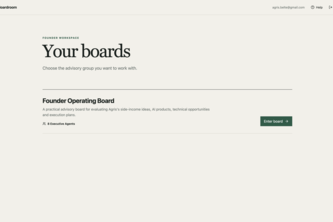
What the company appears to be: Boardroom is described as a GPT-5.6-powered decision platform that structures AI-advised meetings into durable, searchable organisational memory. It allows users to create "Boards" made up of AI Executive Agents with different roles, and organises discussions into Meetings that generate structured records including summaries, decisions, actions, risks, and assumptions.
What changed: The author states that the project evolved from a local Python CLI prototype (Phase 2) into a hosted web application (Phase 3) during Build Week. It was built using React, Python, Cloudflare Workers, Cloudflare D1, and OpenAI’s GPT-5.6 API.
Single most important open question: Is there evidence of any real-world usage or adoption beyond the author's prototype? The description does not indicate whether Boardroom has been used by anyone other than the founder, nor whether it has generated any revenue, customers, or traction.
What The Product Actually Is
The description states that Boardroom is a platform where users can create "Boards" made up of AI Executive Agents, each with a different role and responsibility. Users can ask these agents for advice in structured meetings. When the meeting concludes, a Secretary summarises the discussion and creates a structured record including summaries, decisions, actions, risks, and assumptions.
The system is described as not being just another chat interface but a complete workflow from creating Boards to running Meetings to generating structured decision records that can be reopened and reviewed later.
Evidence:
- "Boardroom allows a user to create Boards made up of AI Executive Agents, each with a different role and responsibility."
- "Discussions are organised into Meetings where users can ask individual Agents or the whole Board for advice."
- "The Secretary summarises the discussion, and when the Meeting is closed, Boardroom creates a structured record including summaries, decisions, actions, risks and assumptions."
Inference: The platform appears to be designed to turn unstructured AI conversations into structured organisational knowledge.
Positioning & Claim Evolution
The author states that the goal was not to build another chat application but to create a decision platform where discussions become structured organisational knowledge that can be reviewed, searched and built upon over time.
The product is positioned as an AI-advised decision-making tool that creates durable, structured records of meetings rather than isolated conversations.
Evidence:
- "Rather than building another chat application, I wanted to build a decision platform where discussions become structured organisational knowledge that can be reviewed, searched and built upon over time."
- "Unlike traditional AI chats, this information is stored as structured data, creating a growing organisational memory instead of isolated conversations."
Inference: The positioning evolved from a simple AI chatbot to a structured decision-making platform with long-term organisational memory.
Target Customer & ICP
The description does not explicitly state the target customer or ideal customer profile (ICP). It is implied that the product targets individuals or teams who make important decisions and want to capture those decisions in a structured, searchable format.
Evidence:
- No explicit mention of customer segments or personas.
- The platform is described as for users who "make important decisions" and want to "capture those decisions in a structured, searchable format."
Not evidenced: No indication of whether the target is enterprise, individual professionals, or specific industries.
Business Model & Pricing Evidence
There is no evidence of pricing, revenue model or monetisation strategy in the description. The author does not state how the platform would be sold or who would pay for it.
Evidence:
- No mention of pricing, subscriptions, or monetisation.
Not evidenced: No indication of business model, pricing tiers, or customer acquisition costs.
Technical & Delivery Signals
The system is built using React, Python, Cloudflare Workers, Cloudflare D1, and OpenAI’s GPT-5.6 API. It was designed with an architecture-first approach, implemented in small batches, and supported by Codex as an engineering partner.
Evidence:
- "Built with (author-declared): cloudflare, codex, openai, python, react, typescript, workers"
- "I used an architecture-first approach, building the application in small numbered implementation batches."
- "Codex became an engineering partner throughout the project, helping review architecture, implement features, improve quality, write documentation and prepare the final submission."
Inference: The platform is built with modern cloud-native tools and has a structured development process.
Traction & Maturity Signals
There is no evidence of traction or maturity. The product is described as a prototype developed during a hackathon, with no mention of users, customers, revenue, or adoption beyond the author's own use.
Evidence:
- "Boardroom Phase 2 already existed as a local Python CLI prototype before Build Week."
- "During Build Week I designed and built Phase 3 as a hosted web application."
Not evidenced: No data on usage, users, customers, revenue, or product-market fit.
Competitive Context
The description does not mention any competitors. It is unclear whether similar platforms exist in the market for structured AI decision-making or organisational memory tools.
Evidence:
- No mention of competitors or existing solutions in this space.
Not evidenced: No indication of competitive landscape, market positioning, or differentiation from other tools.
Open Questions & Risks
- No traction or adoption: The product is described as a prototype with no evidence of real-world usage.
- Unproven business model: There is no indication of how the platform would be monetised or whether it has a viable path to revenue.
- Single founder: The team size is listed as 1, which may limit execution capacity.
- No customer feedback or validation: No evidence of user testing or feedback loops.
- Unverified technology claims: The description refers to GPT-5.6, which is not publicly confirmed.
Inference: The platform appears to be a concept with no demonstrated commercial viability or market traction.
Questions the description leaves open
- What specific decision-making problems are you trying to solve for users?
- Have you tested this with any real users or teams?
- How do you plan to monetise the platform?
- What is your roadmap beyond the current prototype?
- Are there any existing tools in the market that do something similar?
- How do you plan to scale beyond a single founder?
Overall Assessment
Not evidenced: There is no evidence of revenue, customers, traction or business model viability. The product is described as a prototype built during a hackathon with no indication of commercial potential or market validation.
Confidence level: Low — the description provides no data to assess product-market fit, scalability, or commercial viability.
Assessment: Not ready for investment or partnership at this stage. The project is in early prototype form and lacks any evidence of traction, monetisation or customer validation.
User Stories BotA demo video on every pull request
Get a demo video on every new feature
GitHub App that watches your pull requests and records a narrated, captioned demo.
Save time on demo prep and make informed decisions faster with a video walkthrough of every new feature.
Source
Submitted to the OpenAI 2026 hackathon on Devpost. Project home on Devpost. Back to the full gallery on Devpost.
This competitive analysis was produced by top-founders.com (opens in a new tab)
Generated by a language model from this project's public Devpost page — its tagline, the author's own write-up and any built-with tags listed there — as captured in August 2026. Short quotations are the author's words. It is an opinion on the idea as a business, not on the people behind it, and it reflects the description as published then. If the project has moved on, request a correction below. The analysis is not independent research and contains no verified traction, revenue or customer data.
An independent guide by KFG International LLC — not affiliated with, endorsed by, or connected to Devpost or OpenAI.