

Archive position — measured, not model output
0 likes on Devpost
2,263 of the 7,850 archived projects have more likes, and 5,587 share exactly 0 — so this project's #6,854 place in the like-ranked listing is a tie-break inside that group, not a ranking.
Projects (log scale)
Likes on Devpost. ▲ marks this project's group.
Show the figures
| Likes | Projects | Share of archive |
|---|---|---|
| 0 | 5,587 | 71.2% |
| 1 | 1,758 | 22.4% |
| 2 | 284 | 3.6% |
| 3–4 | 132 | 1.7% |
| 5–9 | 75 | 1.0% |
| 10+ | 14 | 0.2% |
 User Stories BotA demo video on every pull request
Get a demo video on every new feature
GitHub App that watches your pull requests and records a narrated, captioned demo.
Save time on demo prep and make informed decisions faster with a video walkthrough of every new feature.
Executive Summary
What the company appears to be
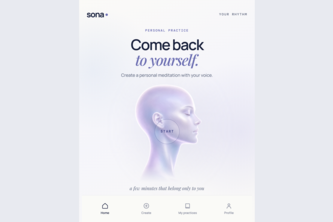
SONA - Personal Meditation is a self-reported personal meditation app that generates guided audio practices using AI voice cloning. The product allows users to record their own voice, clone it via ElevenLabs, and receive personalized meditations in their own voice across specific emotional states (anxiety, sleep, focus, energy) or custom intentions.
What changed
The project is described as a hackathon submission built with AI tools like Codex, GPT-5.6, and ElevenLabs. It represents an early-stage prototype with no evidence of revenue, customers, or product-market fit beyond the author’s own description.
Single most important open question
Is there any evidence of user adoption, monetization, or traction beyond the self-reported project description?
What The Product Actually Is
The description states that SONA is a personal meditation app that:
- Allows users to upload or record their voice.
- Uses ElevenLabs Instant Voice Cloning to create a personalized voice profile.
- Generates bilingual (English/Russian) guided meditations based on user intentions or predefined categories.
- Integrates ambient audio tracks with the cloned voice for practice playback and saving.
- Operates through a mobile-first web interface built using Next.js, React, Supabase, and Vercel.
The product is described as a self-contained, private audio experience, where practices are stored in a user’s private library and not shared or publicly accessible.
Evidence
- The author states that the app uses ElevenLabs Instant Voice Cloning.
- It supports 5–12 minute meditation sessions.
- It integrates browser Web Audio API for mixing.
- It uses Supabase for authentication, storage, and privacy controls.
Inference The product is a personalized audio meditation tool, not a marketplace or SaaS platform. It is built as a single-user experience with no evidence of multi-user or enterprise functionality.
Positioning & Claim Evolution
The tagline states:
“Sona creates a personal guided meditation for what you need right now and speaks it back in the voice you know best: your own.”
This positions SONA as:
- A personalized meditation tool.
- Using AI voice cloning to deliver meditations in the user’s own voice.
- Focused on emotional states or custom intentions.
The author describes the product as a “meaningfully extended” result of an iterative Codex + GPT workflow, suggesting that it was built quickly and iteratively using AI tools. The project is described as a hackathon submission, not a commercial product.
Evidence
- The tagline and write-up emphasize personalization and voice cloning.
- The author states the app was built with AI tools like Codex and GPT-5.6.
- It is positioned as a self-contained, private experience.
Inference The positioning is early-stage, focused on user self-service, and not yet validated in a commercial or market context.
Target Customer & ICP
The description does not state:
- Who the target customer is.
- What demographic or user segment they serve.
- Whether there are any specific personas or use cases beyond “personal meditation.”
Evidence
- The app supports English and Russian.
- It allows users to choose from predefined emotional states (anxiety, sleep, focus, energy) or custom intentions.
Inference The ICP is likely self-directed individuals seeking personal meditation, possibly with a tech-savvy or early-adopter profile. No evidence of segmentation or targeting beyond the app’s own structure.
Business Model & Pricing Evidence
There is no evidence in the description of:
- A pricing model.
- Revenue streams.
- Monetization strategy.
- Subscription plans or freemium tiers.
Evidence
- The app uses ElevenLabs voice cloning, which may involve costs.
- It stores user data via Supabase, which may have associated costs.
- No mention of paid features or monetization.
Inference The business model is not evidenced, and the project is described as a hackathon submission with no commercial intent stated.
Technical & Delivery Signals
The author states:
- The app was built using Next.js 16, React 19, TypeScript, Tailwind CSS.
- Authentication and data persistence are handled by Supabase Auth, Postgres, and Storage.
- Voice cloning is done via ElevenLabs Instant Voice Cloning and eleven_multilingual_v2.
- Audio mixing uses the browser Web Audio API.
- Deployment is on Vercel.
Evidence
- The app is built with modern web stack (Next.js, React, Supabase).
- It integrates AI voice tools for personalization.
- It supports private user data storage and access control.
Inference The technical architecture suggests a modern, scalable web application, but no evidence of production-grade infrastructure or performance metrics.
Traction & Maturity Signals
There is no evidence of:
- User adoption.
- Revenue.
- Customers.
- Product-market fit.
- Any traction beyond the author’s own description.
Evidence
- The project was submitted to a hackathon (OpenAI 2026).
- It is described as a prototype or proof-of-concept.
- No mention of user base, retention, or usage metrics.
Inference The product is in early-stage development, likely not yet released to users beyond the author.
Competitive Context
There is no evidence of:
- Competitors.
- Market analysis.
- Product differentiation from existing meditation apps.
Evidence
- The app uses AI voice cloning, which is a novel feature in this space.
- It supports bilingual content (English/Russian).
- No mention of competitors or market positioning.
Inference The competitive landscape is not evidenced, but the use of voice cloning and personalization may differentiate it from standard meditation apps.
Open Questions & Risks
- No revenue, customers, or traction: The product is described as a hackathon submission with no evidence of monetization or adoption.
- Unverified claims: All features are self-reported; no independent validation.
- Privacy and compliance risks: Voice cloning raises data privacy concerns, but the description does not elaborate on how these are mitigated.
- Dependency on external services: Reliance on ElevenLabs and Supabase may introduce risk if those services change pricing or availability.
Evidence
- No mention of monetization or user base.
- The app is described as a prototype.
- Voice cloning is used without further explanation of compliance or data handling.
Questions the description leaves open
- What is the actual user feedback or testing done beyond the author’s own use?
- How does the product handle edge cases in voice recording and audio processing?
- Are there plans to monetize or scale this beyond a prototype?
- What are the technical limitations of ElevenLabs voice cloning for long-term use?
- Is there any data on how users interact with the app or what they value most?
Overall Assessment
Not evidenced.
The description provides no evidence of:
- Revenue.
- Customers.
- Traction.
- Product-market fit.
- Commercial viability.
This is a self-reported hackathon prototype, not a commercial product. The author states that the app was built using AI tools, but there is no indication of any business model or monetization strategy.
Confidence Low.
Next steps
If this were to be considered for investment or partnership, further due diligence would require evidence of user adoption, revenue, or a clear path to market traction.
User Stories BotA demo video on every pull request
Get a demo video on every new feature
GitHub App that watches your pull requests and records a narrated, captioned demo.
Save time on demo prep and make informed decisions faster with a video walkthrough of every new feature.
Source
Submitted to the OpenAI 2026 hackathon on Devpost. Project home on Devpost. Back to the full gallery on Devpost.
This competitive analysis was produced by top-founders.com (opens in a new tab)
Generated by a language model from this project's public Devpost page — its tagline, the author's own write-up and any built-with tags listed there — as captured in August 2026. Short quotations are the author's words. It is an opinion on the idea as a business, not on the people behind it, and it reflects the description as published then. If the project has moved on, request a correction below. The analysis is not independent research and contains no verified traction, revenue or customer data.
An independent guide by KFG International LLC — not affiliated with, endorsed by, or connected to Devpost or OpenAI.