

Archive position — measured, not model output
0 likes on Devpost
2,263 of the 7,850 archived projects have more likes, and 5,587 share exactly 0 — so this project's #6,855 place in the like-ranked listing is a tie-break inside that group, not a ranking.
Projects (log scale)
Likes on Devpost. ▲ marks this project's group.
Show the figures
| Likes | Projects | Share of archive |
|---|---|---|
| 0 | 5,587 | 71.2% |
| 1 | 1,758 | 22.4% |
| 2 | 284 | 3.6% |
| 3–4 | 132 | 1.7% |
| 5–9 | 75 | 1.0% |
| 10+ | 14 | 0.2% |
 User Stories BotA demo video on every pull request
Get a demo video on every new feature
GitHub App that watches your pull requests and records a narrated, captioned demo.
Save time on demo prep and make informed decisions faster with a video walkthrough of every new feature.
Executive Summary
What the company appears to be
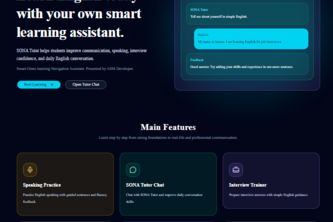
SONA Tutor is an AI-powered English learning platform described by its author as a tool for helping learners build real-world communication skills through structured lessons, guided practice, and instant AI feedback. The platform is self-reported to include features such as structured lessons, speaking and interview practice, progress tracking, and secure user accounts.
What changed
The project was submitted to the OpenAI 2026 hackathon on Devpost, indicating it is a prototype or early-stage product built in a short timeframe. It was developed by one person (Anuj M.) using AI tools like GPT-5.5, GPT-5.6, and Codex, with full-stack technologies including Next.js, React, Supabase, and Tailwind CSS.
The single most important open question
Is there evidence of any user base or commercial traction beyond the author's own development efforts?
What The Product Actually Is
The description states that SONA Tutor is an AI-powered English learning platform. It includes:
- Structured English lessons
- Real-life communication practice
- AI-powered answer feedback
- Speaking and interview practice
- Progress tracking
- Secure user accounts
It is described as a web application built using Next.js, React, TypeScript, Tailwind CSS, Supabase Authentication, Vercel, and OpenAI GPT-5.5, GPT-5.6, and Codex.
The author notes that AI assisted with architecture, implementation, debugging, testing, and refinement, but the final decisions were made by the developer.
Inference The platform is a self-contained web application focused on English language learning using AI for feedback and lesson delivery.
Positioning & Claim Evolution
The author states:
- SONA Tutor helps learners build real-world communication skills.
- It focuses on structured lessons, guided practice, and meaningful AI feedback.
- The goal is to help learners move from basic English to confident real-world communication.
It is positioned as a platform that addresses the gap between memorizing grammar and practicing actual communication.
Claim
The product aims to bridge the gap between grammar learning and practical use of English.
Not evidenced There is no evidence of how this compares to existing platforms or whether it has been validated with users.
Target Customer & ICP
The description does not specify a target customer segment or ideal customer profile (ICP). It only states that the platform is for learners who want to improve communication skills.
Not evidenced No indication of learner demographics, proficiency levels, geographic focus, or specific use cases beyond general English learners.
Business Model & Pricing Evidence
The description does not mention any business model or pricing strategy. There is no information on monetization, subscription plans, or how the platform intends to generate revenue.
Not evidenced No evidence of a business model or pricing structure.
Technical & Delivery Signals
The author reports:
- Built with Next.js, React, TypeScript, Tailwind CSS
- Uses Supabase for authentication
- Deployed on Vercel
- Integrated OpenAI GPT-5.5, GPT-5.6, and Codex
- AI assisted in architecture, implementation, debugging, testing, and refinement
The author also notes challenges such as scalable lesson architecture, authentication flows, and meaningful AI feedback.
Inference The platform is a full-stack web application using modern tools and AI for content generation and user interaction.
Not evidenced No evidence of scalability, performance metrics, or production deployment details beyond the author's own account.
Traction & Maturity Signals
The description states:
- Built a production-ready web application
- Designed a structured English learning system
- Created reusable lesson architecture
- Integrated AI-powered learning assistance
- Successfully deployed the application online
It was submitted to a hackathon, indicating it is likely an early-stage prototype or MVP.
Not evidenced No evidence of user adoption, retention, revenue, or customer feedback. The project is described as a solo effort and not validated with users beyond the developer's own use.
Competitive Context
The description does not mention any competitors or how SONA Tutor compares to existing English learning platforms.
Not evidenced No competitive analysis or positioning relative to other tools in the market.
Open Questions & Risks
- The platform is described as a solo project, with no evidence of team or external support.
- It was built for a hackathon, suggesting it may be an MVP or prototype.
- No evidence of user traction, revenue, or commercial viability.
- AI tools were used extensively, raising questions about whether the product is truly differentiated or just AI-assisted.
- The author’s own account is the only source of information — no third-party validation.
Inference The project may lack commercial viability or scalability without further development and user testing.
Not evidenced No evidence of market demand, user feedback, or competitive differentiation.
Questions the description leaves open
- What is the intended target audience for SONA Tutor?
- How does the platform plan to monetize its service?
- Has the product been tested with real users beyond the developer’s own use?
- What are the key differentiators from existing English learning platforms?
- Is there a plan to scale beyond the current MVP, and what resources are needed?
- How is user data handled, especially in terms of privacy and security?
Overall Assessment
The description indicates that SONA Tutor is an early-stage prototype built by one developer for a hackathon. It includes basic features like structured lessons, AI feedback, and progress tracking but lacks evidence of traction, revenue, or user adoption.
Not evidenced No commercial viability, user base, or business model has been demonstrated.
Assessment The project is in an early phase with no clear indication of commercial readiness or market validation. It may be a promising concept, but further due diligence is needed to assess its potential for growth or partnership opportunities.
User Stories BotA demo video on every pull request
Get a demo video on every new feature
GitHub App that watches your pull requests and records a narrated, captioned demo.
Save time on demo prep and make informed decisions faster with a video walkthrough of every new feature.
Source
Submitted to the OpenAI 2026 hackathon on Devpost. Project home on Devpost. Back to the full gallery on Devpost.
This competitive analysis was produced by top-founders.com (opens in a new tab)
Generated by a language model from this project's public Devpost page — its tagline, the author's own write-up and any built-with tags listed there — as captured in August 2026. Short quotations are the author's words. It is an opinion on the idea as a business, not on the people behind it, and it reflects the description as published then. If the project has moved on, request a correction below. The analysis is not independent research and contains no verified traction, revenue or customer data.
An independent guide by KFG International LLC — not affiliated with, endorsed by, or connected to Devpost or OpenAI.