

Archive position — measured, not model output
0 likes on Devpost
2,263 of the 7,850 archived projects have more likes, and 5,587 share exactly 0 — so this project's #6,856 place in the like-ranked listing is a tie-break inside that group, not a ranking.
Projects (log scale)
Likes on Devpost. ▲ marks this project's group.
Show the figures
| Likes | Projects | Share of archive |
|---|---|---|
| 0 | 5,587 | 71.2% |
| 1 | 1,758 | 22.4% |
| 2 | 284 | 3.6% |
| 3–4 | 132 | 1.7% |
| 5–9 | 75 | 1.0% |
| 10+ | 14 | 0.2% |
 User Stories BotA demo video on every pull request
Get a demo video on every new feature
GitHub App that watches your pull requests and records a narrated, captioned demo.
Save time on demo prep and make informed decisions faster with a video walkthrough of every new feature.
Executive Summary
What the company appears to be
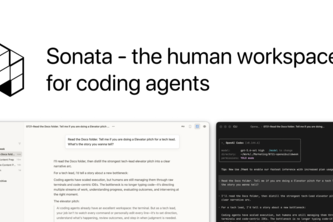
Sonata is a self-reported macOS application designed to improve the human experience of using AI coding agents like Claude Code and Codex. It runs these CLIs natively, offering a UI layer for reading, writing, and managing sessions — without replacing or abstracting the terminal itself.
What changed
The author pivoted from attempting to hide the terminal in favor of co-presence with it, recognizing that full integration requires access to CLI hooks and transcripts that are not yet available. This shift led to a more transparent, hybrid approach where the terminal remains visible as a diagnostic surface.
Single most important open question
Is there evidence of real-world usage beyond the author’s personal workflow? The description does not indicate any external adoption or customer base.
Note
All findings are based on self-reported information from the project description. No independent verification, traction data, revenue, or customer evidence is available.
What The Product Actually Is
The description states that Sonata is a free, open-source Mac app built with Electron and TypeScript. It is described as:
- A workspace for reading, writing, and managing sessions involving AI coding agents.
- Designed to run Codex & Claude CLIs natively, preserving their behavior and subscriptions.
- Not a terminal skin, IDE, new agent runtime, subscription, or cloud layer.
It supports:
- Reading: Sessions rendered in clean turn cards with markdown, folded tool calls, plan blocks, and typography.
- Writing: A composer for expressing intent using natural typing, images, files, and slash commands.
- Managing: Tagging, filtering, and naming sessions across projects.
- Previewing: Markdown, HTML, images, and changed files open in floating windows.
Inference The app is built by the agents it hosts — Codex and Claude Code — using GPT-5.6 for some features, such as session tagging.
Positioning & Claim Evolution
The author claims that Sonata is a workspace designed for humans working with AI coding agents. It positions itself as:
- A modern interface for CLIs like Claude Code and Codex.
- A tool for builders and design engineers who want to use the CLI benefits without its learning curve.
- Not an abstraction or replacement of the terminal, but rather a layer on top that enhances it.
Evolution of claims
- Originally, the author attempted to hide the terminal and operate only in the background.
- This approach was abandoned due to lack of proper hooks and transcripts from CLIs.
- The current version runs the CLI side-by-side with Sonata, allowing for diagnostics and visibility into agent behavior.
Claim vs Fact
The claim that it is a "workspace designed for humans" is self-reported. There is no evidence of user feedback or external validation.
Target Customer & ICP
The description states that Sonata is for:
- Builders and design engineers
- People whose workflow centers on AI coding agents but not necessarily on editing code directly
- Users who want to benefit from CLI tools like Claude Code and Codex without the terminal’s learning curve
Inference The target audience seems narrowly defined around early adopters of agentic coding tools, likely developers or designers already using these CLIs.
Business Model & Pricing Evidence
The description states that Sonata is:
- A free, open-source app
- Built with no commercial model mentioned
- Not a subscription-based product
Not evidenced No pricing structure, monetization strategy, or business model beyond the free and open-source nature of the tool.
Technical & Delivery Signals
The author reports that Sonata is built using:
- Electron + TypeScript
- Node.js, Playwright, Vite, xterm.js, node-pty
- A UI-agnostic runtime managing PTY orchestration, hooks, and transcript normalization
- A replaceable renderer shell on top
Key technical points:
- The newest feature (session tagging) was built end-to-end by Codex using GPT-5.6.
- The app is described as a daily driver for the author.
- It supports native CLI behavior and capabilities.
Inference The use of AI agents to build parts of the product suggests an experimental or early-stage approach, possibly indicating a prototype or personal project rather than a scalable commercial offering.
Traction & Maturity Signals
The description states:
- The app is used daily by the author.
- It was submitted to the OpenAI 2026 hackathon.
- Features like session tagging were built in a single day using Codex.
Not evidenced No external users, customer data, or adoption metrics are provided. There is no indication of any user base beyond the founder.
Competitive Context
The author does not mention competitors directly. However, the product appears to be positioned in the space of:
- AI coding agent interfaces
- CLI enhancement tools
- Developer tooling for agentic workflows
Inference The lack of competitive analysis or differentiation from other tools is notable, especially given that this is a hackathon submission.
Open Questions & Risks
- No external adoption: The only evidence of usage is the author’s personal workflow.
- Unproven market demand: No customers, users, or feedback are reported.
- Limited scope: The app is described as a macOS-only tool and built by one person.
- Dependency on CLIs: Reliance on Claude and Codex APIs and their future compatibility.
- Hackathon product: Submitted to a hackathon, suggesting it may be a prototype or proof-of-concept.
Inference Without traction, revenue, or user feedback, the commercial viability of Sonata is unproven.
Questions the description leaves open
- What specific use cases are you solving for beyond your own workflow?
- Are there any users outside of yourself who are actively using Sonata?
- How do you plan to scale beyond a single-person development effort?
- What is the long-term vision for monetization or commercialization?
- How do you intend to handle compatibility with evolving CLI APIs from Claude and Codex?
Overall Assessment
Not evidenced No financials, traction, or customer data are available.
Assessment Based on the self-reported description alone, Sonata appears to be a personal project or prototype built by one individual. There is no evidence of commercial traction, user adoption, or scalable business model. It may represent an early-stage idea or experimental tool with potential, but lacks the signals necessary for investment or partnership consideration at this stage.
User Stories BotA demo video on every pull request
Get a demo video on every new feature
GitHub App that watches your pull requests and records a narrated, captioned demo.
Save time on demo prep and make informed decisions faster with a video walkthrough of every new feature.
Source
Submitted to the OpenAI 2026 hackathon on Devpost. Project home on Devpost. Back to the full gallery on Devpost.
This competitive analysis was produced by top-founders.com (opens in a new tab)
Generated by a language model from this project's public Devpost page — its tagline, the author's own write-up and any built-with tags listed there — as captured in August 2026. Short quotations are the author's words. It is an opinion on the idea as a business, not on the people behind it, and it reflects the description as published then. If the project has moved on, request a correction below. The analysis is not independent research and contains no verified traction, revenue or customer data.
An independent guide by KFG International LLC — not affiliated with, endorsed by, or connected to Devpost or OpenAI.