

Archive position — measured, not model output
1 like on Devpost
505 of the 7,850 archived projects have more likes, and 1,758 share exactly 1 — so this project's #968 place in the like-ranked listing is a tie-break inside that group, not a ranking.
Projects (log scale)
Likes on Devpost. ▲ marks this project's group.
Show the figures
| Likes | Projects | Share of archive |
|---|---|---|
| 0 | 5,587 | 71.2% |
| 1 | 1,758 | 22.4% |
| 2 | 284 | 3.6% |
| 3–4 | 132 | 1.7% |
| 5–9 | 75 | 1.0% |
| 10+ | 14 | 0.2% |
 User Stories BotA demo video on every pull request
Get a demo video on every new feature
GitHub App that watches your pull requests and records a narrated, captioned demo.
Save time on demo prep and make informed decisions faster with a video walkthrough of every new feature.
Executive Summary
What the company appears to be
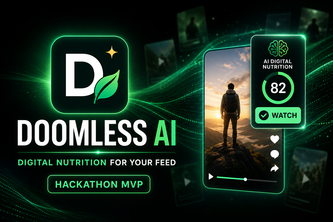
DoomLess AI is an AI-powered Chrome extension that evaluates short-form content (specifically Instagram Reels) in real time and displays a "Digital Nutrition Label" to help users make informed decisions about their attention.
What changed
The project was submitted as part of the OpenAI 2026 hackathon. It describes a working MVP built with a Chrome extension, AI pipeline, and dashboard, focused on Instagram Reels. The author states that this is an early-stage prototype, not yet commercialized or monetized.
Single most important open question
Is there any evidence of user adoption, revenue, or traction beyond the hackathon MVP?
What The Product Actually Is
The description states that DoomLess AI is a privacy-first Chrome extension for Instagram Reels on desktop. It detects active Reels and analyzes available surface evidence (caption, creator, hashtags, visible text, accessibility labels, duration, metadata) to generate an explainable Digital Nutrition Label.
The label includes:
- A 0–100 Digital Nutrition Score
- Seven explained content metrics
- Content classification and confidence level
- Attention-cost and Return on Attention estimates
- Recommendations (Watch, Save, Entertainment, Limit, or Skip)
It uses a secure AI pipeline, including GPT-5.6 for structured analysis, with fallback scoring when AI fails.
The extension is built using:
- Manifest V3 Chrome Extension
- TypeScript, React, Vite, Tailwind CSS
- MutationObserver and IntersectionObserver for detection
- Service worker backend (Next.js/Vinext)
- Local storage for user data
Inference: The product is a browser-based tool designed to improve attention quality by evaluating content before or during consumption.
Positioning & Claim Evolution
The description states that DoomLess AI aims to:
- Evaluate individual content instead of blocking access or limiting time
- Measure content quality rather than screen time
- Transform passive scrolling into informed choice
- Provide a "Digital Nutrition Label" similar to food labels
It positions itself as different from typical wellbeing tools that:
- Measure application-level time
- Block access or limit sessions
- Focus on reducing usage
- Treat all content inside an app similarly
Instead, DoomLess focuses on content-level evaluation, separating learning value, relevance, emotional impact, and behavioral risk.
Inference: The positioning is centered around autonomy and informed decision-making, not restriction or control.
Target Customer & ICP
The description states that DoomLess AI targets people who:
- Use Instagram Reels
- Want to evaluate content quality before investing attention
- Are interested in improving their digital diet and reclaiming attention
It is designed for users of short-form feeds (like Instagram Reels), not general social media users.
Inference: The ICP appears to be digitally-aware individuals who are concerned about time spent on platforms but want to retain agency over what they consume.
Business Model & Pricing Evidence
The description does not provide any information about:
- Revenue model
- Pricing structure
- Monetization strategy
- Customer acquisition cost
- Paid features or tiers
Not evidenced
Technical & Delivery Signals
The project is built as a Chrome extension, using:
- Manifest V3
- TypeScript, React, Vite, Tailwind CSS
- MutationObserver and IntersectionObserver for detection
- Service worker backend (Next.js/Vinext)
- GPT-5.6 API integration
- Local storage for caching and user data
It includes features like:
- Active-Reel gating
- Hover delay
- Duplicate request prevention
- Timeout handling
- Caching and fallback scoring
- Demo mode
- Dashboard analytics
Inference: The technical stack suggests a lightweight, privacy-focused browser tool with AI integration. It is built for performance and resilience.
Traction & Maturity Signals
The description states that this is a working MVP, submitted to the OpenAI 2026 hackathon.
It includes:
- Live detection of Instagram Reels
- Structured AI analysis
- Interactive UI with explanations
- Dashboard for behavior tracking
- Demo mode
However, there is no evidence of:
- User base or adoption
- Revenue or monetization
- Customer feedback or retention
- Product-market fit validation
Not evidenced
Competitive Context
The description does not mention any competitors directly. It contrasts DoomLess with:
- Tools that measure screen time
- Tools that block access or limit sessions
- Tools that treat all content inside an app similarly
It implies a niche in content-level evaluation, rather than platform-level restriction.
Inference: The competitive space seems to be around digital wellbeing tools, but specific competitors are not named.
Open Questions & Risks
- No revenue or traction evidence: The project is described as an MVP from a hackathon.
- Unproven market demand: No data on user interest or willingness to pay.
- AI dependency risks: Reliance on GPT-5.6 for analysis introduces potential latency, cost, and availability issues.
- Privacy vs. utility trade-off: The extension collects surface-level data but may not scale well without deeper content access.
- Limited scope: Currently only supports Instagram Reels; future expansion is speculative.
Inference: The project lacks commercial viability indicators and user traction beyond a prototype.
Questions the description leaves open
- What is the current usage or feedback from users of the MVP?
- How do you plan to monetize this product, if at all?
- Are there any plans to expand beyond Instagram Reels?
- What are the technical limitations of relying on surface-level evidence for content analysis?
- How do you handle edge cases like private accounts or content with no metadata?
- Have you considered how users might react to recommendations that conflict with their preferences?
- Is there a long-term roadmap for scaling beyond Chrome extension?
Overall Assessment
The description states that DoomLess AI is an early-stage MVP built for the OpenAI 2026 hackathon.
There is no evidence of:
- Revenue
- Customers
- Traction
- Product-market fit
- Commercial strategy
It is described as a privacy-first, AI-powered tool aimed at improving digital nutrition through real-time content evaluation.
Inference: This project is in the very early stages and does not yet demonstrate commercial viability or traction. It may be suitable for early-stage investment or partnership if further development shows promise, but currently lacks sufficient evidence to support a strong due-diligence read.
User Stories BotA demo video on every pull request
Get a demo video on every new feature
GitHub App that watches your pull requests and records a narrated, captioned demo.
Save time on demo prep and make informed decisions faster with a video walkthrough of every new feature.
Source
Submitted to the OpenAI 2026 hackathon on Devpost. Project home on Devpost. Back to the full gallery on Devpost.
This competitive analysis was produced by top-founders.com (opens in a new tab)
Generated by a language model from this project's public Devpost page — its tagline, the author's own write-up and any built-with tags listed there — as captured in August 2026. Short quotations are the author's words. It is an opinion on the idea as a business, not on the people behind it, and it reflects the description as published then. If the project has moved on, request a correction below. The analysis is not independent research and contains no verified traction, revenue or customer data.
An independent guide by KFG International LLC — not affiliated with, endorsed by, or connected to Devpost or OpenAI.