

Archive position — measured, not model output
1 like on Devpost
505 of the 7,850 archived projects have more likes, and 1,758 share exactly 1 — so this project's #970 place in the like-ranked listing is a tie-break inside that group, not a ranking.
Projects (log scale)
Likes on Devpost. ▲ marks this project's group.
Show the figures
| Likes | Projects | Share of archive |
|---|---|---|
| 0 | 5,587 | 71.2% |
| 1 | 1,758 | 22.4% |
| 2 | 284 | 3.6% |
| 3–4 | 132 | 1.7% |
| 5–9 | 75 | 1.0% |
| 10+ | 14 | 0.2% |
 User Stories BotA demo video on every pull request
Get a demo video on every new feature
GitHub App that watches your pull requests and records a narrated, captioned demo.
Save time on demo prep and make informed decisions faster with a video walkthrough of every new feature.
Executive Summary
What the company appears to be
The description states that DP: Income & Expense Tracker is a personal finance application built as a single-person Android project. It combines income/expense tracking, financial analytics, habit checklists, and family expense management. The author describes it as an app designed to make money management simple and engaging while encouraging better financial habits.
What changed
This is a self-reported, unverified project submitted for the OpenAI 2026 hackathon. There is no evidence of prior versions, product-market fit, or commercial traction. It is presented as a proof-of-concept or prototype built by one developer using Kotlin and Firebase.
Single most important open question
Is there any evidence that this app has been used beyond the author's own testing, or that it has attracted users who are willing to pay for its features?
What The Product Actually Is
The description states that DP is a personal finance application built for Android. It includes:
- Income and expense tracking
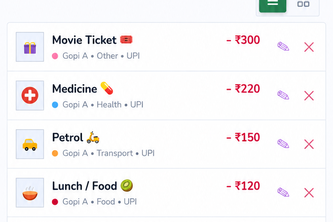
- Multiple payment modes (UPI, Cash, Card, Wallet, Net Banking)
- Smart categories
- Daily transaction history
- Financial dashboard with net balance, income, and expense
- Spending analytics and category-wise charts
- Family expense tracking with member-wise spending
- Daily habit checklist
- Notes
- Member-wise reports
The app was built using Kotlin, Jetpack Compose, MVVM architecture, and Firebase (Firestore, Authentication, Storage, Analytics).
Inference It is a mobile-first financial tool that attempts to merge budgeting with productivity habit tracking.
Positioning & Claim Evolution
The author claims the app helps users understand where their money goes while encouraging better daily habits. It positions itself as more than just an expense tracker—it aims to be a "personal finance companion" that combines budgeting, analytics, family expense tracking, and habit building into one experience.
Inference It is positioned as a lifestyle or productivity-enhancing tool rather than a pure financial management solution.
Target Customer & ICP
The description states the app targets individuals looking to manage personal finances, build better habits, and take control of their financial future. It also mentions family expense tracking, implying household use cases.
Inference The primary customer is likely an individual user or small household managing personal finances with some interest in habit-building.
Business Model & Pricing Evidence
There is no evidence provided about pricing, monetization strategy, or business model. The description does not mention subscriptions, in-app purchases, advertising, or any revenue-generating mechanism.
Not evidenced
Technical & Delivery Signals
The app was built as a full-stack Android project using:
- Frontend: Kotlin, Jetpack Compose, Material Design
- Backend: Firebase (Firestore, Authentication, Storage, Analytics)
- Architecture: MVVM, Repository Pattern
- Data structure includes transaction details like amount, category, payment mode, date, member, type, and notes
Inference It is a mobile-first solution built with modern Android development practices and cloud-based backend services.
Traction & Maturity Signals
The project was submitted to the OpenAI 2026 hackathon. There is no evidence of user adoption, revenue, or customer engagement beyond the author’s own use.
Not evidenced
Competitive Context
There are many personal finance apps available in the market that offer similar features such as income/expense tracking, analytics, and habit checklists. However, the description does not provide any information on how this app differentiates itself from existing solutions or whether it has been compared to them.
Not evidenced
Open Questions & Risks
- The project is a single-person effort with no team or external validation.
- No evidence of user adoption or product-market fit.
- No pricing model, monetization strategy, or revenue data.
- The app is described as a hackathon submission—no indication of long-term viability or scalability.
- Lack of third-party integrations (e.g., bank APIs) or advanced features beyond the basic scope.
Inference This is a prototype with no commercial traction, and its future success depends heavily on whether it evolves into something that can attract users and generate revenue.
Questions the description leaves open
- Has the app been tested by anyone other than yourself?
- Are there any plans to integrate with banks or financial institutions?
- What is your plan for monetization, if any?
- Do you have a roadmap beyond the current features?
- How do you intend to scale this product beyond a single developer?
Overall Assessment
The description states that DP: Income & Expense Tracker is a personal finance app built by one developer as part of a hackathon project. There is no evidence of revenue, customers, or traction.
Assessment Not ready for investment or partnership at this stage. It is a self-reported prototype with no commercial validation. Any potential value lies in its future development and ability to attract users or partners, but that cannot be assessed from the provided information alone.
User Stories BotA demo video on every pull request
Get a demo video on every new feature
GitHub App that watches your pull requests and records a narrated, captioned demo.
Save time on demo prep and make informed decisions faster with a video walkthrough of every new feature.
Source
Submitted to the OpenAI 2026 hackathon on Devpost. Project home on Devpost. Back to the full gallery on Devpost.
This competitive analysis was produced by top-founders.com (opens in a new tab)
Generated by a language model from this project's public Devpost page — its tagline, the author's own write-up and any built-with tags listed there — as captured in August 2026. Short quotations are the author's words. It is an opinion on the idea as a business, not on the people behind it, and it reflects the description as published then. If the project has moved on, request a correction below. The analysis is not independent research and contains no verified traction, revenue or customer data.
An independent guide by KFG International LLC — not affiliated with, endorsed by, or connected to Devpost or OpenAI.