

Archive position — measured, not model output
1 like on Devpost
505 of the 7,850 archived projects have more likes, and 1,758 share exactly 1 — so this project's #972 place in the like-ranked listing is a tie-break inside that group, not a ranking.
Projects (log scale)
Likes on Devpost. ▲ marks this project's group.
Show the figures
| Likes | Projects | Share of archive |
|---|---|---|
| 0 | 5,587 | 71.2% |
| 1 | 1,758 | 22.4% |
| 2 | 284 | 3.6% |
| 3–4 | 132 | 1.7% |
| 5–9 | 75 | 1.0% |
| 10+ | 14 | 0.2% |
 User Stories BotA demo video on every pull request
Get a demo video on every new feature
GitHub App that watches your pull requests and records a narrated, captioned demo.
Save time on demo prep and make informed decisions faster with a video walkthrough of every new feature.
Executive Summary
What the company appears to be
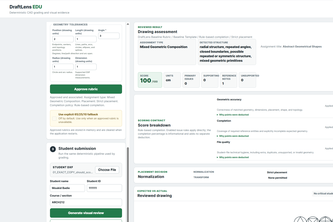
DraftLens EDU is a self-reported educational tool designed to automate CAD drawing grading by comparing student submissions against instructor-approved reference drawings. It claims to provide explainable, visual feedback and deterministic scoring with guidance on corrections.
What changed
The project was developed as part of the OpenAI 2026 hackathon. The author states that it emerged from personal experience in CAD education, aiming to reduce manual grading burden and inconsistency.
Single most important open question
Is there evidence of real-world use or traction beyond this hackathon submission? The description contains no data on actual students, instructors, or deployment.
What The Product Actually Is
The description states that DraftLens EDU is a system that compares an instructor-approved reference DXF with a student DXF and produces:
- A deterministic score;
- A reviewed drawing with markings for each mistake;
- Detailed findings;
- Correction guidance;
- An authoritative PDF report.
It identifies specific types of errors such as:
- Missing or extra geometry;
- Incorrect position, length, angle, radius;
- Endpoint and topology problems;
- Complete drawing displacement;
- Scale or unit mismatch;
- Incompatible assignment files.
The system uses:
- Python and FastAPI for backend;
- ezdxf for DXF parsing;
- Shapely for geometric operations;
- GPT-5.6 for requirement definition and architectural decisions;
- Codex for implementation, testing, and diagnostics.
It also includes:
- A web interface built with JavaScript, HTML, CSS, and SVG;
- PDF reporting via ReportLab;
- Automated regression tests using pytest.
Inference The product appears to be a proof-of-concept or prototype built in a short timeframe, likely for demonstration purposes. It does not appear to have been deployed at scale or integrated into existing educational platforms.
Positioning & Claim Evolution
The author positions DraftLens EDU as a solution to the inefficiencies and inconsistencies of manual CAD grading. The tagline emphasizes:
- Explainability;
- Visual marking inside drawings;
- Guidance on corrections.
It is described as addressing:
- Time-consuming grading;
- Inconsistent scoring due to fatigue or workload;
- Lack of visibility into student errors.
Inference The positioning suggests a niche within CAD education, targeting educators who assign frequent drawing assignments and want more structured feedback. However, the description does not indicate whether this addresses a market need beyond personal use or if it has evolved from an idea into a scalable offering.
Target Customer & ICP
The author identifies instructors in CAD and visualization education as primary users. These are likely:
- Educators teaching drafting, engineering design, or architectural visualization;
- Institutions using AutoCAD or similar tools for instruction.
Inference There is no evidence of segmentation beyond the general category of educators. No indication of whether the tool targets specific institutions, levels (e.g., high school vs. university), or disciplines within CAD.
Business Model & Pricing Evidence
Not evidenced.
The description does not mention:
- Revenue streams;
- Pricing models;
- Subscription plans;
- Licensing fees;
- B2B or B2C structure.
Inference This appears to be a prototype or hackathon project with no commercial model described. It is unclear if the creators intend to monetize it or how they would do so.
Technical & Delivery Signals
The system uses:
- Python and FastAPI;
- ezdxf for DXF parsing;
- Shapely for geometric operations;
- GPT-5.6 and Codex for development support;
- JavaScript, HTML, CSS, SVG for UI;
- ReportLab for PDF generation.
It includes features like:
- Deterministic grading pipeline;
- Spatial indexing for performance optimization;
- Causal issue classification;
- Rule-based scoring with deduction caps;
- Student-only inspection mode;
- Compatibility checks against unrelated files.
Inference The technical stack and architecture suggest a focused, domain-specific solution. The use of AI tools (GPT/Codex) indicates an unconventional developer approach but does not imply scalability or production readiness.
Traction & Maturity Signals
Not evidenced.
There is no mention of:
- Users;
- Customers;
- Revenue;
- Adoption metrics;
- Production deployment;
- Feedback loops;
- Iteration history beyond the hackathon release.
Inference The project remains at a prototype stage, with no evidence of real-world usage or product-market fit. The final release includes 304 automated tests passing, but this is not indicative of user traction.
Competitive Context
Not evidenced.
The description does not reference:
- Competitors;
- Existing tools in CAD education or grading automation;
- Market size or competitive landscape.
Inference No information exists to assess how DraftLens EDU compares to other educational tools or platforms, nor whether it addresses a gap in the market.
Open Questions & Risks
- Unproven commercial viability: No evidence of revenue, customers, or monetization strategy.
- Limited scope: The tool is described as a hackathon prototype with no indication of long-term development plans.
- No institutional integration: No mention of LMS or platform integrations, which are common in educational tools.
- AI dependency: Heavy reliance on GPT-5.6 and Codex raises questions about reproducibility and scalability without those tools.
- Niche focus: The tool targets a narrow segment (CAD educators), limiting potential market reach.
Questions the description leaves open
- What is the actual demand for this type of grading automation in CAD education?
- Have you tested the system with real instructors or students?
- Is there a plan to move beyond the hackathon prototype into a productized offering?
- How would you scale this solution across multiple institutions or users?
- Are there any existing partnerships or pilot programs with educational institutions?
- What are the technical limitations of the current implementation that would prevent production use?
Overall Assessment
Not evidenced.
There is no evidence to support:
- A viable business model;
- Market traction;
- Product maturity;
- Commercial potential.
Inference This project appears to be a hackathon submission with no demonstrated path to commercialization. It lacks any signs of traction, revenue, or institutional adoption. Any investment or partnership would require further validation of market need and product development beyond the prototype stage.
User Stories BotA demo video on every pull request
Get a demo video on every new feature
GitHub App that watches your pull requests and records a narrated, captioned demo.
Save time on demo prep and make informed decisions faster with a video walkthrough of every new feature.
Source
Submitted to the OpenAI 2026 hackathon on Devpost. Project home on Devpost. Back to the full gallery on Devpost.
This competitive analysis was produced by top-founders.com (opens in a new tab)
Generated by a language model from this project's public Devpost page — its tagline, the author's own write-up and any built-with tags listed there — as captured in August 2026. Short quotations are the author's words. It is an opinion on the idea as a business, not on the people behind it, and it reflects the description as published then. If the project has moved on, request a correction below. The analysis is not independent research and contains no verified traction, revenue or customer data.
An independent guide by KFG International LLC — not affiliated with, endorsed by, or connected to Devpost or OpenAI.